

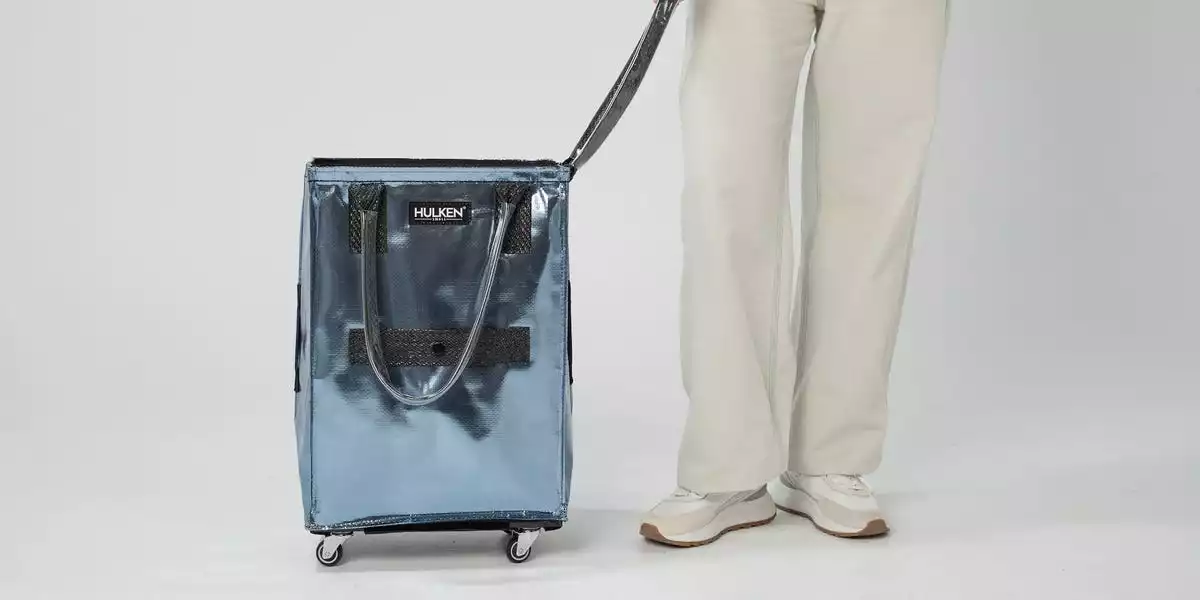

A utilitarian object recast as cultural shorthand for modern mobility
Hulken’s rise is a case study in how everyday infrastructure can be rebranded into lifestyle identity. Founded in 2018 by Alex Schinasi and Yoni Sheleg, the company took a familiar, almost invisible urban object—the shopping cart—and translated its core promise (carry more, move easier) into a fashion-forward, foldable tote. The result is a product that reads simultaneously as tool and signal: practical enough for makeup artists, stylists, and commuters, yet visually distinctive enough to function as a status marker in the social-media economy.
The growth trajectory is striking: from $390,000 in revenue in 2020 to $29 million in 2024, with forecasts pointing toward $50 million. That scale-up suggests Hulken has moved beyond novelty into repeatable demand, powered by a blend of design differentiation, cultural placement, and direct-to-consumer execution. Celebrity visibility—most notably Kardashian adjacency—helped accelerate awareness, but the more durable engine appears to be the brand’s ability to make “carrying” feel like an aesthetic choice rather than a compromise.
At a macro level, Hulken is benefiting from a broader consumer pattern: premiumization of the mundane. In an era when many shoppers are selective about discretionary spending, they still pay up for objects that deliver a mix of utility, durability, and social meaning. Hulken’s bright color drops and water-resistant materials turn a functional purchase into something closer to a collectible—an approach that echoes streetwear’s scarcity logic while staying anchored in daily use.
Design leadership and material choices: where fashion discipline meets product engineering
Hulken’s differentiation is not only marketing; it is embedded in product architecture. The brand’s emphasis on foldability paired with structural rigidity speaks to a design problem that sits between soft goods and hard goods—closer to luggage engineering than to conventional totes. That hybrid positioning becomes more credible with the arrival of Kathleen Scully, a former Louis Vuitton executive, whose recognition via the Accessories Council 2025 Design Excellence Award for Tech and Innovation signals that the company is being evaluated on more than trend appeal.
Material selection is central to the strategy. Hulken’s use of durable, water-resistant polymers aligns with an industry-wide shift toward high-performance plastics that can be molded into distinctive silhouettes and colorways while meeting real-world wear demands. Yet this choice also exposes the company to the volatility of petrochemical inputs and to the political economy of global trade. The next phase—experimentation with new materials—will likely be judged through three lenses:
- Cost resilience: reducing sensitivity to oil-linked resin pricing and input inflation
- Sustainability credibility: potential movement toward bio-based or post-consumer recycled resins, which can strengthen ESG narratives and retailer acceptance
- Aesthetic flexibility: maintaining the vivid palette and tactile “signature” that makes the product recognizable at a distance
This is where Hulken’s positioning becomes especially contemporary: consumers increasingly reward brands that treat materials as a form of innovation, not just sourcing. If Hulken can evolve its polymer story without sacrificing performance, it can defend premium pricing while meeting tightening expectations around environmental impact and transparency.
Scaling to $50 million: omnichannel ambition under tariff and supply-chain pressure
Hulken’s early momentum has been amplified by direct-to-consumer (D2C) agility—tight narrative control, rapid feedback loops, and the ability to orchestrate limited releases. But the leap from strong D2C performance to sustained mass-market relevance typically requires selective omnichannel expansion, and that introduces a delicate trade-off: distribution can accelerate growth while also diluting exclusivity.
The company’s exploration of retailer partnerships and collaborations is therefore less a tactical add-on than a strategic inflection point. The key question is whether Hulken can expand access while preserving the “designed object” aura that justifies its premium. A controlled approach could include:
- Curated retail placements in premium department stores or design-forward specialty retailers
- Pop-ups in high-traffic urban nodes—transit hubs, co-working corridors, and event venues—where the product’s utility is instantly legible
- Limited-edition collaborations that keep the brand in cultural circulation without relying solely on paid media
At the same time, the operational environment is tightening. Hulken faces the same headwinds confronting many consumer-goods brands: tariffs, supply-chain volatility, and rising input costs. Import duties on Asian-made plastics and logistics disruptions can compress margins, forcing difficult decisions about price pass-through versus margin sacrifice. The most likely strategic responses mirror broader industry movement:
- Supplier diversification to reduce single-region exposure
- Nearshoring or regional manufacturing cells (often discussed in contexts like Mexico or Eastern Europe) to shorten lead times and hedge geopolitical risk
- Traceability investments—potentially including blockchain-enabled documentation—to satisfy regulators and sustainability-minded consumers
In this environment, operational resilience becomes a brand attribute. Consumers may not track tariff schedules, but they do notice stockouts, quality drift, and sudden price spikes—each of which can erode the premium story.
Beyond the tote: travel expansion and the emerging “smart accessory” frontier
Hulken’s move into travel with a carry-on tote is a logical adjacency: it extends the brand’s core promise—mobility with structure—into a category where consumers already accept higher price points. The strategic opportunity is to build an ecosystem of modular, interoperable products that serve the “work-from-anywhere” lifestyle: commuting, gig work, creative production, and short-haul travel.
A particularly interesting forward path is the potential for digital-physical integration. If Hulken experiments with RFID or NFC-enabled tags, the tote could become a platform for:
- Inventory and authenticity verification (useful in resale and limited drops)
- Loyalty and personalization via app-linked experiences
- Aftercare and repair workflows that reinforce durability and sustainability claims
Whether Hulken chooses to pursue “smart accessory” features or remain purely analog, its core achievement is already clear: it has demonstrated that design discipline, cultural placement, and functional clarity can elevate an overlooked object into a premium category of its own. The next chapter will be written in materials labs, supplier negotiations, and carefully chosen partnerships—where the brand’s ability to protect its identity while scaling operations will determine whether Hulken becomes a lasting fixture of modern urban carry culture or a defining artifact of a specific moment in consumer taste.

 By
By
 By
By
 By
By
 By
By
 By
By

 By
By







