
A micro-operator’s playbook for monetizing cash access in a digital-first economy
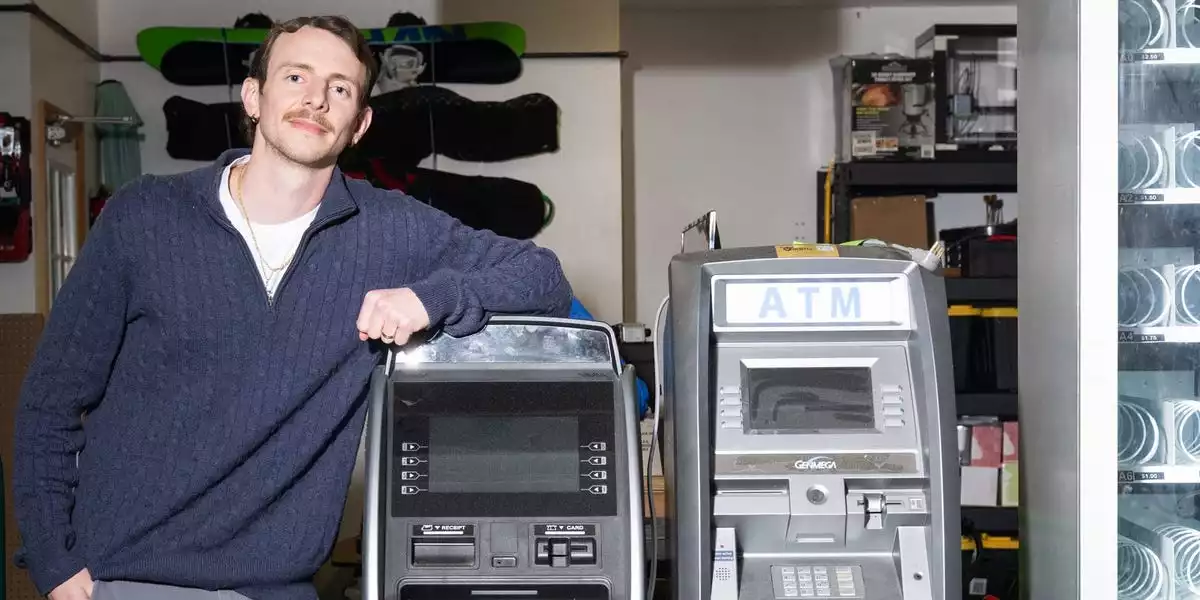
William Butterton’s Viking Vendors, launched in 2022 from Silverdale, Washington, reads like a case study in modern asset-light entrepreneurship: a technically trained professional deploying a small amount of capital—about $5,000 for two ATMs—to build a side business that can be managed in under an hour a week. Over roughly 18 months, the footprint grew to eight machines (five ATMs and three vending units) and generated an average monthly profit of about $1,500, with ATM surcharge revenue doing most of the heavy lifting.
The mechanics are straightforward but strategically revealing. Butterton’s ATMs earn primarily through a $3 surcharge per withdrawal, a fee that becomes meaningful when placed in locations where cash demand is structurally “sticky”—notably cash-only or cash-preferred retail such as barbershops, nail salons, and convenience stores. His stated interest in licensed marijuana dispensaries underscores the same logic: where card acceptance is constrained or costly, cash access becomes a utility, and the ATM becomes a toll bridge.
This is not a story about the triumph of cash over digital payments. It is about market segmentation—and the persistence of cash as an enabling technology in specific corridors of the economy. Even as contactless payments and digital wallets dominate headlines, the ground truth in many neighborhoods remains hybrid: consumers toggle between digital convenience and cash necessity depending on merchant policy, fees, privacy preferences, or banking access.
Key operational choices also matter. Butterton has avoided revenue-share agreements with host locations, keeping the full surcharge margin. That boosts unit economics but can narrow the pool of willing venues—an early signal of the trade-off between maximum margin and faster network expansion.
Where the real friction sits: banking rails, fraud risk, and the compliance perimeter
The most telling detail in Butterton’s early journey is not the surcharge math—it’s the onboarding struggle. He initially faced banks reluctant to process ATM transactions amid heightened fraud concerns. That hesitation reflects a broader reality: the ATM business may look like “hardware plus cash,” but it is deeply dependent on financial infrastructure gatekeepers—processing relationships, settlement, risk controls, and increasingly, compliance expectations.
For micro-operators, the friction points tend to cluster in three areas:
- Processing access and underwriting: Banks and processors must evaluate fraud exposure, chargeback dynamics (where applicable), and reputational risk. Small operators often lack the scale, history, or compliance scaffolding that makes underwriting easy.
- Insurance and physical risk management: Butterton flags theft, vandalism, and insurance challenges that intensify as the fleet grows. Physical cash attracts physical crime, and insurers price that reality into premiums, exclusions, and security requirements.
- Regulatory spillover (AML/KYC expectations): While traditional ATMs are not identical to money transmitters, regulators increasingly scrutinize cash-heavy ecosystems—especially adjacent to higher-risk categories. As rules tighten, independent operators may face rising documentation and monitoring burdens, even when acting in good faith.
This is where Banking-as-a-Service (BaaS) and fintech intermediaries could reshape the landscape. A credible platform that standardizes onboarding, provides transparent pricing, and embeds compliance workflows could turn today’s bespoke, relationship-driven process into something closer to an API-enabled utility. In effect, the next wave of ATM entrepreneurship may be less about buying machines and more about plugging into a risk-managed operating system for cash access.
ATMs as connected endpoints: security telemetry, data-driven placement, and new transaction layers
Butterton’s model also highlights a quiet technological pivot: the ATM is no longer just a box that dispenses cash. In a world of low-cost sensors and ubiquitous connectivity, it can become a networked endpoint—a data node that reports health, cash levels, tamper events, and transaction patterns in near real time.
The business implications are significant:
- Remote monitoring and tamper alerts can reduce downtime and shrink the window of vulnerability to theft or vandalism.
- Camera-assisted verification and telemetry can support insurance claims and deter opportunistic crime, while also improving service reliability.
- Auditability and cash logistics optimization can lower operational drag—especially for small operators trying to keep the business “semi-passive.”
Beyond security, the next competitive edge is likely to come from analytics. Site selection has always been the ATM operator’s core competency, but machine learning can formalize it: foot traffic proxies, demographic indicators, nearby merchant density, and historical transaction volume can be modeled to predict yield per location. Dynamic pricing—adjusting surcharge levels within legal and reputational constraints—could further optimize revenue, though it must be balanced against consumer sensitivity and competitive alternatives.
Just as important is the possibility of service-layer expansion. ATMs and kiosks can evolve into multi-function terminals that support:
- Bill payment and prepaid top-ups
- QR-based cash-to-digital transfers
- Crypto on-ramps (where permitted and responsibly managed)
- Retail-adjacent fulfillment such as transit passes or prepaid telecom products
These additions change the negotiation with host venues. A simple cash dispenser is easy to commoditize; a multi-service terminal can justify better placement, stronger partnerships, and potentially a revenue-share model that accelerates growth.
The strategic signal for business leaders: resilient cash niches, platformization, and selective consolidation
Butterton’s results—modest in scale but strong in efficiency—illustrate why the side-hustle economy continues to professionalize. Under inflationary pressure and uneven wage growth, skilled workers increasingly seek income streams that behave like micro-infrastructure: small assets, predictable demand, and manageable time requirements.
At the same time, the story hints at where the sector is headed. As compliance expectations rise and security technology becomes table stakes, the solo operator model may give way to platformization—white-label providers and aggregators offering procurement, placement support, monitoring software, insurance pathways, and compliance tooling. That shift would likely drive selective consolidation, not because cash is disappearing, but because the cost of operating safely and credibly is becoming more systematized.
For executives watching payments, fintech, retail, or urban services, the takeaway is pragmatic: cash is no longer the default, but it remains strategically indispensable in specific verticals and geographies. The entrepreneurs who thrive will be those who treat ATMs not as legacy hardware, but as connected financial infrastructure—positioned at the intersection of physical commerce, risk management, and the still-unfinished transition from cash to code.

 By
By
 By
By


 By
By

 By
By