

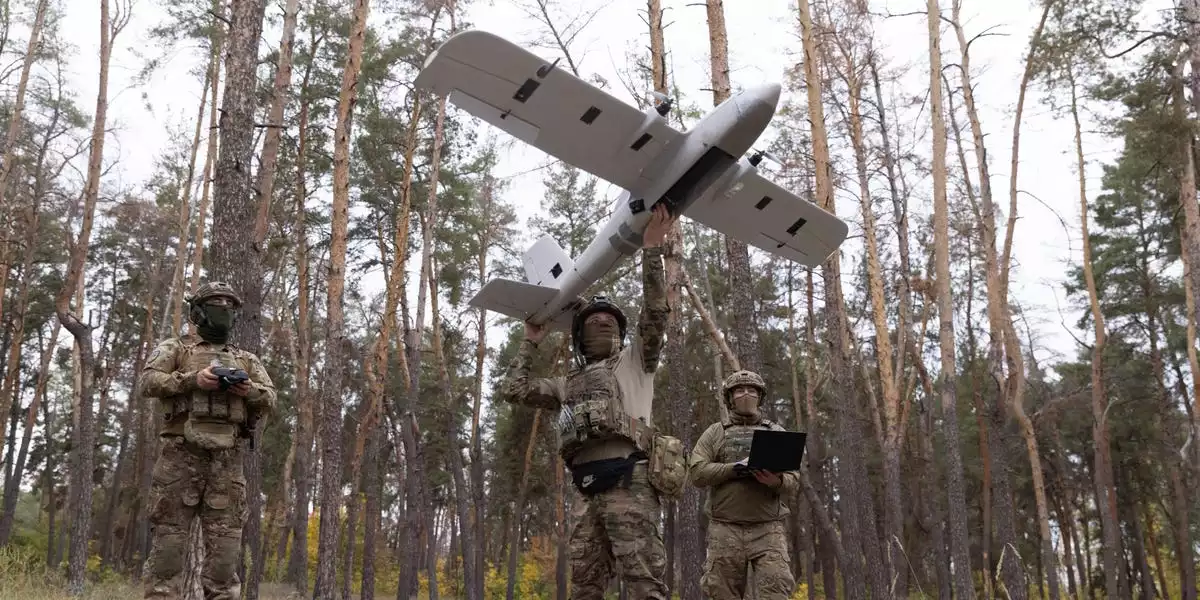

The Drone Imperative: How Ukraine’s Battlefield Is Rewriting U.S. Army Doctrine
The war in Ukraine has become a crucible for military innovation, forcing a global reckoning with the role of small unmanned aircraft systems (sUAS) in modern conflict. What was once the province of ISR—intelligence, surveillance, reconnaissance—has evolved, almost overnight, into a domain where $2,000 quadcopters can neutralize multimillion-dollar armored vehicles. For the U.S. Army, this is not merely a lesson in adaptation but a clarion call to overhaul its approach to lethality, procurement, and the very architecture of war.
From Surveillance to Strike: The Rise of Kinetic Drones
The data emerging from Ukraine is unequivocal: drones are responsible for an estimated 80% of battlefield strikes. Ukrainian forces, leveraging commercial off-the-shelf (COTS) technology, have transformed hobbyist drones into precision-guided munitions, overwhelming Russian positions and exposing a glaring “capability gap” in Western doctrine. The U.S. Army’s response is as ambitious as it is urgent—plans to procure one million drones, revamp training at institutions like Fort Rucker, and embed man-machine teaming into the heart of its operational playbook.
This shift is not simply about numbers. It is about reimagining the kill chain, where drones serve as both sensors and shooters, integrated into joint fires and sensor-to-shooter networks. The Army’s new Unmanned Advanced Lethality Course now trains soldiers not just to fly, but to fight—emphasizing kinetic employment, electronic countermeasures, and the art of outmaneuvering enemy electronic warfare.
Software, Swarms, and the New Economics of War
If the last century was defined by the supremacy of platforms—tanks, jets, carriers—the new era is unmistakably software-defined. The decisive edge now lies in:
- Modular payloads and autonomy algorithms: Rapid firmware updates confer new tactics overnight, while additive manufacturing enables swift airframe iteration.
- Swarm intelligence and networked operations: Drones no longer operate in isolation; they are nodes in a resilient, self-healing mesh, compressing decision cycles from minutes to seconds.
- Counter-UAS innovation: Russian jamming has forced Ukrainian operators into a Darwinian race, spurring advances in RF-silent navigation, optical-flow guidance, and AI-based target recognition. For the U.S., this means hardening GPS-reliant systems and developing layered defenses that blend kinetic, directed-energy, and cyber effects.
The economic implications are profound. The cost curve has inverted: attritable assets—cheap, expendable, and mass-produced—now threaten the dominance of exquisite, high-value platforms. Budgets are migrating toward vast drone inventories and the software ecosystems that orchestrate them. This realignment is already stressing domestic supply chains, from microelectronics to secure battery manufacturing, and inviting collaboration with commercial giants like Qualcomm and NVIDIA.
Strategic Ripples: Deterrence, Democratization, and the Race for AI Supremacy
The proliferation of sUAS is not merely a technological phenomenon; it is reshaping the very logic of deterrence and escalation. Swarm-enabled saturation attacks complicate adversary air-defense planning, diluting the risk of losing high-value assets and offering new options for distributed lethality—particularly salient in Indo-Pacific scenarios, where anti-access/area-denial (A2/AD) networks abound.
Yet, as the cost of entry plummets, airpower is being democratized. Non-state actors and smaller nations now wield capabilities once reserved for superpowers, raising the strategic premium on counter-UAS infrastructure and the urgent need for international norms governing autonomous weapons. The rapid, remote nature of drone warfare compresses decision time, blurs attribution, and heightens escalation risks—demanding that automated target recognition always be paired with robust human oversight.
For executives and policymakers, several non-obvious vectors merit attention:
- Convergence with private 5G/6G networks: Telecom vendors are emerging as defense stakeholders, providing low-latency ISR backhaul for tactical operations.
- ESG and sustainability pressures: Lithium supply constraints and drone end-of-life disposal are becoming material concerns for institutional investors.
- Workforce transformation: The rise of “drone NCOs” and AI-literate soldiers is mirrored by civilian robotics labor shortages, opening the door to cross-sector training partnerships.
- Regulatory spillover: FAA developments in beyond-visual-line-of-sight (BVLOS) operations may accelerate both military and commercial drone adoption.
Capturing the Future: Strategic Recommendations for the Drone Age
The path forward demands agility and foresight. For defense contractors, the imperative is clear: pivot R&D toward open-architecture payloads and AI-driven mission software, and establish rapid-prototyping lines capable of Ukrainian-tempo scale. Technology firms and investors should prioritize secure communications, anti-spoofing navigation, and edge-compute chipsets—assets that will command premium valuations as the software-defined battlefield matures.
Policymakers must integrate sUAS doctrine into multi-domain operations, ensuring that training pipelines produce operators fluent in both kinetic employment and cyber/EW defense. Interoperability standards must be fast-tracked, enabling coalition partners to plug-and-fight with U.S. drone swarms and preserve alliance cohesion. Ethical AI review boards should be embedded within acquisition programs, pre-empting regulatory backlash and aligning with emerging NATO and UN guidelines.
The U.S. Army’s embrace of lethal sUAS is more than a tactical adjustment—it is a systemic reconfiguration of how wars are fought, won, and deterred. Those who internalize the shift from platform-centric to network-centric, software-defined warfare will shape the competitive landscape as the drone age accelerates, leaving behind those who cling to the paradigms of the past.

 By
By
 By
By
 By
By
 By
By
 By
By
 By
By

 By
By







