

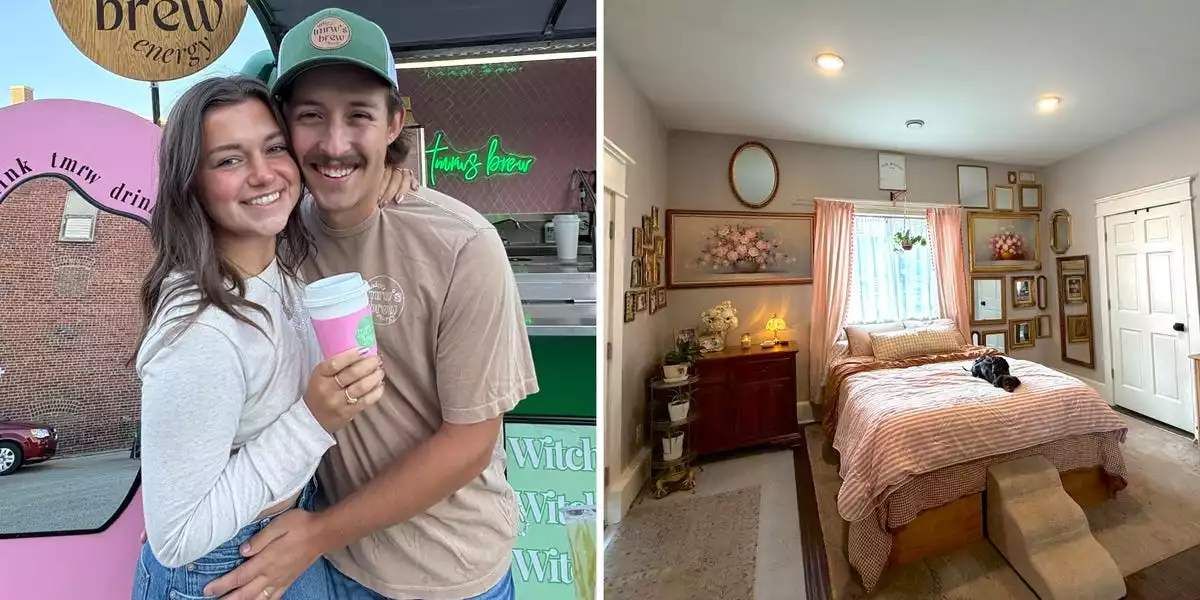

A garage apartment as a balance sheet: how housing choices are becoming startup strategy
MaryHelen and Robbie Maida’s decision to move into a rent-free, 560-square-foot garage apartment on family property reads, at first glance, like a familiar post-graduation compromise—an interlude between campus life and “real adulthood.” Yet the more revealing interpretation is financial: they converted a housing arrangement into a capital allocation strategy.
In an era defined by student-loan obligations, elevated rents, and higher interest rates, the Maidas effectively treated rent avoidance as a predictable, recurring return—then reinvested that return into enterprise creation. The result is a small but telling portfolio: Tmrw’s Brew, a mobile coffee truck business, alongside MaryHelen’s boutique wedding-planning service, with Robbie’s full-time employment providing income stability.
For business and technology leaders, the signal is not merely that young adults are “moving back home.” It is that household structure is increasingly functioning like a financial instrument, reshaping how early-stage ventures are funded, how labor markets compete for talent, and how cities think about housing supply.
Key dynamics embedded in the Maidas’ approach include:
- Burn-rate reduction as seed funding: eliminating rent creates investable cashflow without taking on debt.
- Risk management through income stacking: a salaried job underwrites entrepreneurial volatility.
- Asset utilization over asset acquisition: leveraging existing real estate avoids the friction of new construction or commercial leases.
The broader takeaway is that the boundary between “where you live” and “how you finance growth” is dissolving—especially for founders operating at microenterprise scale.
Family-backed “soft capital” and the quiet reinvention of early-stage funding
The Maidas’ story highlights a form of financing that rarely appears in venture capital narratives: family-enabled soft capital. This is not a cash infusion, not a priced equity round, and not a bank loan. It is access to an asset—housing—on terms that function like zero-interest financing.
From a capital-structure perspective, this matters because it avoids two common constraints for new founders:
- Debt servicing pressure, particularly punishing when interest rates are high and revenues are uncertain.
- Equity dilution, which can be disproportionate at the earliest stages when valuations are low and leverage is limited.
Instead, the Maidas used a family real-estate asset as a stabilizer—effectively turning shelter into a runway extension. This model is increasingly relevant as alternative funding mechanisms proliferate (revenue-based financing, micro-VC, creator monetization), because it underscores a parallel truth: many businesses don’t fail from lack of ideas; they fail from cashflow fragility in the first 12–24 months.
At the same time, the model raises a structural question for the broader economy: if family assets become a primary on-ramp to entrepreneurship, then access to startup opportunity may tilt further toward those with intergenerational real estate. That doesn’t diminish the Maidas’ execution; it clarifies the macro context in which such execution becomes more feasible.
Accessory dwelling units (ADUs) and the new micro-incubator economy
The garage conversion also sits squarely within a major housing and policy trend: the rise of accessory dwelling units (ADUs)—backyard cottages, garage apartments, and secondary suites increasingly legalized in cities such as Los Angeles and Portland. While ADUs are often framed as a partial remedy for housing shortages, the Maidas’ case points to a second-order effect: ADUs can operate as micro-incubators.
Why ADUs are becoming economically consequential:
- Land-use efficiency: they increase density without requiring large-scale redevelopment.
- Faster time-to-occupancy: conversions can be simpler than ground-up builds, depending on permitting.
- Household flexibility: they support multigenerational living, caregiving, and income diversification.
- Entrepreneurial optionality: lower fixed costs can enable experimentation—especially for service businesses.
This is where technology quietly amplifies the trend. Mobile payment systems, local SEO, social media marketing, and lightweight e-commerce tooling allow physical-world businesses—like a coffee truck or event planning—to launch with startup-like speed. The Maidas’ low-overhead base makes it easier to test demand, refine pricing, and scale operations without the drag of a high monthly lease.
For developers and proptech players, the implication is commercial: there is room for “garage catalyst” products—ADU kits, modular interiors, and plug-and-play utility solutions—paired with financing and permitting support. For financial institutions, the opportunity is equally direct: ADU-backed lending and underwriting models that treat secondary units as collateral or future income streams.
Multigenerational living goes mainstream—and business leaders will have to design for it
Perhaps the most culturally significant shift embedded in the Maidas’ experience is the normalization of multigenerational households. What was once stigmatized as a setback is increasingly reframed as a rational response to structural conditions: student debt, housing inflation, and the uneven geography of opportunity.
This normalization has practical consequences for employers, platforms, and brands:
- Workforce strategy: early-career talent may prioritize flexibility and location optionality over traditional relocation. Benefits that acknowledge housing realities—stipends, remote/hybrid options, financial wellness programs—become more than perks; they become retention tools.
- Platform ecosystems: micro-entrepreneurs need integrated back-office systems—permitting guidance, invoicing, inventory, scheduling, and local marketing—especially when operating from home-adjacent setups like ADUs.
- Market positioning: brands that authentically reflect intergenerational narratives can resonate with consumers living similar economics, without romanticizing the pressures that made such choices necessary.
The Maidas’ garage apartment is not just a living space; it is a case study in how housing, entrepreneurship, and household finance are converging into a single operating system. As ADUs proliferate and multigenerational living becomes a default rather than an exception, the most competitive organizations—public and private—will be those that recognize this shift early and build products, policies, and compensation models that align with the new architecture of everyday economic life.

 By
By

 By
By
 By
By
 By
By

 By
By
 By
By







