

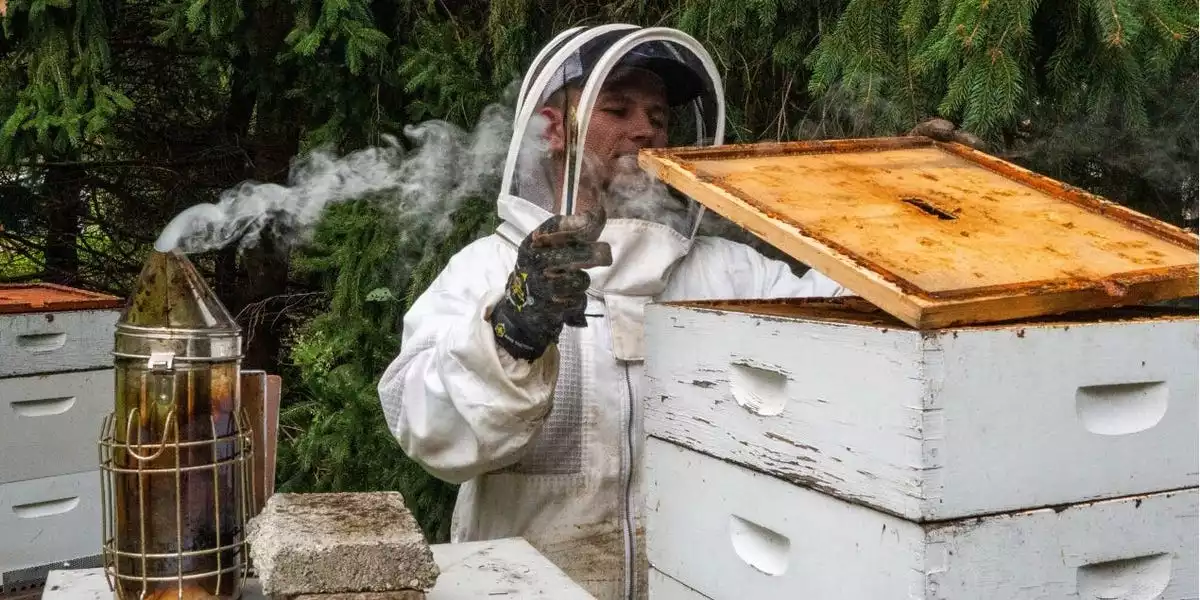

A student-run apiary as a real-time case study in sustainable entrepreneurship
Anthony Ondo’s story sits at the intersection of rising higher-education costs, local food economies, and practical climate-minded enterprise. At 23, the Chatham University senior is not merely running a side hustle; he is operating a 50-hive apiary in western Pennsylvania with a clear financial objective: underwriting tuition through biannual honey harvests, complemented by modest scholarships and loans. The result is a compelling example of how a micro-agricultural business—often perceived as artisanal or lifestyle-driven—can function as a disciplined, revenue-oriented model when paired with operational rigor and market positioning.
What makes the venture particularly notable is its dual footprint: a commercial operation distributed across regional sites and an educational extension on Chatham’s Eden Hall campus, where student apiaries connect academic sustainability concepts to hands-on management. In an era when universities are under pressure to demonstrate career outcomes and experiential learning value, Ondo’s work effectively becomes a living laboratory—one that produces both honey and institutional insight.
From a business and technology lens, the broader signal is clear: environmental stewardship is increasingly being treated as an investable operating principle, not a philanthropic add-on. Ondo’s approach reflects a growing cohort of emerging entrepreneurs who are building income streams from sustainability-aligned ventures—often substituting creativity and partnerships for traditional financing.
Barter-driven land access and “asset-light” scaling in physical industries
A defining feature of Ondo’s model is how it solves a classic constraint in agriculture: access to suitable land. Rather than relying on capital-intensive leases or ownership, he negotiates hive placements with landowners and farms, frequently using barter arrangements—exchanging product value for site access. This is an “asset-light” strategy more commonly associated with the platform economy, translated into a physical, resource-dependent sector.
Key operational implications stand out:
- Lower fixed costs and faster expansion: By reducing cash outlays for land, the business can allocate resources toward hive health, equipment, and distribution rather than rent.
- Risk-sharing with local stakeholders: Landowners gain a tangible benefit (honey and pollination services), while Ondo avoids long-term contractual rigidity.
- Geographic diversification: Distributed hive placements can reduce localized environmental risk (weather patterns, forage variability), improving resilience across seasons.
This structure also creates a subtle but important competitive advantage: it embeds the business into a network of local relationships that are difficult to replicate quickly. In practical terms, community trust becomes a form of defensible infrastructure—a moat built not from patents or scale alone, but from reciprocal value exchange.
Precision apiculture and the next layer of technology-enabled yield management
As Ondo’s hive count grows, the operational complexity rises with it. That is where precision apiculture—a subset of precision agriculture—becomes more than a futuristic add-on. Remote monitoring tools can help small operators manage scale without proportionally scaling labor, and can improve decision-making in areas that directly affect yield and colony health.
Potential technology applications include:
- IoT sensors tracking hive temperature, humidity, and acoustic or movement indicators tied to bee activity
- Remote alerts for anomalies that may signal disease, queen loss, or environmental stress
- Predictive analytics to anticipate colony risk, optimize harvest timing, and reduce losses associated with colony collapse dynamics
- Digital recordkeeping for forage conditions, treatment schedules, and yield comparisons across sites
For technology vendors and agtech builders, the strategic opening is the underserved segment between hobbyist tools and industrial-scale systems. Many solutions are either too basic to drive measurable ROI or too expensive and complex for micro-enterprises. Ondo’s operation illustrates a market need for SME-friendly sensor kits, subscription analytics, and mobile-first management platforms—tools that treat small farms as serious businesses rather than niche users.
At the same time, Eden Hall’s integration of student apiaries adds an institutional dimension: the campus becomes a testbed for data-informed sustainability education, generating real operational datasets and case studies that can inform curriculum, policy research, and community partnerships.
Tuition economics, place-based branding, and the resilience logic of micro-supply chains
Ondo’s tuition-funding strategy lands amid a national debate about affordability and student debt. While his path is not universally replicable, it highlights a structural shift: students increasingly seek countercyclical income streams and entrepreneurial alternatives to debt-heavy financing. If more institutions formalize support for student-run ventures—through mentorship, facilities, or even tuition-credit pilots—the boundary between “financial aid” and “enterprise enablement” could blur in meaningful ways.
On the market side, the venture’s revenue logic benefits from niche branding. Selling “Western Pennsylvania honey” aligns with consumer demand for:
- Terroir-driven local products with traceable origin
- Health-oriented and natural food narratives
- Small-batch authenticity that can justify premium pricing relative to commodity honey
This positioning matters because it reduces exposure to commodity volatility and global supply disruptions. More broadly, micro-apiaries contribute to decentralized agricultural resilience: diversified local production can buffer regions against climate variability, trade shocks, and concentration risk in industrial supply chains.
Equally important is the ecosystem effect. Barter-based hive placements and local partnerships create stakeholder coalitions—farmers, landowners, cafés, and university programs—where economic and environmental incentives align. That alignment is often what turns sustainability from aspiration into execution: pollination services, biodiversity support, and local commerce reinforce one another.
Ondo’s venture ultimately reads as more than a personal financing solution. It is a compact blueprint for how modern entrepreneurship can blend asset-light strategy, applied sustainability, and emerging agtech—and how institutions and communities can become co-producers of both economic value and ecological outcomes when the incentives are designed to meet in the middle.

 By
By

 By
By
 By
By
 By
By
 By
By
 By
By








