

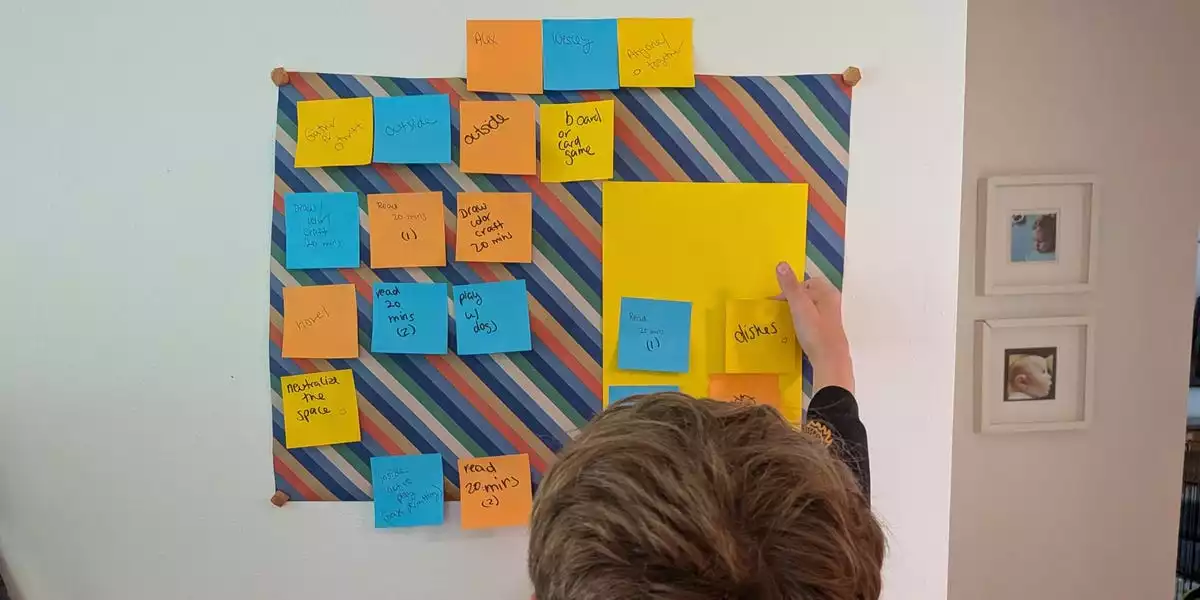

A living-room Kanban moment that mirrors a wider productivity reset
A U.S.-based independent journalist—also a mother of two children aged 10 and 12—has offered a deceptively simple case study in modern productivity: when summer break dissolved household structure, she rebuilt it with an analog Kanban board, using color-coded sticky notes to visualize tasks and progress. What reads like a family logistics hack is also a revealing signal about where the productivity market is heading—especially as households increasingly resemble miniature hybrid-work ecosystems.
Kanban, a Japanese-origin workflow method popularized in manufacturing and later software development, thrives on a core principle: make work visible. In this home implementation, tasks such as reading, pet care, chores, and creative projects (including novel writing) are broken into discrete units and moved across stages. The children—both diagnosed with ADHD—reportedly adopted the system quickly, and the family introduced a clear incentive mechanism: screen time is “earned” after completing Kanban tasks.
Even the early friction points are instructive. When sticky notes failed to adhere reliably, the mother solved it by mounting wrapping paper as a wall substrate, a small act of iterative prototyping that echoes the “continuous improvement” ethos Kanban was designed to support. The result is not a rigid schedule, but a flexible visual contract—one that can evolve as the summer unfolds, including the possibility of adding a personal task column for the parent.
Why analog Kanban is resurfacing in a cloud-first era
In a market saturated with digital task managers—Trello, Asana, Jira, and countless niche apps—the return of paper-based workflow tools is not nostalgia; it is strategy. Analog Kanban aligns with a growing countertrend often described as digital minimalism: reducing cognitive clutter, limiting notifications, and reclaiming attention from always-on platforms.
Several forces make the analog format newly competitive:
- Lower cognitive load: A wall-mounted board externalizes memory. Instead of holding tasks mentally (or hunting through apps), the household sees the workload at a glance.
- Tactile engagement: Moving a sticky note is a physical completion signal—small, but behaviorally meaningful.
- Offline resilience: No logins, no battery, no sync failures. In an age of platform fatigue and intermittent connectivity, “works without Wi‑Fi” is a feature, not a limitation.
- Shared visibility: Families and teams often fail not because of effort, but because of misalignment. A physical board creates a single source of truth that is hard to ignore.
For businesses, the subtext is clear: productivity isn’t only a software problem. It’s a human-factors design problem, and analog tools can outperform digital ones when the goal is compliance, clarity, and routine—especially in environments where attention is already under siege.
Neurodiversity, behavior design, and the next wave of EdTech and workplace tooling
The most commercially and socially salient detail is that both children have ADHD—and the system appears to “click.” That matters because it points to a broader design opportunity: neurodiversity-friendly task visualization.
By converting responsibilities into small, color-coded, discrete actions, the board implicitly applies principles from cognitive load theory and behavior design:
- Chunking: Tasks become manageable units rather than ambiguous obligations.
- Immediate feedback: Progress is visible, not abstract.
- Reduced initiation friction: The next step is obvious, which can be crucial for ADHD task-start challenges.
- Clear incentives: Screen time becomes a transparent reward structure rather than a recurring negotiation.
This is where the story moves from lifestyle anecdote to product roadmap. The market opening is for hybrid physical-digital systems that preserve tactile simplicity while adding optional intelligence:
- Physical boards with companion apps that auto-log completion
- E-ink or low-power displays that mimic paper while enabling analytics
- NFC-tagged cards or smart sticky notes that bridge the wall and the cloud
- Adaptive coaching prompts tuned for ADHD and other neurodivergent profiles
As ADHD diagnosis rates and awareness continue to rise, demand is likely to grow for tools that don’t merely “organize tasks,” but reduce friction in starting and finishing them. This is as relevant to classrooms and households as it is to employers building inclusive workflows for neurodiverse teams.
The economic signal: time reclaimed becomes value created
The family’s early feedback—chores completed faster than expected, leaving more leisure time—highlights a basic economic truth: time is a convertible asset. Reclaimed minutes can become rest, learning, creative output, or simply reduced stress. That conversion is precisely what many consumers and employers are willing to pay for.
Several strategic implications follow:
- Consumer product expansion: Stationery brands and smart whiteboard makers could see demand shift earlier in the year, creating a “summer productivity” season alongside back-to-school. Expect more ADHD-friendly Kanban kits, chore gamification bundles, and customizable family workflow sets.
- Subscription and services upside: There is room for “family productivity management” offerings—bundling physical materials, micro-learning modules, and coaching into recurring revenue models.
- Change management lessons for enterprises: The children’s rapid buy-in suggests a transferable adoption principle: make commitments visible, goals bite-sized, and rewards explicit. Organizations struggling with new workflow rollouts can borrow this logic—reducing resistance by turning abstract expectations into tangible progress markers.
- Business continuity through low-dependency tools: The wrapping-paper workaround is a reminder that resilience sometimes means having an analog fallback. For critical operations, “paper-first backups” can be a legitimate component of continuity planning, not an anachronism.
What makes this episode notable is not that a family used a Kanban board—it’s that a method born on factory floors is now being reinterpreted as a household operating system. As hybrid work blurs the boundary between professional and personal productivity, the next competitive frontier may belong to tools that respect attention as scarce capital—whether they run on cloud infrastructure or a strip of tape and a stack of sticky notes.

 By
By
 By
By
 By
By
 By
By
 By
By


 By
By







