

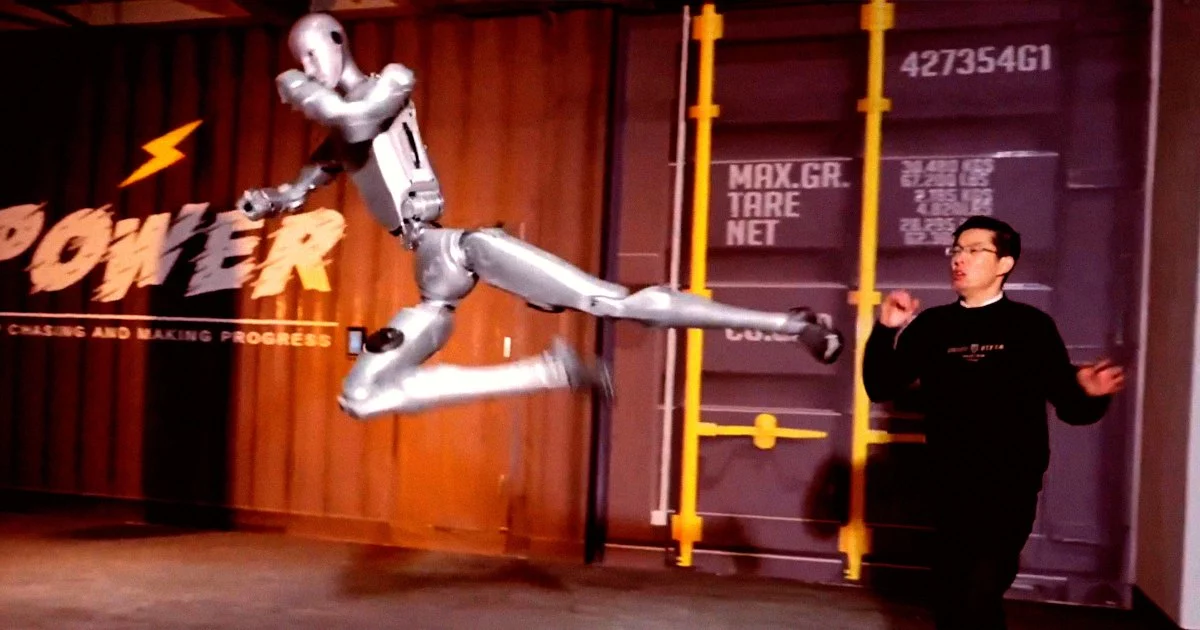

The Allure and Ambiguity of Martial-Arts Humanoids
The robotics world, ever hungry for spectacle, recently found its latest star in Unitree’s six-foot “H2” humanoid—a machine whose acrobatic kicks and watermelon-smashing punches have ricocheted across social feeds and news cycles. The H2’s performance, both athletic and faintly menacing, is emblematic of a broader trend: the most publicized humanoid robots today, from EngineAI’s prototypes to Boston Dynamics’ Atlas revamp and Tesla’s Optimus, are not folding laundry or assisting the elderly. Instead, they are leaping, striking, and dazzling with feats of kinetic bravado.
This choreography of power, however, masks a strategic tension at the heart of humanoid robotics. Billions in venture and corporate R&D have yet to produce machines that excel at the prosaic but commercially crucial tasks—object handling, situational adaptability, and long-duration autonomy—that employers and consumers actually demand. The question looms: are we witnessing the birth of a transformative industry, or a misallocation of capital driven by viral optics and martial-arts pageantry?
Hardware Triumphs, Human Tasks Unsolved
The technical underpinnings of these demonstrations are real, and not to be dismissed. Advances in actuation—high-torque, low-latency servos, lightweight composite frames—have enabled humanoids to balance dynamically and execute complex strikes. Reinforcement learning pipelines, trained in simulation, now transfer sophisticated movement patterns to physical robots with uncanny fidelity.
Yet, the gap between spectacle and service remains wide. The same machines that can shatter fruit with a punch struggle to grasp a coffee mug reliably. End-effector design and haptic sensing lag behind, leaving everyday manipulation—arguably the holy grail of robotics—frustratingly out of reach. Software, too, is caught in a liminal state: while dynamic balance and striking are tractable, semantic scene understanding and compliant manipulation are still research-grade, not production-ready. Battery technology, meanwhile, imposes harsh constraints; high-output maneuvers drain energy at a rate that precludes long-duration utility, a limiting factor until solid-state or fuel-cell breakthroughs arrive.
Economic Incentives and the Spectacle Dividend
The capital flows tell a story of their own. Over $2 billion has poured into humanoid robotics in the past 18 months, but only a sliver—roughly 15%—targets service-oriented pilots. The lion’s share chases platform showcases, with athletic prowess serving as a proxy for technological promise and, crucially, valuation uplift. In this context, martial-arts demos are less about product-market fit than about brand signaling: viral videos serve as modern “air shows,” attracting defense and entertainment contracts, recruiting talent, and securing sovereign grants long before household ROI is plausible.
This spectacle dividend is not without risk. The same force amplification that excites crowds will trigger higher insurance premiums and liability concerns in civilian settings. Early adopters in warehousing or hospitality may find that risk-adjusted cost savings erode, lengthening the payback period and dampening enthusiasm.
Meanwhile, governments—particularly in China and the U.S.—increasingly view agile humanoids as dual-use assets, suitable for logistics, ISR, and EOD roles. Military curiosity partly explains the emphasis on combat mobility, but it also brings export-control, IP, and ethical scrutiny to the fore, especially as supply chains for key components remain concentrated in Japan and China.
Navigating the Next Decade: From Viral Demos to Real Utility
For decision-makers, the path ahead is both fraught and full of possibility. In the near term, expect a steady drumbeat of theatrical demonstrations as firms court investors and defense memoranda. Procurement teams would do well to look past headline agility metrics, interrogating mean time between failures, battery logistics, and API openness. Component suppliers—especially those specializing in actuators and torque sensors—are likely to enjoy pricing power, and strategic partnerships secured now may yield lasting cost advantages.
Over the medium term, the first commercially viable niches for humanoids will likely emerge in semi-structured environments: security patrols, high-value asset inspection, and live-action entertainment. Here, the blending of humanoids with digital twins and video management systems will be key. Regulatory bodies are poised to introduce “kinetic capability disclosure” rules, and companies investing early in safety certification will shorten their time to market as household applications mature.
Looking further ahead, the true inflection point may arrive when language-model-driven task planning converges with reliable dexterous manipulation—a synthesis that could transform humanoids from viral curiosities into essential infrastructure, particularly in aging economies. Yet, if the industry remains fixated on combat aesthetics without parallel progress in fine-motor control, it risks a “Segway moment,” where hype outpaces utility and investor appetite wanes.
For those charting the future of robotics, the lesson is clear: diversify bets across gripper, perception, and battery innovation; demand KPI transparency beyond viral videos; scenario-plan for regulatory scrutiny; and, perhaps most intriguingly, explore media monetization as a bridge to mass-market relevance. In this landscape, separating viral optics from functional roadmaps is not just prudent—it may be the difference between fleeting spectacle and enduring value.

 By
By
 By
By
 By
By

 By
By


 By
By







