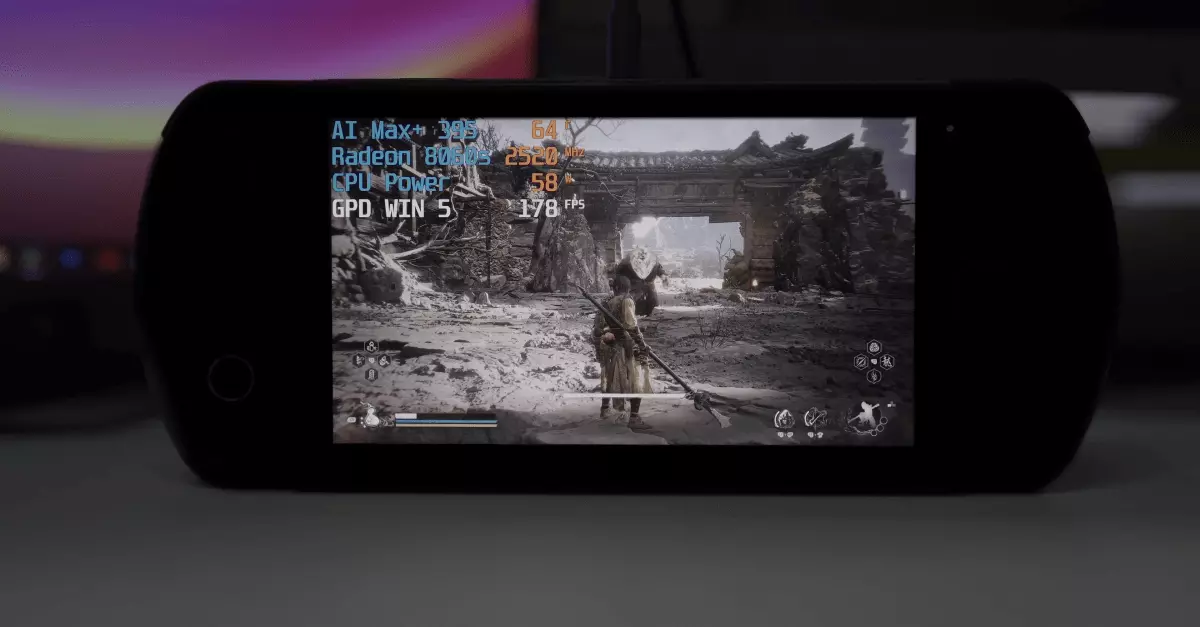

Redefining the Handheld: GPD’s Win 5 and the End of All-in-One Portability
Handheld gaming has, for decades, been defined by its self-contained simplicity—a battery, a screen, a processor, all fused into a single, pocketable artifact. GPD’s forthcoming Win 5, however, signals a deliberate and radical break from this lineage. By externalizing its power source and embracing AMD’s cutting-edge Ryzen AI Max+ silicon, the Win 5 is poised to blur the boundaries between mobile console, ultraportable workstation, and AI edge device. This is not merely an incremental upgrade; it is a reimagining of what “handheld” can mean in an era where gaming, productivity, and AI are converging.
Silicon Ambitions and the Rise of Local AI
At the heart of the Win 5 lies AMD’s new Ryzen AI Max+ platform—offered in both 16-core/32-thread and 8-core/16-thread variants. These chips are not just about brute CPU or GPU power; they are equipped with XDNA 2 NPUs, delivering up to 60 TOPS of AI performance. In a market where handhelds have historically prioritized GPU rasterization for gaming, GPD is making a calculated bet: the next wave of differentiation will come from local AI inference.
- AI-First Features:
– Upscaling and dynamic frame generation for smoother visuals
– On-device language model companions and voice agents
– Generative NPC behavior and real-time translation
The Win 5’s support for up to 128 GB of LPDDR5X unified memory is a clear nod to the memory-hungry nature of AI workloads. This capacity not only future-proofs the device for large language models (LLMs) exceeding 7 billion parameters but also positions it as a credible platform for developers eager to explore edge AI applications—an alignment with the broader industry narrative championed by Microsoft’s Copilot+ PC initiative.
Power, Modularity, and the End of the Self-Contained Handheld
Perhaps the Win 5’s most audacious move is the externalization of its battery. By shifting to a modular “battery backpack” (up to 80 Wh), GPD sidesteps the volumetric and regulatory constraints that have long shackled mobile devices. No longer beholden to the strictures of UN 38.3 or IATA Section II, the company can leverage commodity high-density cells, tailoring capacity and compliance to each market with unprecedented flexibility.
- Thermal and Power Innovations:
– Dual fans and four heat pipes enable sustained 35–45 W APU operation
– Outpaces Steam Deck’s 15 W envelope, approaching thin-and-light laptop territory
– USB-4 I/O with 8K/60 passthrough transforms the device into a desktop-class thin client
The trade-off is clear: the Win 5 is less a “grab-and-go” handheld and more a modular ecosystem. For users, this means the freedom to choose between featherweight unplugged sessions or marathon gaming stints tethered to a wall—or, potentially, a third-party battery backpack. For GPD, it opens a new axis of differentiation, particularly in markets like China’s café/arcade scene or Western living rooms, where outlets are never far away.
Economic Leverage and Strategic Positioning
The external battery is more than a technical flourish; it is a lever for economic and regulatory advantage. By decoupling the battery from the core device, GPD can:
- Reduce Bill of Materials (BOM) volatility tied to fluctuating lithium prices—up 24% year-over-year
- Sidestep tariffs on “power-stored devices” in certain export markets
- Lower warehouse insurance premiums and simplify compliance with the EU’s tightening battery-recycling directives
This architecture also enables GPD to adopt a razor-and-blade pricing model: a lower base unit cost entices enthusiasts, while margins are recouped through sales of battery packs, docks, and other accessories. The high-memory configurations, meanwhile, signal average selling prices north of $1,200—a premium tier justified by workstation-grade performance and AI capabilities.
The New Frontier: Hybrid Devices and Platform Ecosystems
The Win 5’s hybrid, modular paradigm tacitly acknowledges a truth often ignored by the industry: most “portable” gaming happens within arm’s reach of a power source. If this model gains traction, it could force larger OEMs to bifurcate their offerings—true mobile variants with restrained power budgets, and performance-oriented dockables that straddle the line between console and PC.
This shift is not just about hardware. The inclusion of a powerful NPU opens the door to new software experiences—voice agents, generative AI, and real-time translation—that can be monetized through premium SKUs or subscriptions. Accessory ecosystems, too, are poised for expansion, with third-party battery backpacks and specialized docks creating a moat of platform stickiness.
For executives and strategists, the implications are profound. Regulatory trends favor modularity and repairability, AI middleware vendors are seeking edge-inference showcases, and retail channels may soon position devices like the Win 5 alongside ultrabooks rather than consoles. The future of handheld computing is not a battle for the smallest, lightest device—it is a contest for the most versatile, adaptable platform.
As the industry stands on the cusp of this new era, the Win 5 emerges not as a mere competitor to the Steam Deck, but as a harbinger of a modular, AI-accelerated hybrid device class—one that dares to challenge the very definition of portability.

 By
By
 By
By

 By
By
 By
By

 By
By