
A mining fortune meets the commercial space capital markets
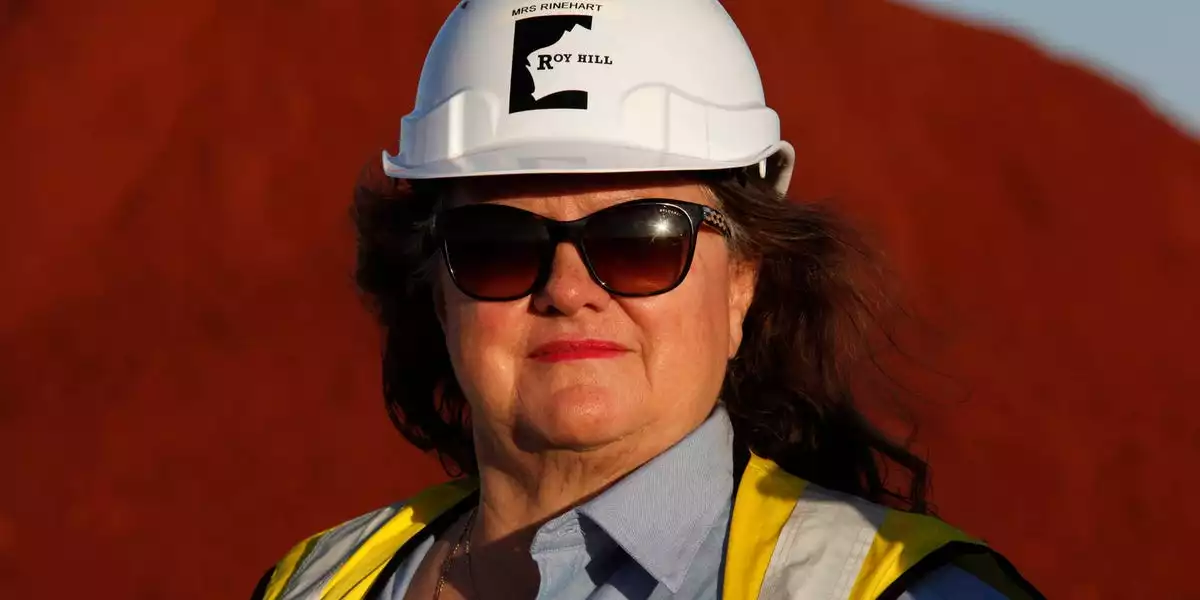
Gina Rinehart’s reported multihundred-million-dollar—potentially US$1+ billion—investment in SpaceX via Hancock Prospecting lands at a pivotal moment for both the resources sector and the commercial space economy. SpaceX’s public-market debut—priced around a landmark US$85 billion IPO and framed by a headline US$2 trillion valuation—is being read by investors as more than a liquidity event. It is a signal that space infrastructure, once financed largely through private venture capital and government contracts, is now being positioned as a durable, scalable asset class.
The market’s immediate response—shares reportedly rising nearly 20% on debut—underscores a broader thesis taking hold: that the next decade’s strategic competition will be shaped not only by software and semiconductors, but by the physical supply chains that make advanced systems possible. Rinehart’s move is notable because it links two historically separate domains—critical minerals and space systems—through a single balance sheet.
For Hancock Prospecting, already invested in non-Chinese rare-earth suppliers Lynas Rare Earths and MP Materials, the SpaceX stake reads as a calculated extension of a portfolio that is increasingly aligned with the industrial priorities of Western governments and defense-adjacent technology markets. For SpaceX, the presence of a deep-pocketed resources investor adds a different kind of strategic optionality: access to capital and relationships tied to the materials that underpin aerospace manufacturing, satellite production, and next-generation propulsion.
The critical-minerals logic behind a SpaceX stake
At first glance, a mining conglomerate buying into a space company can look like thematic investing—an attempt to capture “frontier” growth. Yet the underlying industrial logic is more concrete: space is becoming a materials-intensive economy, and the bottlenecks are increasingly upstream.
Several vectors make the minerals-to-orbit connection more than speculative:
- Rare-earth elements and advanced materials demand: Satellites, electric propulsion systems, high-efficiency motors, sensors, and defense-grade electronics rely on high-performance magnets, alloys, and composites—many of which are tied to rare-earth supply chains.
- Supply-chain de-risking away from China: With China’s dominance in rare-earth processing shaping procurement decisions across the US, Australia, Japan, and Europe, investments in Lynas and MP Materials position Hancock within a growing ecosystem of “friend-shored” critical materials.
- Vertical integration as a strategic hedge: Owning exposure to both the upstream inputs (minerals) and downstream platforms (space infrastructure) can reduce vulnerability to price shocks, export controls, and geopolitical disruption—while improving negotiating leverage in long-term offtake agreements.
This is also a bet on timing. Rare-earth pricing and investment cycles have historically been volatile, but demand drivers are broadening beyond consumer electronics into EVs, wind turbines, grid modernization, and defense systems. If commercial space continues to scale—through satellite constellations, lunar missions, and in-orbit services—the materials intensity of that expansion could become a meaningful incremental demand channel, particularly for specialized alloys and magnet-grade inputs.
From launch services to off-world logistics: the technology convergence
SpaceX’s identity in the public imagination is still anchored to rockets and launch cadence. But the strategic narrative increasingly extends to space-based logistics and infrastructure, including satellite networks and longer-horizon concepts such as lunar operations and asteroid resource activity. Whether or not asteroid mining becomes commercially viable on the timelines enthusiasts project, the direction of travel is clear: space companies are moving from transportation toward industrial capability in orbit and beyond.
That shift carries specific technological implications that intersect with Hancock’s core competencies:
- In-situ resource utilization (ISRU): Extracting and processing materials on the Moon or other bodies requires new approaches to excavation, beneficiation, and refining under extreme constraints—areas where terrestrial mining expertise can inform engineering design, even if the machinery is radically different.
- Autonomous robotics and closed-loop systems: Off-world operations demand autonomy, fault tolerance, and minimal human intervention. The same automation trends transforming modern mines—remote operations, AI-assisted maintenance, sensor fusion—map naturally onto space industrialization.
- Dual-use technology acceleration: The overlap between commercial space, defense, and scientific missions is tightening. That convergence tends to increase demand for high-spec materials and secure supply chains, and it can compress adoption timelines as governments co-fund capabilities with commercial spillovers.
In this context, Rinehart’s investment can be read as an attempt to place Hancock at the intersection of three reinforcing growth arcs: critical minerals, space infrastructure, and defense-linked advanced manufacturing.
Capital, geopolitics, and the emerging “space-minerals” playbook
The strategic subtext is geopolitical as much as financial. By pairing stakes in Western rare-earth producers with exposure to a leading US space enterprise, Hancock potentially becomes a connective node between Australian resource security and American space and defense priorities, including programs adjacent to NASA’s Artemis ambitions and broader national security space initiatives.
Several forward-looking dynamics are likely to shape how this story evolves:
- Acceleration of non-Chinese processing capacity: Expect continued capital deployment into midstream refining and magnet supply chains, where the real chokepoints remain. Aerospace and defense customers increasingly prefer traceable, politically resilient sourcing.
- Partnership models between miners and aerospace primes: The next phase may involve joint R&D, offtake structures, and co-investment in technologies relevant to ISRU, in-orbit manufacturing, and high-reliability materials.
- Regulatory and legal maturation: Space-resource rights, environmental safeguards, and export-control regimes are still evolving. Investors with long time horizons will watch how the US, Australia, and multilateral bodies shape norms around space resource utilization and strategic materials.
- A new category of portfolio construction: Institutional capital may increasingly treat space infrastructure and critical minerals as complementary exposures—one providing growth and strategic optionality, the other offering inflation-hedging characteristics and industrial indispensability.
The larger significance of Rinehart’s SpaceX stake is that it frames the commercial space economy not as a distant sci-fi wager, but as an extension of today’s industrial system—one that will be constrained by the same realities that govern Earth-bound manufacturing: materials, energy, logistics, and geopolitics. If SpaceX’s IPO marks a coming-of-age for space as an investable sector, Hancock’s entry suggests the next competitive frontier may be defined by who controls the inputs as much as who builds the rockets.

 By
By
 By
By

 By
By
 By
By
 By
By
 By
By