

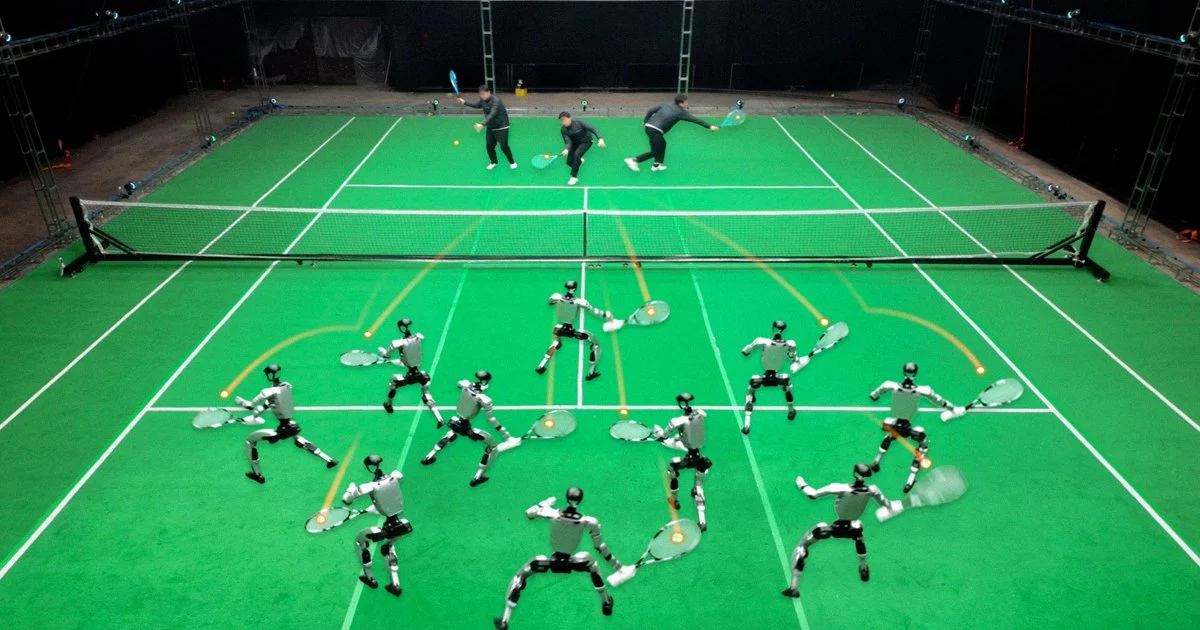

Athletic autonomy as a proxy for real-world readiness in humanoid robotics
Galbot’s reported achievement—integrating its LATENT control algorithm with a Unitree G1 humanoid chassis to sustain high-dynamic tennis rallies—lands as more than a viral robotics moment. Tennis is an unusually revealing benchmark for humanoid autonomy because it compresses several hard problems into a single, unforgiving loop: perception under motion, prediction under uncertainty, whole-body balance, and rapid actuation with minimal latency. A robot that can repeatedly return volleys across changing trajectories is demonstrating not just “skill,” but robustness under continuous perturbation.
What makes this milestone strategically relevant is the implied transferability. The same capabilities that keep a biped stable while tracking and striking a fast-moving ball—anticipation, footwork, coordinated torso-arm dynamics, and recovery from near-failure states—map cleanly onto industrial and field settings where conditions are rarely static. In that sense, athletic autonomy is becoming a publicly legible proxy for a deeper claim: humanoids are approaching the point where they can handle tasks that are dynamic, unstructured, and time-sensitive, not merely repetitive.
This arrives amid broader deployments and demonstrations spanning automotive assembly, logistics sorting, martial-arts exhibitions, and even visual reconnaissance in conflict zones. The throughline is clear: humanoid robotics is shifting from staged choreography toward adaptive control in open environments, where the next state cannot be scripted in advance.
Data-efficient learning: why “imperfect” human motion fragments matter
A central technical assertion in the LATENT approach is its ability to learn from fragmented, imperfect human motion capture rather than relying on exhaustive, curated datasets. That design choice is not a footnote—it is a business model and scaling strategy.
High-quality demonstration data is expensive to collect, difficult to standardize, and often unavailable for the very tasks where robots could create the most value (hazardous inspection, emergency response, irregular maintenance, disaster recovery). Training from imperfect fragments suggests a pivot toward data efficiency, where the system extracts reusable motor primitives—balance corrections, reach patterns, foot placement strategies—without needing a pristine “gold standard” recording of every task.
From an enterprise perspective, this reframes the competitive landscape around who can acquire and operationalize motion knowledge fastest, not merely who has the best hardware. It also elevates motion data into a strategic asset class:
- Motion-fragment libraries could become proprietary moats, akin to domain datasets in language AI.
- Synthetic augmentation and simulation pipelines become more valuable when real-world data is sparse or messy.
- The ability to generalize from imperfect data reduces time-to-deployment in new environments, improving automation ROI.
Technically, the promise is that imperfect data can still encode the essential structure of human movement—timing, coordination, recovery behaviors—if the learning system is designed to distill primitives rather than memorize trajectories. If that holds at scale, it changes how the industry thinks about training humanoids for long-tail tasks where “perfect demonstrations” are unrealistic.
Millisecond feedback loops and whole-body planning: the control stack becomes the product
The tennis demonstration highlights a second inflection point: real-time whole-body control with millisecond-level feedback paired with predictive planning. In practical terms, this is the difference between a robot that can execute a motion and a robot that can continuously renegotiate its motion as the world changes.
For humanoids, whole-body control is not optional. Every reach, step, or twist is a balance problem, and every balance correction affects the next perception frame. The significance of smooth, biologically plausible motion is not aesthetic—it is a signal that perception, dynamics, and control are being integrated tightly enough to avoid the brittle, stop-start behavior that has historically limited bipedal robots outside lab conditions.
Equally notable is the claim of platform portability: deploying LATENT on an unmodified Unitree G1 suggests a modular separation between hardware and intelligence. If the control stack can travel across chassis with minimal rework, the industry may move toward a more software-defined robotics ecosystem, where:
- Hardware becomes a scalable commodity layer (within performance bands).
- Differentiation concentrates in control software, sensor fusion, and skill libraries.
- Field upgrades become more feasible, accelerating iteration cycles and reducing deployment friction.
This is where the economics sharpen. If a control stack can be upgraded like enterprise software—improving reaction time, stability, and task repertoire without replacing the robot—then the lifetime value of deployed fleets rises, and procurement decisions begin to resemble platform bets rather than single-purpose automation purchases.
Strategic and geopolitical stakes: from factory floors to dual-use frontiers
The broader context—humanoids appearing in logistics, manufacturing, public demonstrations, and conflict-adjacent reconnaissance—underscores that robotics innovation is now entangled with labor markets and geopolitics.
On the labor side, aging demographics and persistent shortages in logistics and manufacturing are pushing executives to consider automation that is adaptable, not merely efficient. Humanoids are compelling precisely because they can, in theory, operate in spaces built for humans without requiring a full redesign of facilities. If athletic-grade control translates into dynamic material handling, precision assembly, or mixed-environment navigation, it could shift the ROI calculus away from specialized cobots toward more general-purpose bipedal systems.
On the geopolitical side, Galbot’s progress reinforces the intensifying competition between Chinese and Western robotics ecosystems, often framed through comparisons to incumbents such as Boston Dynamics. The mention of deployments near conflict zones adds a sharper edge: humanoid capability is inherently dual-use, and improvements in mobility, perception, and autonomy can migrate from commercial applications to defense and security contexts with limited friction.
That reality will likely accelerate debates over:
- Export controls on advanced actuators, sensors, and autonomy software
- Liability and safety standards for robots operating near the public
- Governance frameworks for autonomous behavior in sensitive environments
For business leaders and policymakers, the key is to recognize that humanoid robotics is no longer just a manufacturing technology story. It is becoming a platform domain where data strategy, software portability, workforce design, and regulatory engagement will determine who scales responsibly—and who scales first. The tennis rally may be the headline, but the real signal is the maturation of control and learning systems that can keep up with a world that refuses to stand still.

 By
By
 By
By


 By
By
 By
By
 By
By
 By
By







