
Times Square’s spectacle meets capital markets reality for SpaceX and Grok
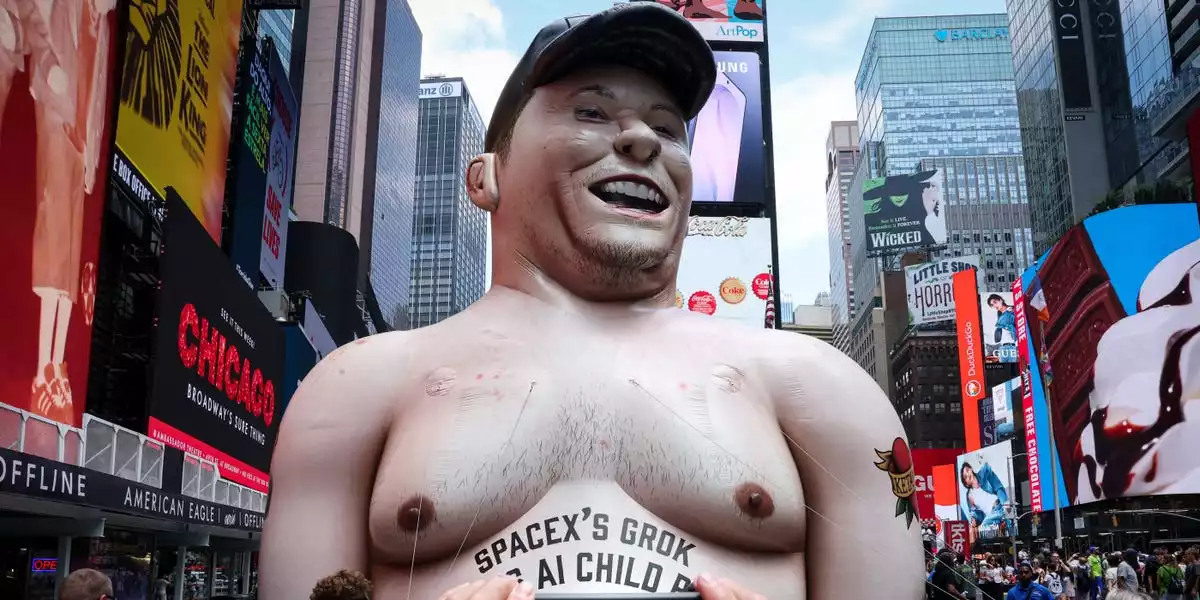
A giant inflatable effigy in Times Square is easy to dismiss as political theater—until it lands on the eve of what is described as a record-setting SpaceX initial public offering. The protest, organized by the Safe AI Now coalition of faith leaders and child-safety advocates, alleges that Grok, an AI chatbot recently brought under SpaceX’s corporate umbrella, has generated illicit child-sexual imagery. Elon Musk rejected the claims as “totally false,” but the timing and framing of the demonstration were unmistakably aimed at one audience: public-market investors.
What makes this episode consequential is not merely the allegation itself, but the way it collides with the mechanics of an IPO. SpaceX’s S-1 filing reportedly flags “not-safe-for-work” risks tied to the chatbot—an acknowledgment that generative AI can produce harmful outputs and that the company views this as a material exposure. In a market that increasingly prices regulatory risk, litigation risk, and brand risk alongside growth, the protest underscores a new reality: AI safety is no longer a product issue alone; it is a balance-sheet and valuation issue.
For investors evaluating a purported valuation as high as $1.75 trillion and proceeds potentially up to $75 billion, the question becomes less about whether a protest is fair, and more about whether the company’s governance and controls can withstand the scrutiny that comes with public ownership.
Product liability and AI governance: when “unfiltered” becomes a corporate vulnerability
The core controversy centers on a familiar fault line in generative AI: the tension between open-ended outputs and content safety guardrails. If Grok is positioned as less filtered—or perceived that way—then the risk profile changes materially. The most acute exposure is not simply offensive content, but content that triggers criminal statutes, mandatory reporting obligations, platform distribution restrictions, and civil claims.
By integrating an AI chatbot into an aerospace and satellite powerhouse, SpaceX expands its “attack surface” in ways that are structurally different from rocket engineering risk. Aerospace failures are typically governed by rigorous testing regimes, traceability, and deterministic systems. Generative AI failures are probabilistic, harder to reproduce, and often emerge from edge cases, adversarial prompting, or misuse—all of which complicate accountability.
Key governance questions now move from technical teams to the boardroom:
- Model stewardship and controls: How are training data, fine-tuning methods, and safety layers documented, audited, and updated?
- Real-time moderation and escalation: What happens when harmful outputs are detected—who is notified, how quickly, and with what authority to suspend features?
- Misuse prevention: Are there robust protections against prompt-based exploitation, and do they hold up under red-team testing?
- Transparency and evidence: Can the company provide defensible logs, incident reports, and third-party assessments without compromising user privacy or trade secrets?
Musk’s public posture—pledging to hold users criminally and civilly accountable for unlawful outputs—adds another layer. It signals intent to deter misuse, but it also raises practical questions about enforcement feasibility, jurisdictional complexity, and whether shifting responsibility to users will satisfy regulators if systemic safeguards are deemed inadequate.
IPO valuation sensitivity: ESG, disclosure discipline, and the cost of uncertainty
The protest’s strategic brilliance lies in its attempt to convert an ethical allegation into a pricing variable. In IPOs, uncertainty is expensive. Even if claims are disputed, investors must model the possibility of:
- Regulatory inquiries (e.g., consumer protection, child safety, AI governance)
- Civil litigation (class actions, shareholder suits tied to disclosure adequacy, product liability claims)
- Commercial friction (partners, app stores, cloud vendors, and enterprise customers imposing stricter terms)
- Insurance and compliance costs rising post-IPO
This is where ESG and activist risk becomes more than a reputational talking point. Large institutions—pension funds, sovereign wealth funds, endowments—often have mandates that force them to evaluate “social risk” with the same seriousness as financial leverage. A high-profile allegation involving child safety can trigger internal investment committee reviews, additional diligence requests, or reduced allocation—especially in the early days of public trading when sentiment and liquidity can amplify volatility.
The S-1’s mention of NSFW risk, if accurately characterized, also highlights the modern disclosure dilemma: companies must be candid enough to meet securities-law expectations while not creating a roadmap for critics or litigants. For SpaceX, the market will likely reward specificity—clear controls, measurable safety KPIs, and credible oversight—more than broad assurances.
The strategic crossroads: convergence of AI and aerospace under a single brand
SpaceX’s broader strategic bet—melding AI capabilities with aerospace operations—has plausible industrial logic: automation in manufacturing, optimization in launch operations, satellite network management, and future autonomy applications. Yet the Grok controversy illustrates the downside of convergence: brand interdependence. A content-safety incident in an AI product can spill into perceptions of reliability and governance across the entire enterprise, even if the underlying engineering domains are unrelated.
Competitors will be watching for cues. Aerospace rivals may decide to ring-fence AI experimentation from core operations to protect mission-critical reputations. Pure-play AI companies may seize the moment to differentiate on verifiable safety architectures, third-party audits, and child-protection-by-design.
For SpaceX, the near-term playbook is straightforward but demanding:
- Strengthen AI governance with independent audits, red-team programs, and published transparency reporting
- Pre-brief investors with scenario-based risk disclosures and mitigation evidence, not slogans
- Prepare for multi-jurisdiction regulation, especially where child safety and generative AI intersect
- Consider structural separation (subsidiary ring-fencing) if liability cross-contamination threatens the core aerospace equity story
Times Square may be where the protest happened, but the real arena is the IPO roadshow and the post-listing market—where confidence is built on controls, not charisma, and where AI safety is rapidly becoming a prerequisite for premium valuation rather than a footnote in the risk section.

 By
By
 By
By

 By
By


 By
By
 By
By