

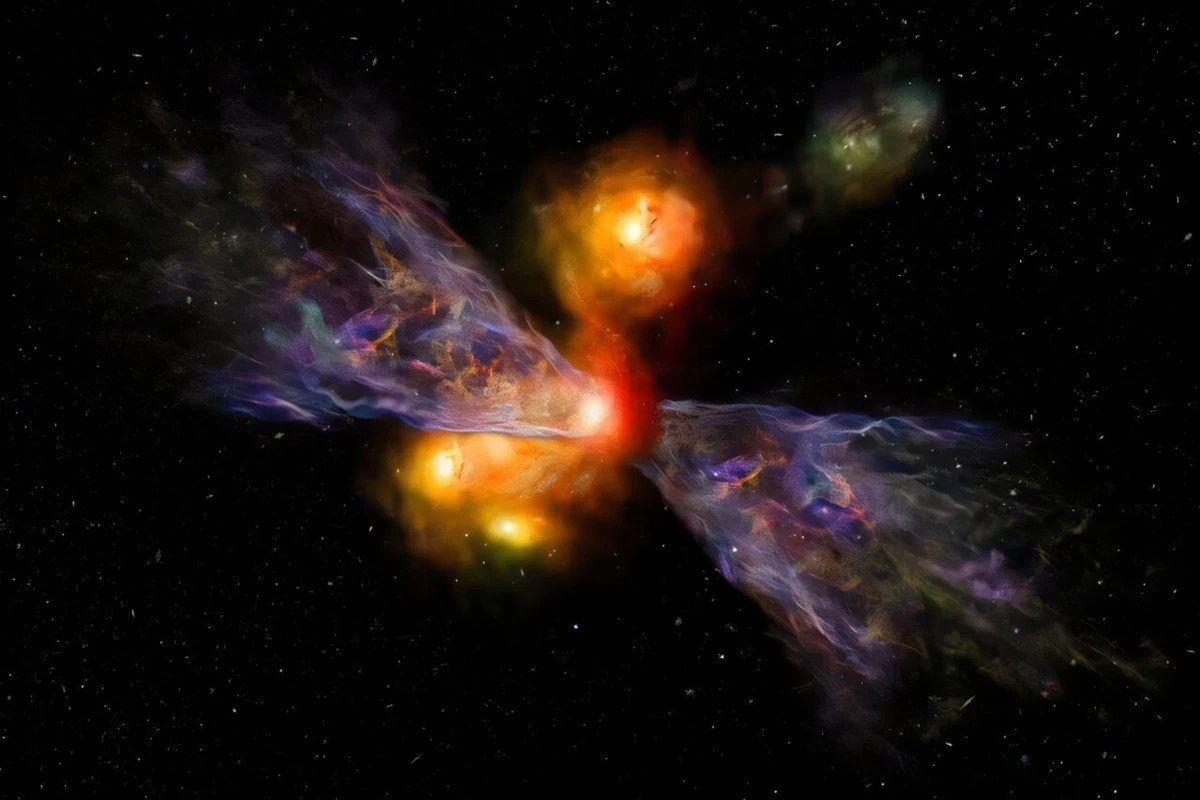

JWST’s view of CRISTAL-02: a fast-track to galactic “retirement” in the early universe
Astronomers using the James Webb Space Telescope (JWST) have captured a striking moment in cosmic evolution: a massive galaxy, CRISTAL-02, observed at roughly one billion years after the Big Bang (redshift z ≈ 6), appears to be ejecting the very fuel required to keep forming stars. Instead of a slow fade-out—where star-forming gas is gradually consumed over billions of years—JWST data indicate a powerful outflow of cold gas, a plume substantial enough to shut down star formation on a timescale of ~50 million years.
That timeline matters. In astrophysical terms, 50 million years is a blink—suggesting that some of the universe’s earliest massive galaxies could become “dead” (quiescent) far sooner than classical models would predict. The observation also helps explain a puzzle sharpened by JWST itself: the telescope has revealed an unexpectedly large population of massive, prematurely quiescent galaxies in the early universe, challenging long-standing assumptions about how quickly galaxies can assemble, burn bright, and then go quiet.
A key implication is that galaxy “quenching” may be less mysterious—and less dependent on exotic cosmological tweaks—than some proposals have suggested. Rather than invoking variable dark-energy behavior to reconcile early galaxy demographics, the CRISTAL-02 evidence elevates a more proximate mechanism: merger-driven starbursts that trigger feedback strong enough to expel star-forming gas.
—
Merger-driven feedback moves from supporting actor to leading explanation
The CRISTAL-02 finding strengthens the case that galaxy interactions and mergers—already known to compress gas and ignite intense star formation—can also generate the conditions for rapid shutdown. The logic is straightforward and increasingly testable with JWST:
- Mergers funnel gas inward, feeding a starburst (and potentially a central black hole).
- The starburst produces radiation pressure, stellar winds, and supernova-driven shocks.
- Those forces can drive large-scale outflows, pushing cold gas out of the galaxy’s star-forming regions—or out of the galaxy entirely.
- Once the gas reservoir is removed or heated beyond usability, the galaxy transitions toward quiescence.
What makes this result particularly consequential is its potential to unify multiple JWST-era observations under a single, evidence-led framework. If nearly half of massive early galaxies are in interactions, as suggested, then merger-induced winds could plausibly account for the surprising abundance of early “dead” galaxies without requiring more speculative changes to cosmological parameters.
This is not a dismissal of dark energy as a foundational component of modern cosmology; rather, it is a reminder of how scientific narratives can drift toward the exotic when the nearer-term physics has not yet been observed at sufficient resolution. JWST’s contribution here is less about rewriting cosmology and more about tightening the causal chain between observable events—mergers, starbursts, outflows—and the end state of galaxies.
For galaxy-evolution modeling, the recalibration is immediate: feedback physics and hydrodynamics become even more central, and simulations must better capture how gas behaves under extreme early-universe conditions. The prize is predictive power: models that can forecast not only how galaxies grow, but also how and when they stop.
—
The technology stack behind the discovery: infrared precision meets data-intensive astrophysics
CRISTAL-02 is also a story about instrumentation and computation. JWST’s infrared sensitivity and spatial resolution enable astronomers to detect faint, distant structures and infer gas motion and composition at epochs previously beyond reach. In practical terms, JWST is turning early-universe galaxy evolution into an observational science rather than a largely inferential one.
Yet the telescope’s optics are only the front end of a modern “big science” pipeline. Extracting kinematic signatures and chemical fingerprints from faint high-redshift sources intensifies demand for:
- High-performance computing (HPC) to run large-scale hydrodynamic simulations and forward-model observations
- Machine-learning pipelines for classification, denoising, and parameter inference across vast survey datasets
- Petabyte-scale storage and data governance to support reproducibility, collaboration, and long time-horizon reanalysis
- Advanced visualization and interactive analytics to interpret multi-dimensional data products (spectra, morphology, velocity fields)
These requirements are not academic overhead; they are innovation drivers. The same computational patterns—distributed processing, accelerated inference, robust metadata, and scalable storage—map cleanly onto commercial needs in cloud architecture, AI operations, and real-time observability. As astronomy becomes more data-intensive, it also becomes a proving ground for the next generation of analytics tooling.
—
Business and strategy signals: why “big science” keeps paying—and what leaders can learn from cosmic feedback
JWST’s continued stream of high-impact results reinforces a strategic point for governments, industry partners, and investors: flagship research infrastructure can deliver outsized return on investment when it creates platforms—not just projects. The spillovers are tangible, particularly in:
- Precision optics and imaging sensors with downstream uses in medical diagnostics and environmental monitoring
- Cryogenic engineering and materials science relevant to quantum systems and advanced electronics
- Algorithms for signal extraction and pattern recognition that translate into autonomy, navigation, and industrial inspection
At the same time, the CRISTAL-02 narrative offers a useful, cautionary analogue for corporate strategy—especially in an era where mergers, rapid scaling, and restructuring are often treated as default growth levers. In galaxies, mergers can ignite brilliance but also trigger self-quenching outflows. In organizations, aggressive integration can similarly generate disruptive “winds”: cultural friction, talent loss, duplicated systems, and resource misallocation that quietly erode the very growth the deal was meant to accelerate.
Three strategic takeaways stand out:
- Treat integration as a managed feedback system, not a one-time event; monitor leading indicators the way astronomers validate signals across datasets.
- Avoid hyper-growth resource burn by building phased investment tranches and stress-tested capacity plans—starbursts are spectacular, but they are rarely sustainable.
- Prefer evidence-led diagnosis over exotic explanations; before blaming macro forces or structural inevitabilities, audit proximate operational causes that can be measured and corrected.
CRISTAL-02 is ultimately a reminder that systems—cosmic or corporate—often fail not from lack of ambition, but from unmanaged feedback. JWST is showing, with unprecedented clarity, how quickly a thriving galaxy can expel its future, and how decisive the right observation can be in replacing speculation with mechanism.

 By
By
 By
By

 By
By
 By
By

 By
By








