

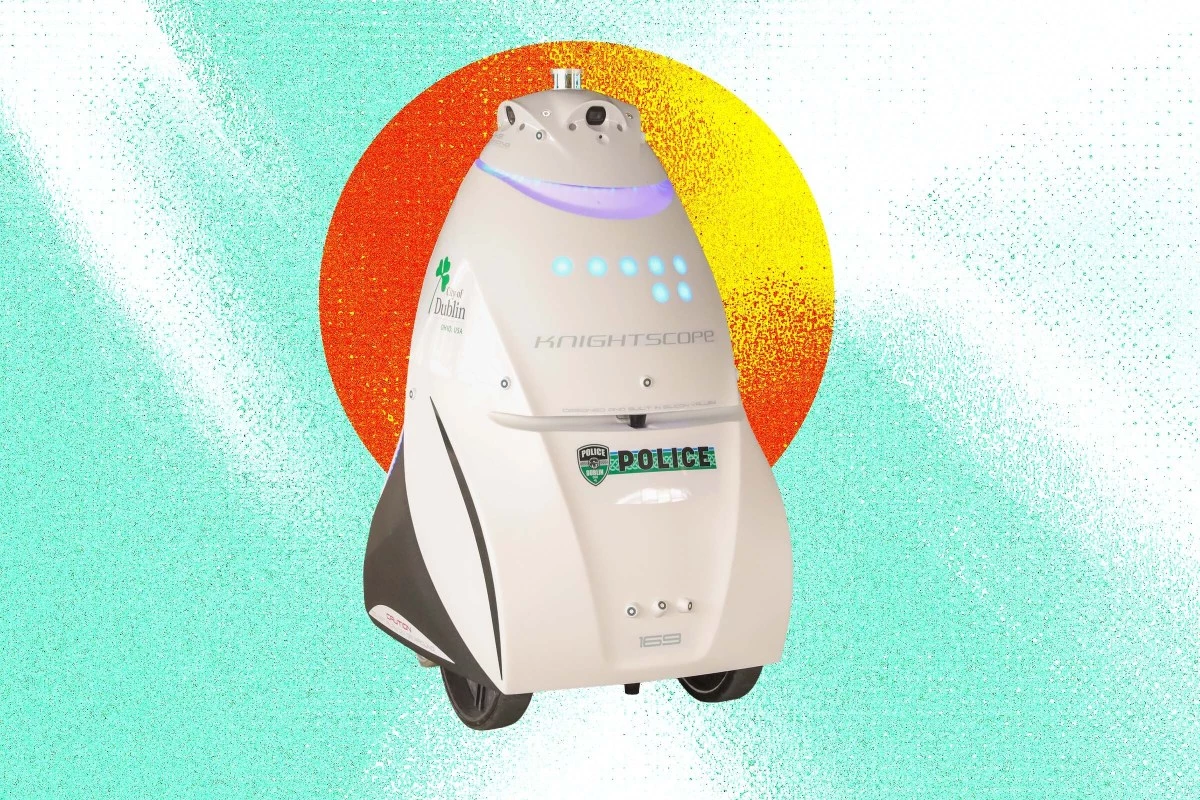

Dublin’s DubBot shutdown signals a reality check for autonomous security robotics in public safety
Dublin, Ohio’s decision to decommission its autonomous security robot—a Knightscope K5 unit branded “DubBot”—after fewer than 12 months is more than a local procurement footnote. It is a crisp data point in a growing body of evidence that autonomous security robots are struggling to meet the operational standards of real-world municipal policing and facilities security.
The city deployed the robot to patrol a municipal parking garage at a reported total cost of $128,080 (partially reimbursed). The measurable outcomes were stark: no arrests, no citations, and no incidents that required human intervention. While a lack of crime could be interpreted as a success in deterrence, the absence of verifiable prevention events, coupled with the broader pattern of curtailed deployments elsewhere, makes it difficult to defend the investment on performance grounds alone.
Dublin’s experience also aligns with other high-profile rollbacks, including pilots in New York City’s subway system and San Antonio International Airport, where technical shortcomings and operational friction reportedly outweighed the promised benefits. Taken together, these cases are pushing autonomous security robotics into a more sober phase—one where claims of “force multiplication” must be supported by auditable metrics, not marketing narratives.
The sensor-to-action problem: when data capture doesn’t become actionable security
On paper, the Knightscope K5 platform represents a familiar smart-city proposition: a mobile device equipped with 360-degree cameras, microphones, thermal imaging, and an emergency call button, continuously collecting environmental signals. In practice, the central challenge has been the sensor-to-action gap—the distance between capturing data and producing reliable, timely, decision-grade alerts.
Several technical and operational dynamics tend to surface in these deployments:
- Limited autonomy in unstructured environments: Parking garages, transit hubs, and terminals are dynamic spaces with changing lighting, reflective surfaces, pedestrians, and vehicles—conditions that stress navigation and perception systems.
- SLAM and navigation fragility: Reports of navigational drift, mapping inconsistencies, and resets point to a maturity issue in core robotics functions such as simultaneous localization and mapping (SLAM).
- Connectivity and verification bottlenecks: Even when sensors detect anomalies, security value depends on dependable communications, low-latency alerting, and human verification workflows. If links are unreliable or alerts are noisy, the system becomes operationally expensive rather than labor-saving.
- “Autonomous” systems requiring shadow operators: Across multiple pilots, the need for human intervention—whether for route corrections, incident validation, or system recovery—undercuts the premise that robots reduce staffing burdens.
The deeper issue is not that robotics cannot contribute to security, but that public safety is a mission-critical domain. Reliability thresholds are unforgiving, and failure modes are reputationally costly for both vendors and governments. A robot that performs well in controlled demos but inconsistently in live environments quickly becomes perceived as a novelty—especially when it cannot demonstrate a clear chain from detection to response.
ROI under scrutiny: total cost of ownership, opportunity cost, and taxpayer accountability
Municipal technology procurement lives and dies by total cost of ownership (TCO) and defensible return on investment. Dublin’s original budget reportedly contemplated $238,440 for two robots, while the deployed program totaled $128,080 with partial reimbursement. Yet reimbursements do not erase the underlying question: what did the city buy in terms of measurable security outcomes?
When autonomous security robots fail to generate tangible results—incident detection improvements, response-time reductions, or validated deterrence—economic critiques intensify:
- ROI assumptions don’t materialize: Many robotics pitches rely on reduced patrol hours and lower overtime. If robots require frequent human oversight, those savings evaporate.
- Maintenance-to-uptime ratios matter: A security platform’s value is proportional to its availability. Downtime, resets, and troubleshooting convert capital outlay into recurring operational drag.
- Opportunity cost becomes the headline: The same funds could support camera upgrades, improved lighting, access control modernization, analytics-driven hotspot mapping, or community policing initiatives—tools with more established performance baselines and vendor ecosystems.
- Public procurement demands proof, not possibility: Under tightening budgets and heightened scrutiny, cities increasingly need auditable KPIs rather than aspirational projections.
This is where autonomous security robotics faces a structural disadvantage: it is often sold as a visible symbol of innovation, but evaluated as a safety instrument. Visibility amplifies expectations; underperformance amplifies backlash.
What a credible path forward looks like: hybrid models, performance-based contracts, and interoperability
The retreat from stand-alone robotic patrols does not necessarily imply the end of robotics in public safety. It suggests the market is converging on a more realistic operating model: robots as augmenters, not replacements, embedded in workflows that preserve human accountability.
A more durable framework for cities and agencies would emphasize:
- Rigorous pilot design with transparent KPIs: Predefine metrics such as verified incident detection rate, false-alert rate, response-time impact, uptime, maintenance burden, and operator workload, with public reporting where appropriate.
- Human-in-the-loop operations: Use robots for repetitive perimeter sweeps and presence, while routing ambiguous events to trained staff for verification—reducing risk from automation errors.
- Interoperability as a procurement requirement: Favor systems that integrate with command-and-control centers, video management software (VMS), GIS mapping tools, and existing incident ticketing to avoid siloed data and vendor lock-in.
- Performance-based contracting and supplier risk controls: Tie payments to verified milestones, include penalty clauses for chronic downtime, and adopt sunset clauses that prevent pilots from becoming permanent by inertia.
The broader industry context matters as well. Autonomous security robotics is exhibiting a familiar hype-cycle correction, similar to what has played out in autonomous vehicles and drone delivery: early enthusiasm meets operational complexity, and only the most robust architectures survive. For municipalities, the lesson is straightforward and increasingly non-negotiable: innovation is not a substitute for evidence, and public safety technology must earn its place through measurable, repeatable performance in the environments where it is actually expected to work.

 By
By
 By
By

 By
By
 By
By
 By
By
 By
By








