

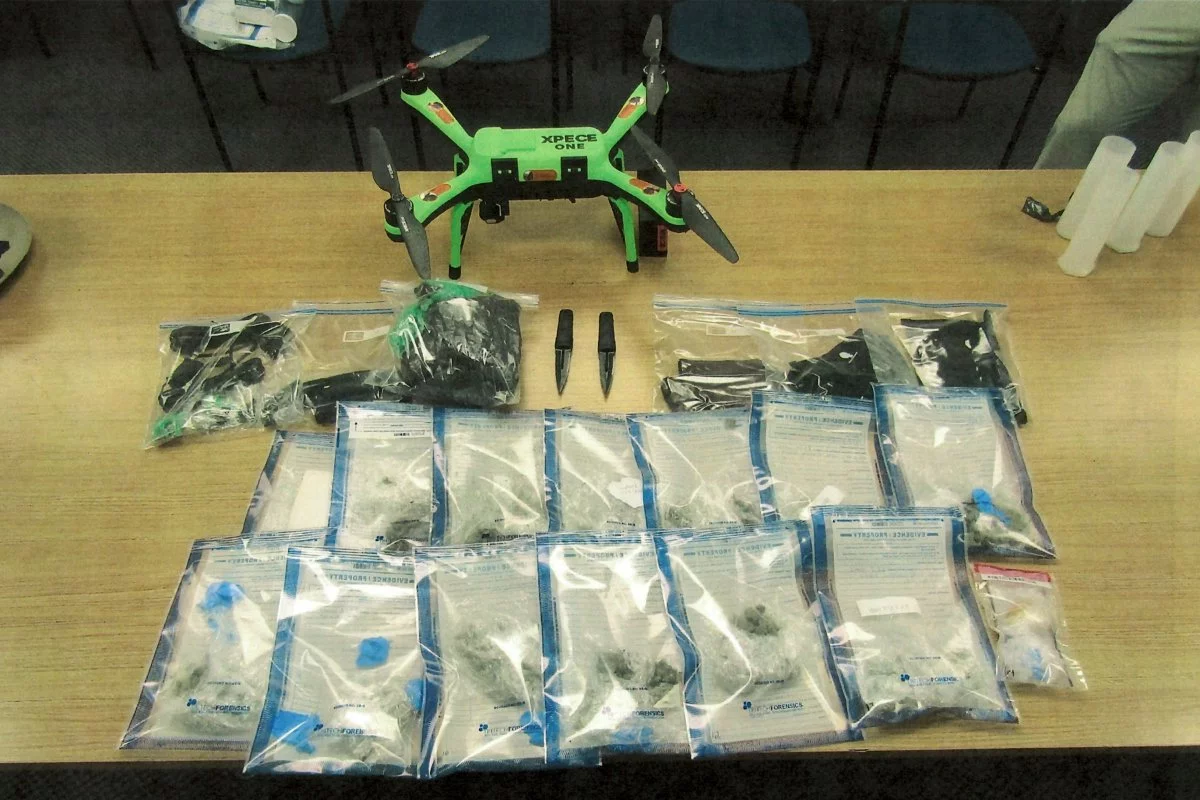

A neon-green drone over the yard: how contraband logistics are being rewritten from the air
The interception of a neon-green Xpece One fishing drone above a New York State prison yard is more than an isolated security incident—it is a vivid signal of how quickly commercial drone technology is being absorbed into illicit supply chains. With a reported value of $2,299 and a 7-pound payload capacity, the platform sits in a sweet spot: affordable enough to be expendable, capable enough to move meaningful quantities of contraband, and common enough to blend into the broader ecosystem of recreational and hobbyist unmanned aircraft.
The seized payload underscores the operational intent behind these flights. Authorities recovered a cache that combined violence-enabling tools, communications, and commodities that fuel prison economies, including:
- Two 8-inch hunting knives, raising the risk of assaults and coercion
- A Motorola phone, enabling off-grid coordination and external criminal connectivity
- Gang-style bandanas, often linked to identity signaling and internal power alignment
- Electric hair trimmers potentially repurposed as tattoo devices, illustrating adaptive “mission creep”
- Paper soaked in an unidentified substance, consistent with evolving drug concealment methods
- 13 balloons filled with marijuana, a high-demand commodity inside facilities
New York officials describe this as one of nearly a dozen drone-facilitated smuggling attempts statewide, while other jurisdictions report far higher volumes. South Carolina’s Department of Corrections, for example, logged 250 drone drops in 2024 and 254 in 2025, and officials estimate many more go undetected—suggesting that U.S. prison drone smuggling incidents may already number in the thousands.
The business model behind prison drone smuggling: low cost, high leverage, scalable risk
From a business and technology perspective, the most consequential detail may be the asymmetry of return on investment. A few thousand dollars buys a drone that can deliver items whose combined value—measured in street pricing, in-prison scarcity premiums, and downstream criminal utility—can be dramatically higher. Even when a drone is intercepted, the economics can still favor repeat attempts, particularly for organized networks that treat drones as disposable logistics assets.
Several dynamics make this a durable model:
- COTS accessibility (Commercial Off-The-Shelf): Fishing and recreational drones are widely available, require limited technical skill to operate, and benefit from rapid consumer innovation cycles (battery life, stabilization, GPS navigation, payload release mechanisms).
- Operational deniability: Remote operation and short mission windows reduce exposure compared with perimeter handoffs or staff corruption schemes, even if those remain significant vectors.
- Modularity and rapid iteration: The same airframe can be adapted for different payloads—drugs, phones, blades, tools, or chemical delivery mediums—allowing criminal operators to test what “works” against local defenses.
- Network effects across jurisdictions: Tactics proven in one state can spread quickly through online communities, informal criminal networks, and copycat behavior, compressing the learning curve for adversaries.
This is also a reminder that contraband is not merely a security problem; it is an operational and governance problem. Introducing weapons, narcotics, and clandestine communications can recalibrate inmate power dynamics, strengthen gang control, and increase violence—effects that cascade into staffing strain, medical costs, lockdown frequency, and litigation exposure.
Why fences and CCTV are losing ground: the counter-drone technology gap in corrections
Traditional prison perimeter security—fences, lighting, patrols, and fixed CCTV—was designed for threats moving on foot or by vehicle. Drones invert that assumption by exploiting a domain where many facilities have limited visibility: low-altitude airspace, often at night, often in short bursts, and frequently with minimal acoustic signature at distance.
Effective counter-drone strategy increasingly requires a layered detection-and-response architecture, typically combining:
- RF sensing to detect control links and video downlinks (where present)
- Radar and/or LiDAR to track small, low-flying objects that cameras may miss
- Optical and infrared systems for confirmation and evidentiary capture
- AI-driven analytics to reduce false positives and classify flight behavior patterns
Yet corrections agencies face constraints that airports or military bases can sometimes avoid. Countermeasures such as RF jamming, “takeover” commands, or directed-energy systems raise legal, safety, and airspace governance issues, particularly under U.S. federal rules governing interference with communications and aircraft operations. Even “soft” interdiction options—net launchers, capture drones, or localized denial tools—require training, clear use-of-force policies, and careful risk management to avoid collateral harm.
Budget realities compound the challenge. Advanced detection systems and integrated command platforms can demand significant capital expenditure and ongoing maintenance—forcing agencies to weigh security modernization against other urgent needs such as staffing, rehabilitation programming, and facility upgrades. Inflationary pressures and tight public-sector budgets make those tradeoffs sharper, not easier.
A new market for perimeter defense—and a preview of broader critical-infrastructure risk
The rise of prison drone smuggling is catalyzing private-public collaboration: corrections departments seeking solutions, and defense-tech firms, AI vendors, and telecom providers recognizing an emerging market for perimeter airspace security. This is likely to accelerate procurement models that look more like enterprise technology—subscription software, managed detection services, and integrated sensor platforms—than traditional corrections hardware.
Strategically, prisons are becoming real-world testbeds for counter-drone concepts that will matter far beyond corrections. The same problems—small aircraft, ambiguous intent, short timelines, and complex legal boundaries—are increasingly relevant to power plants, ports, stadiums, and other critical infrastructure. Conversely, tools developed for aviation and venue security may be adapted to the corrections environment, where the perimeter is fixed but the adversary is persistent.
The policy dimension is equally central. FAA rules, no-fly-zone designations, and enforcement mechanisms can deter some activity, but deterrence depends on interagency coordination, rapid incident response, and evidence pipelines that turn drone recoveries into prosecutable cases. That elevates the importance of drone forensics—serial numbers, flight logs, payload design, and material traces—as well as intelligence partnerships that can connect recovered phones, SIM activity, and operator behavior patterns.
What the neon-green drone episode ultimately illustrates is a broader shift: airspace is now part of the prison perimeter, and the organizations that adapt fastest—technically, operationally, and legally—will set the standard for how institutions defend themselves against a rapidly proliferating, commercially powered aerial threat.

 By
By
 By
By
 By
By
 By
By

 By
By
 By
By







