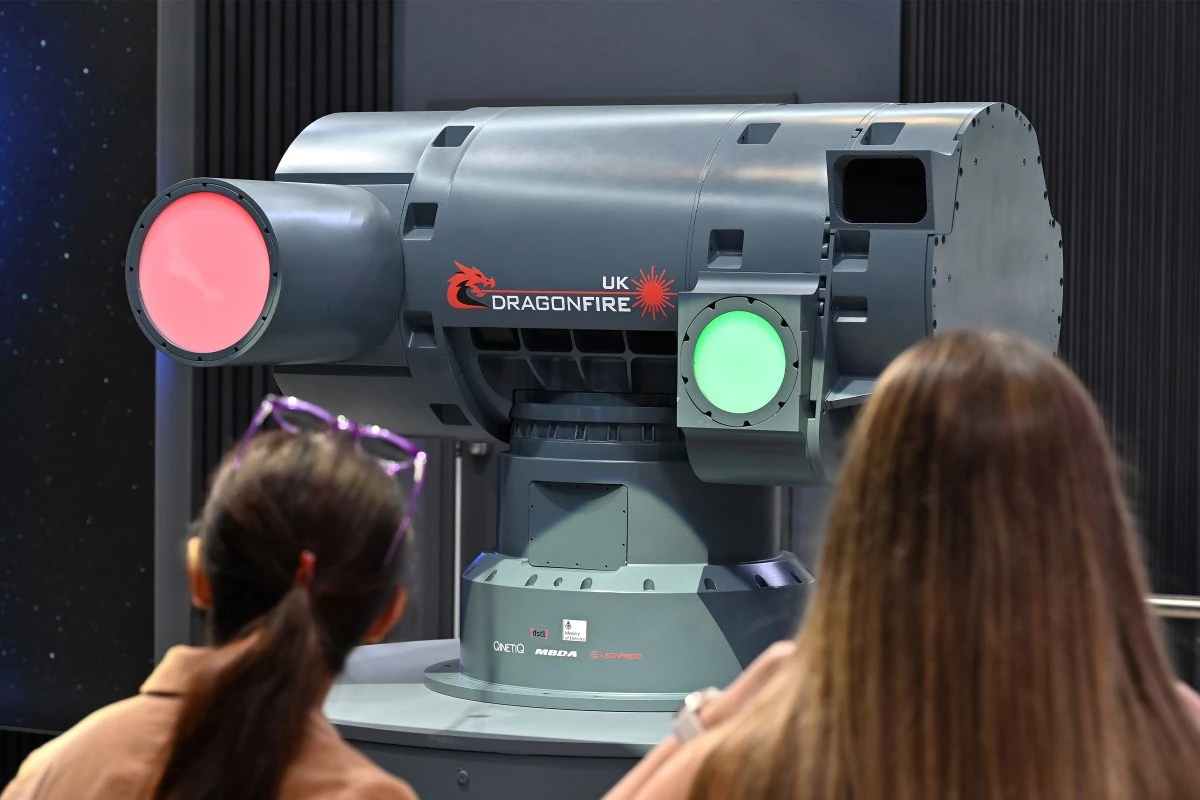

Lasers at Sea: The DragonFire Breakthrough and the New Economics of Drone Defense
In the windswept expanse of Scotland’s firing ranges, the U.K. Ministry of Defence recently marked a watershed moment in military technology. The DragonFire high-energy laser, developed by MBDA, demonstrated an ability to swat drones from the sky at speeds exceeding 650 kilometers per hour, with a precision that borders on the uncanny—coin-sized accuracy at a distance of one kilometer. This is not merely a feat of engineering; it is a signal flare for the future of warfare, where the calculus of defense is being rewritten by photons rather than propellants.
Engineering Triumphs: From Laboratory Curiosity to Operational Arsenal
The technical underpinnings of DragonFire represent a confluence of advances that have, until now, eluded practical deployment. The system’s >50 kW continuous power output is not just a number—it is a threshold that enables the defeat of a wide spectrum of drone threats (Group 1–3), all while drawing from the existing electrical reserves of Royal Navy Type 26 and 31 frigates. This sidesteps the logistical quagmire of retrofitting ships with bulky generators, a perennial stumbling block for directed-energy weapons.
Central to DragonFire’s reliability is its coherent beam combining (CBC) architecture. By distributing the thermal load across multiple fiber-laser modules, CBC dramatically increases operational uptime compared to older, monolithic laser designs. The result is a weapon that not only fires with sub-centimeter accuracy—thanks to adaptive optics and real-time atmospheric compensation—but also does so with a robustness that finally meets the rigors of maritime deployment.
Beneath the hardware, software quietly orchestrates the ballet. AI-driven target classification and sensor fusion compress the kill chain to mere seconds. This software-defined engagement layer is more than a technical flourish; it positions MBDA to tap into lucrative data analytics and sovereign command-and-control markets, a subtle but significant shift in the defense industry’s value proposition.
The Economics of Light: Disrupting the Cost Curve
Perhaps the most seismic impact of DragonFire lies in its economics. At a marginal cost of roughly $13 per shot, the system inverts the traditional cost-exchange ratio that has long plagued modern militaries. Where adversaries could previously exhaust million-dollar missile inventories with swarms of cheap drones, DragonFire restores fiscal deterrence—each engagement barely registers on the balance sheet, at less than 0.001% the cost of a Standard Missile-2.
This shift is not lost on defense ministries or prime contractors. The U.S. Navy’s recent $1 billion expenditure to counter low-cost Houthi drones in the Red Sea underscores the unsustainability of conventional missile-based defense. As lasers like DragonFire become field-viable, missile manufacturers may be compelled to pivot, reserving their wares for the most complex threats—ballistic and hypersonic missiles—while DEWs shoulder the burden of mass drone attrition.
The industrial ramifications ripple outward. Directed-energy weapons, anchored in mature fiber-laser supply chains, are less vulnerable to the geopolitical volatility that haunts traditional munitions—there are no explosive precursors to embargo, no rare minerals to hoard. This supply-chain resilience aligns with NATO’s broader strategic priorities, and signals a rebalancing of procurement toward agile, spiral-upgradeable systems rather than monolithic, decade-long programs.
Strategic Ripples: Shaping Alliances and Civilian Infrastructure
The implications of DragonFire extend far beyond the decks of Royal Navy frigates. The Ukraine conflict and the Red Sea engagements have exposed the vulnerability of advanced militaries to cheap, expendable drones—a vulnerability that lasers are uniquely positioned to address. China, the United States, and Israel are all racing to field comparable systems, but the U.K.’s early operational success could set de facto NATO standards, shaping coalition interoperability and constraining rival ecosystems.
This technological leap will not be confined to the military sphere. As electrification becomes imperative, designers of ships, vehicles, and even civilian infrastructure will be compelled to oversize power and cooling systems, creating new opportunities for suppliers of solid-state converters, advanced batteries, and thermal management technologies. The talent war for photonics and power-electronics engineers will intensify, with defense primes and commercial tech giants vying for the same scarce expertise.
Dual-use spillovers are inevitable. The precision beam steering and rapid optical computing that underpin DragonFire could soon find their way into telecommunications, precision manufacturing, and medical devices, echoing the historical migration of radar and GPS from military to civilian domains.
Navigating the New Landscape: Imperatives for Leaders and Innovators
For decision-makers, the DragonFire milestone is a clarion call to action. Defense portfolios must be rebalanced, with missile inventories reserved for high-end threats and DEWs integrated to counter mass-produced drones. Supply-chain due diligence becomes paramount, as fiber-laser modules and rare-earth dopants emerge as critical chokepoints. Infrastructure upgrades—across ports, airports, and energy facilities—will follow military adoption, with commercial-scale anti-drone lasers poised to become premium security offerings.
Regulatory and ethical frameworks will need to evolve in tandem, as the lowered cost of engagement risks lowering the threshold for lethal force. Early engagement with policymakers will be crucial to shaping the rules of engagement and export regimes, offering first movers a competitive edge in compliance and market access.
As the defense sector braces for consolidation in photonics and power-conditioning, and as venture investment pivots toward AI and battle-management layers, the message is clear: those who internalize the new cost curve of directed energy will wield outsized influence—not just on the battlefield, but across the entire spectrum of critical infrastructure and industrial innovation.

 By
By


 By
By
 By
By

 By
By