

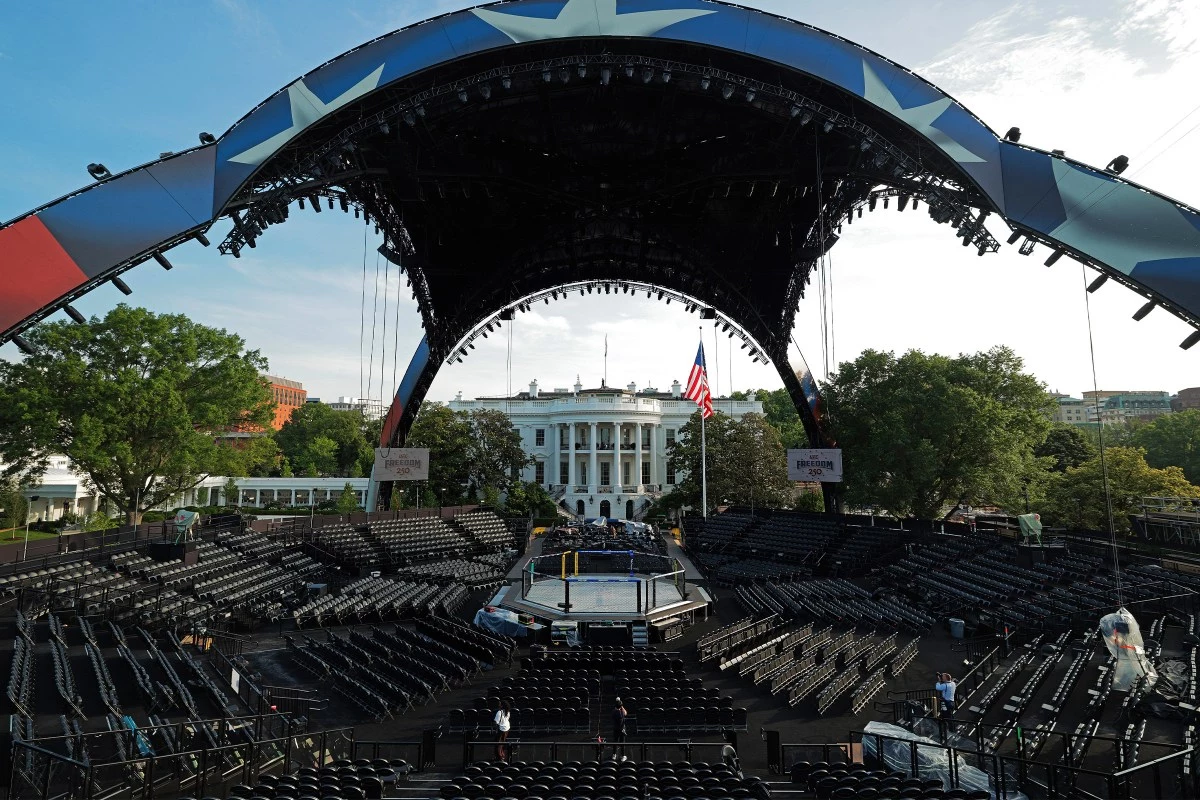

A National Mall UFC spectacle meets the realities of extreme heat and modern risk
Plans by former President Donald Trump and UFC CEO Dana White to stage a marquee Ultimate Fighting Championship event on the National Mall—timed to the United States’ 250th-anniversary celebrations—place a distinctly contemporary form of entertainment at the symbolic center of American civic life. The choice is already culturally and politically charged: an MMA card on the Mall departs from the more traditional optics of baseball, basketball, parades, or historical commemorations. Yet the most immediate variable is neither ideology nor aesthetics—it is weather.
A severe heat advisory projecting a heat index near 107°F reframes the event from a bold outdoor showcase into a high-stakes operational test. Washington, DC’s urban heat dynamics—dense surfaces, limited shade, and high humidity—can turn iconic public space into a physiological stressor for athletes, staff, and tens of thousands of spectators. The backdrop is not an isolated anomaly: May was the nation’s second-hottest on record, reinforcing that climate volatility is no longer a seasonal footnote but a planning constraint.
For the UFC, the setting also collides with organizational precedent. Combat sports are unusually sensitive to environmental conditions, and the promotion has historically avoided open-air venues for good reason: heat, wind, glare, and insects can affect performance, safety, broadcast quality, and officiating. Its only prior open-air experiment—Abu Dhabi in 2010—became a cautionary case study, with reported temperatures around 108°F, humidity, and environmental distractions testing both fighters and production teams. The National Mall proposal effectively asks whether today’s event technology, medical protocols, and risk financing can make what was once exceptional feel routine.
The operational playbook: cooling infrastructure, biometrics, and broadcast-grade control
Outdoor MMA at extreme heat is not simply “an event with extra water.” It is a systems problem spanning sports medicine, temporary infrastructure, and real-time decisioning. Traditional arena HVAC is replaced by a patchwork of rapid-deployment solutions that must work at scale and under scrutiny.
Key operational requirements likely to define success or failure include:
- Environmental control at ground level
– Portable shade structures, reflective coverings, and strategically placed cooling corridors
– Misting stations and high-volume fans designed to avoid creating slippery surfaces or visibility issues
– Heat-mitigation zoning for queues, concessions, and security checkpoints—where crowd density amplifies risk
- Athlete and workforce health monitoring
– Real-time biometric tracking (heart rate, skin temperature proxies, hydration indicators) to flag early heat stress
– Medical staffing models that assume higher incidence of dehydration, syncope, and heat exhaustion
– Clear stop/go thresholds for bout pacing, warm-up timing, and recovery windows
- Production and officiating integrity
– Lighting and glare management for cameras and judges
– Wind and ambient noise planning for audio capture and referee communication
– Contingency protocols for sudden weather shifts that impact canvas traction and fighter footing
Notably, public commentary—including concerns voiced by prominent MMA voices such as Joe Rogan—adds a reputational layer: if influential insiders frame the event as medically precarious, organizers must counter with visible, credible safeguards rather than generic assurances. In an era of instant clips and viral narratives, operational competence becomes part of the storyline.
Sponsorship, insurance, and the economics of climate-resilient live events
The business case for a National Mall UFC card is easy to sketch: a surge of visitors can lift hotels, restaurants, transportation, and media activity across the DC metro area. But extreme heat changes the margin structure. Cooling equipment, additional medical coverage, and enhanced emergency planning are not optional add-ons; they are core costs that can materially reshape profitability and municipal burden.
From a commercial standpoint, the event also becomes a sorting mechanism for sponsors:
- Brands built around ruggedness and intensity may see upside in the spectacle and its cultural signaling.
- More risk-sensitive categories—financial services, healthcare, family-oriented consumer brands—may weigh the reputational exposure of being adjacent to a heat-related incident.
The insurance dimension is equally consequential. Underwriters will scrutinize:
- Heat-related liability and potential exclusions for heat stroke or crowd-management failures
- The adequacy of medical response times and evacuation routes on a high-security, high-density federal landscape
- Whether promoters can demonstrate a defensible, data-driven safety plan rather than discretionary judgment calls
This is where technology and finance begin to converge. A plausible next step for the broader live-events market is bundled risk-management offerings: insurance paired with on-site telemedicine, AI-assisted triage alerts, and standardized heat protocols. If the UFC can operationalize such a model under the brightest possible spotlight, it could become a template for festivals, outdoor concerts, and major civic gatherings facing similar climate pressures.
Political resonance: spectacle as narrative control—and the downside of a single incident
Staging a UFC event as part of America’s semiquincentennial programming is not politically neutral, even if the fights themselves are not partisan. The choice signals a preference for spectacle-driven patriotism, aligning national celebration with a modern, confrontational entertainment form that resonates with certain audiences and unsettles others. For Trump, the optics can function as a high-visibility proxy for leadership branding—decisive, unconventional, and culturally combative—particularly as he seeks to consolidate support around a potential second term.
Yet the same visibility magnifies downside risk. If the event proceeds smoothly, proponents can frame it as proof that large-scale outdoor programming can be executed decisively even under pressure. If there is a heat-related medical crisis—fighter, staff, or spectator—the narrative can invert instantly into a critique of political theater overriding public safety.
The deeper significance is that this UFC-on-the-Mall proposal captures a broader shift in the business of public events: climate conditions are becoming a first-order strategic variable, not an operational footnote. The organizations that thrive will be those that treat heat, air quality, and weather volatility as design constraints—engineering resilience into everything from scheduling and site selection to insurance structures and real-time health monitoring. On the National Mall, that evolution won’t be theoretical; it will be tested in full view.

 By
By
 By
By
 By
By
 By
By
 By
By


 By
By







