
A new kind of destination infrastructure taking shape in Jackson Park
The emerging 19.3-acre Obama Presidential Center campus in Chicago’s Jackson Park is being positioned as more than a commemorative site. Its most immediate public-facing feature—one of the region’s largest outdoor playgrounds—signals a deliberate shift in how major civic institutions compete for attention, trust, and repeat visitation in an era defined by the experience economy.
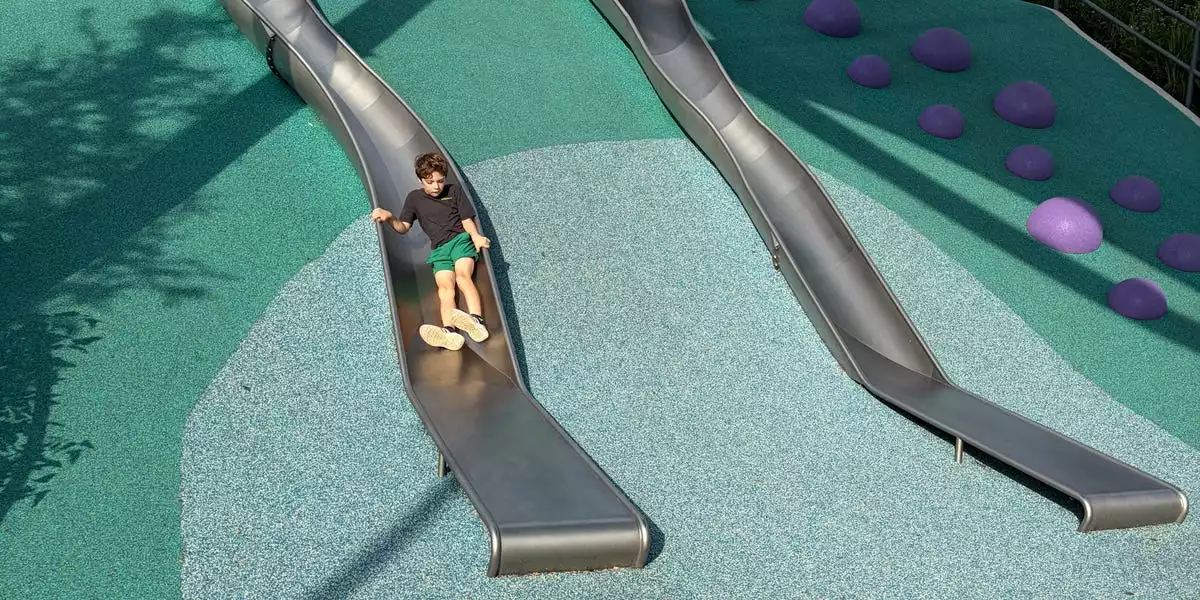
Designed for children ages 2–12, the playground is organized into distinct zones that encourage both imaginative play and physical challenge. Whimsical elements such as a giant frog structure, a sandbox, and a multi-level “climbing forest” connected by ramps, nature trails, and dual slides create a setting that feels closer to a curated attraction than a conventional neighborhood park. That matters economically: destinations that blend recreation, learning, and social gathering tend to increase dwell time, and dwell time is the currency that supports surrounding retail, dining, and service ecosystems.
The campus’s adjacency to established anchors—the Griffin Museum of Science and Industry and the Garden of the Phoenix—further strengthens the area’s “family itinerary” potential. For local businesses and the city’s tourism calculus, this clustering effect can be as important as the playground itself, turning a single visit into a multi-stop day and making Jackson Park a more reliable node in Chicago’s cultural map.
Placemaking with measurable spillovers: foot traffic, local commerce, and neighborhood confidence
Large-scale social infrastructure projects increasingly function as economic catalysts, not only through construction and staffing but through the steady, compounding effects of visitation. The Obama Presidential Center’s integrated approach—playground, gardens, historical artifacts, and public amenities—illustrates a blended model of cultural tourism plus neighborhood engagement.
From a business and urban-development lens, several mechanisms are at work:
- Anchor-driven foot traffic: A high-quality, family-oriented destination draws repeat visitors across seasons, supporting nearby commerce and informal micro-economies (food vendors, local services, event-related spending).
- Property-value stabilization dynamics: While outcomes vary by neighborhood and policy context, high-amenity public assets often contribute to perceived neighborhood stability—an important factor for long-term investment decisions.
- Expanded “time-on-site” behavior: Amenities such as shaded seating, picnic tables, and communal grills encourage longer stays, which can translate into more spending in the surrounding area and stronger community attachment.
At the same time, the project’s early feedback underscores a practical truth about destination placemaking: operational details can shape public perception as much as architectural ambition. Visitors have noted limited swing capacity, supervision challenges on bi-level terrain, and sparse natural shade—factors that can influence whether families view the site as effortless and safe, or as logistically demanding. These are not minor concerns; they affect repeat visitation, which is the foundation of sustained economic spillover.
Inclusive design and sustainable landscaping as a modern civic standard
One of the most consequential aspects of the playground is its emphasis on accessibility. Smooth surfaces that accommodate strollers and wheelchairs, tiered play areas, and navigable ramps reflect a broader shift toward universal design in public space—an approach that treats accessibility not as a compliance requirement but as a baseline expectation for civic legitimacy.
The campus also integrates native gardens, pollinator-friendly landscaping, and curated historical artifacts, aligning the site with contemporary priorities in urban resilience and biodiversity. For city planners and institutional developers, this is increasingly a reputational and operational advantage:
- Native plantings can reduce long-term maintenance costs while supporting local ecosystems.
- Pollinator habitats provide visible, teachable sustainability features that can be integrated into school programming.
- Perceived environmental stewardship strengthens public trust, particularly when paired with tangible amenities like hydration stations and clean restrooms.
Yet sustainability is also about comfort and climate adaptation. The reported lack of natural shade highlights a key design tension in many new public spaces: early-stage landscaping can take years to mature, while heat and sun exposure are immediate. If the campus aims to maximize equitable access—especially for younger children and caregivers—canopy strategy becomes not just an aesthetic choice but a usability requirement.
Strategic philanthropy, brand equity, and the next digital layer of civic experience
The Obama Foundation’s role points to a growing model in civic development: brand-driven institution building that mobilizes philanthropic capital, cross-sector partnerships, and community buy-in around a highly legible public asset. In this framework, the “return” is not only symbolic. It can be evaluated through social ROI: youth engagement, educational programming, workforce pathways, and neighborhood vitality.
A notable emerging opportunity is the potential for technology-enabled visitor insights—a layer not yet central to the physical experience but increasingly common in high-traffic public destinations. If implemented thoughtfully and transparently, tools such as:
- IoT sensors to measure footfall, congestion points, and environmental conditions
- Real-time operations dashboards to optimize staffing, maintenance, and safety coverage
- Mobile wayfinding and accessibility routing for families and visitors with mobility needs
- Augmented reality (AR) overlays that animate historical artifacts, ecology, or engineering concepts behind play structures
could help the campus evolve into a living laboratory for data-informed public space management. The strategic value is twofold: better operations (cleanliness, safety, resource allocation) and richer programming (STEM learning, historical storytelling, ecological literacy). The key will be governance—clear privacy standards, minimal friction for visitors, and a focus on public benefit rather than novelty.
What’s taking shape in Jackson Park is, at its core, a prototype for 21st-century civic infrastructure: inclusive play as a gateway to culture, sustainability, and local economic energy. The institutions that learn to measure, iterate, and operationalize that blend—without losing the human simplicity that makes public space feel welcoming—will define the next generation of landmark development.

 By
By
 By
By
 By
By
 By
By

 By
By