

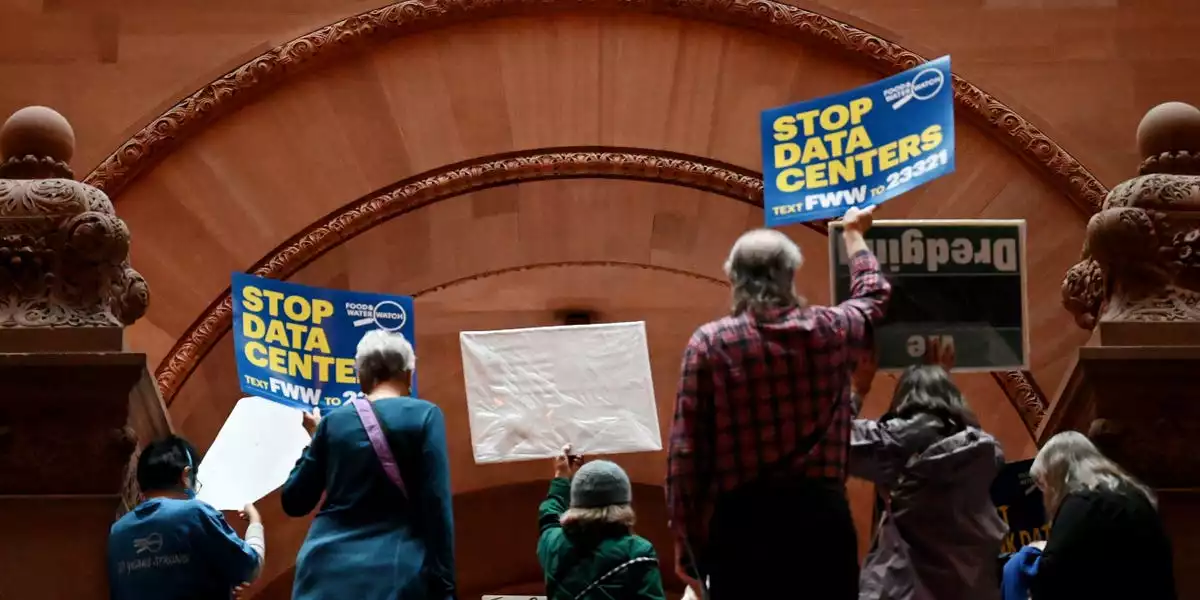

Data centers move from infrastructure footnote to frontline ballot issue
A wave of more than 200 data center projects is no longer just a story about cloud capacity and real estate—it is rapidly becoming a defining local issue in nearly 40 of the 69 most competitive U.S. House districts. What makes this moment politically unusual is the collision of two truths that are both hard to dispute: the United States is in a global race to scale AI compute, and the physical footprint of that compute—power lines, substations, water systems, diesel backups, land conversion—shows up in very tangible ways for nearby communities.
For years, data centers were often welcomed as quiet economic development wins: construction jobs, some permanent roles, and a perception of “clean” industry. The current cycle looks different. Residents and local officials are increasingly framing new campuses as high-intensity industrial loads that can reshape utility planning, strain water resources, and alter land use—while delivering benefits that may feel diffuse or unevenly distributed.
That shift in perception is now being translated into campaign messaging and legislative proposals, with bipartisan interest in restricting, pausing, or more tightly regulating new builds. The result is a novel political test: candidates must reconcile national competitiveness and security narratives with ratepayer anxiety and local environmental concerns.
AI compute demand is rewriting the rules of grid planning and site selection
At the center of the controversy is a technical reality: modern AI—especially generative AI training and inference at scale—drives unprecedented power density and near-continuous demand. Unlike many traditional commercial loads, large data centers can behave like always-on factories for computation, creating planning challenges for utilities and regional transmission organizations.
Key technology and infrastructure dynamics shaping the debate include:
- Siting near low-cost and available power: Developers increasingly target regions where energy is cheaper or where generation already exists—often rural areas with legacy fossil assets, new renewables, or available land for substations and transmission interconnects.
- Edge versus hyperscale trade-offs:
– Hyperscale campuses offer economies of scale and operational efficiency, but they can concentrate environmental and grid impacts in a single locality.
– Edge deployments can reduce latency and potentially ease long-distance transmission needs, yet they may proliferate smaller facilities across more communities—broadening the political footprint rather than shrinking it.
- Grid modernization as both opportunity and risk: The influx of large “anchor loads” can justify investments in transmission upgrades, utility-scale battery storage, and demand-response programs. But without coordinated planning, communities may see the downside first—interconnection bottlenecks, delayed upgrades, or reliance on diesel generators that undercut decarbonization goals and worsen local air-quality concerns.
This is where the technical story becomes political. If residents perceive that grid upgrades are being built “for the data center,” while households face higher bills or reliability worries, opposition can harden quickly. Conversely, if utilities and developers can credibly show that data center-driven investments improve resilience for everyone—storm hardening, new substations, modernized distribution—public sentiment can shift from resistance to conditional acceptance.
Local backlash, utility-rate anxiety, and the emerging regulatory patchwork
Grassroots opposition is coalescing around a consistent set of themes: electricity costs, water usage, land conversion, and community voice. The politics are complicated by the fact that the benefits and burdens of data centers are often asymmetrical:
- Costs are immediate and visible: new transmission corridors, construction disruption, water draw concerns, and the fear of utility-rate hikes.
- Benefits can feel abstract: “AI leadership,” “cloud capacity,” and even national security arguments may not resonate as strongly as monthly bills and local land-use change.
- Tax incentives and abatements can backfire: when communities see public subsidies attached to projects perceived as resource-intensive, the incentive structure itself becomes a target.
The absence of a coherent national framework has created a regulatory vacuum filled by local moratoriums, state-level incentive packages, and ad hoc permitting battles. For developers and investors, this fragmentation introduces uncertainty into timelines and financing. For communities, it can feel like a reactive scramble—trying to write rules after projects are already in motion.
Politically, both parties are finding usable angles. Some candidates emphasize consumer protection and local control; others stress innovation, jobs, and strategic competition. Yet the more the issue is “weaponized,” the more it risks becoming a proxy fight over “big tech,” even when the underlying drivers include enterprise IT, government workloads, and broader digitization beyond consumer platforms.
What stakeholders will need to prove to earn durable permission to build
The next phase of the U.S. data center boom will be shaped less by raw demand and more by social license, grid integration discipline, and financing standards. Several strategic implications stand out:
- Developers and hyperscalers must operationalize community benefit: not as a press release, but as measurable commitments—transparent impact assessments, water stewardship plans, and credible pathways to mitigate rate impacts. Community benefit agreements may become a de facto requirement in contested districts.
- Utilities can reposition data centers as grid underwriters: If structured with clear cost allocation and public accountability, large loads can help finance upgrades that improve reliability for all customers. Without that clarity, the “ratepayer subsidy” narrative will persist.
- Policy is likely to move toward standards, not blanket bans: Expect momentum for frameworks that specify energy-efficiency thresholds, carbon-intensity reporting, water recycling expectations, and backup generation limits, rather than outright prohibitions that could collide with economic development goals and national security priorities.
- ESG and capital markets will tighten the screws: As sustainable finance criteria evolve, lenders and investors may demand stronger proof on water circularity, zero-carbon power procurement, and local impact mitigation—turning community and environmental performance into a cost-of-capital variable.
The political signal to watch is not simply whether projects are approved, but *how* they are approved: with negotiated safeguards and grid commitments, or through polarizing fights that invite copycat resistance. In a midterm environment where a handful of districts can decide control of Congress, the data center has become something rare in modern politics—an advanced technology story that voters can see from their back porch, and one that will increasingly determine where America’s AI future is allowed to physically exist.

 By
By
 By
By
 By
By

 By
By


 By
By







