

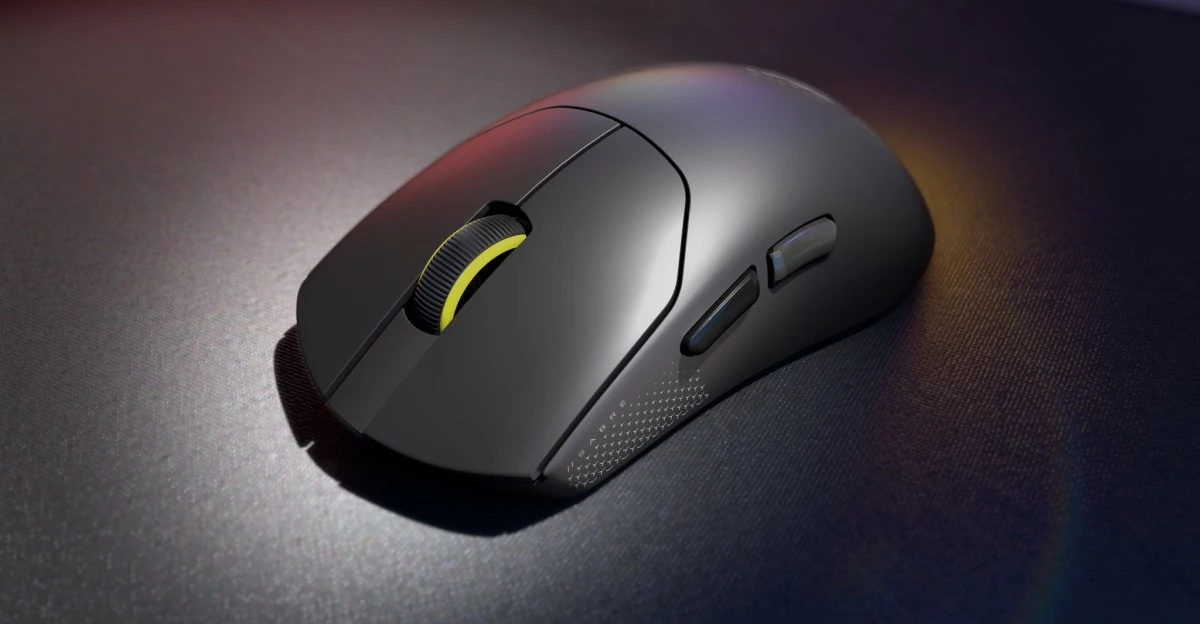

The Ultralight Revolution: Redefining the Gaming Mouse and Beyond
Corsair’s launch of the Sabre V2 Pro Ultralight Wireless gaming mouse marks a watershed moment not just for esports enthusiasts, but for the broader world of human-computer interaction. At 36 grams—nearly a third lighter than its closest mainstream rival—the Sabre V2 Pro is a feat of engineering that signals the dawn of a new era in device design, where every gram saved is a deliberate act of technological and strategic intent.
Engineering at the Edge: Materials, Power, and Latency
The relentless pursuit of weight reduction in the Sabre V2 Pro is more than marketing bravado. It is a masterclass in advanced polymer chemistry, internal ribbing geometries, and the artful miniaturization of PCB layouts. At this vanishingly low mass, Corsair is operating at the very threshold of what current composite plastics can endure before structural integrity is compromised—a proof point not just for gaming peripherals, but for the future of lightweight IoT devices and wearables.
Yet, the quest for lightness does not come at the expense of control. The inclusion of modular grip tape is a quiet acknowledgment that the tactile bond between user and device remains sacrosanct. The industry is moving beyond the binary of “lighter is better,” toward a philosophy of mass-tailored ergonomics.
Under the hood, a 210 mAh battery delivers up to 70 hours of operation at a standard 1 kHz polling rate, or 16 hours at a blistering 8 kHz—where input lag is shaved to a mere 0.125 milliseconds. This is not just a number for spec sheets; it is a harbinger of wireless peripherals that can rival, and even surpass, their wired ancestors. For applications in untethered AR/VR or edge robotics, where sub-millisecond closed-loop control is non-negotiable, these advances are foundational.
Browser-Native Configurators: The Cloud Comes to the Desktop
Perhaps the most quietly radical innovation is Corsair’s shift to a browser-based configurator. This is more than a nod to convenience or cross-platform compatibility. It is a strategic pivot toward “peripheral-as-a-service”—where device management, firmware updates, and even feature upsells are decoupled from the tyranny of locally-installed software. The implications are profound:
- Instantaneous updates and telemetry: Devices become living endpoints, capable of evolving with user needs and feeding back valuable usage data.
- Vendor lock-in migrates: No longer tethered to hardware, the ecosystem now orbits around accounts and cloud services—a playbook borrowed from the SaaS world.
- Compliance and privacy: As peripherals begin to report home from sensitive environments, questions of data sovereignty and regulatory compliance will move to the fore.
For manufacturers and their partners, this is a clarion call to invest in modular, browser-native firmware platforms that can keep pace with rapid hardware iteration and shifting user expectations.
Economic Realities and Strategic Spillovers
At $99.99, the Sabre V2 Pro is deftly positioned to capture the premium segment without encroaching on the flagship pricing territory of competitors like Logitech and Razer. This is a calculated move in a market where, despite stagnating PC shipments, the esports and creator economies continue to expand at a healthy clip. High-performance peripherals remain insulated from broader consumer-electronics headwinds, buoyed by a user base that prizes even marginal gains in responsiveness and comfort.
Yet, the ultralight segment is acutely sensitive to global supply chain volatility. Fluctuations in plastics and lithium pricing can have outsized impacts, given the razor-thin margins for weight and material substitution. Component suppliers are thus incentivized to develop ultra-low-power microcontrollers with integrated radios, and to pioneer composite materials that balance rigidity with recyclability—a nod to the growing importance of sustainability in investor and regulatory calculus.
The innovations powering the Sabre V2 Pro are not confined to gaming. Sub-40 gram actuation mechanisms and low-latency wireless stacks are already finding relevance in surgical robotics, drone piloting, and telepresence haptics. The gaming market, in effect, is underwriting R&D for a host of adjacent sectors where precision and responsiveness are paramount.
The Next Interface Frontier: Data, Design, and Differentiation
Corsair’s latest release is more than a product—it is a signal flare for the future of interface devices. As browser-native configurators and cloud telemetry become standard, the line between hardware and service blurs. The real prize lies in the ability to monetize not just the device, but the data and behaviors it enables—without crossing the thin line into privacy overreach.
For decision-makers across the value chain, the lesson is clear: the next wave of value creation will come to those who see beyond the object in hand, to the ecosystem it inhabits and the data it generates. The Sabre V2 Pro is not just a mouse—it is a harbinger of how we will touch, control, and understand our digital worlds.

 By
By
 By
By

 By
By
 By
By

 By
By
 By
By







