

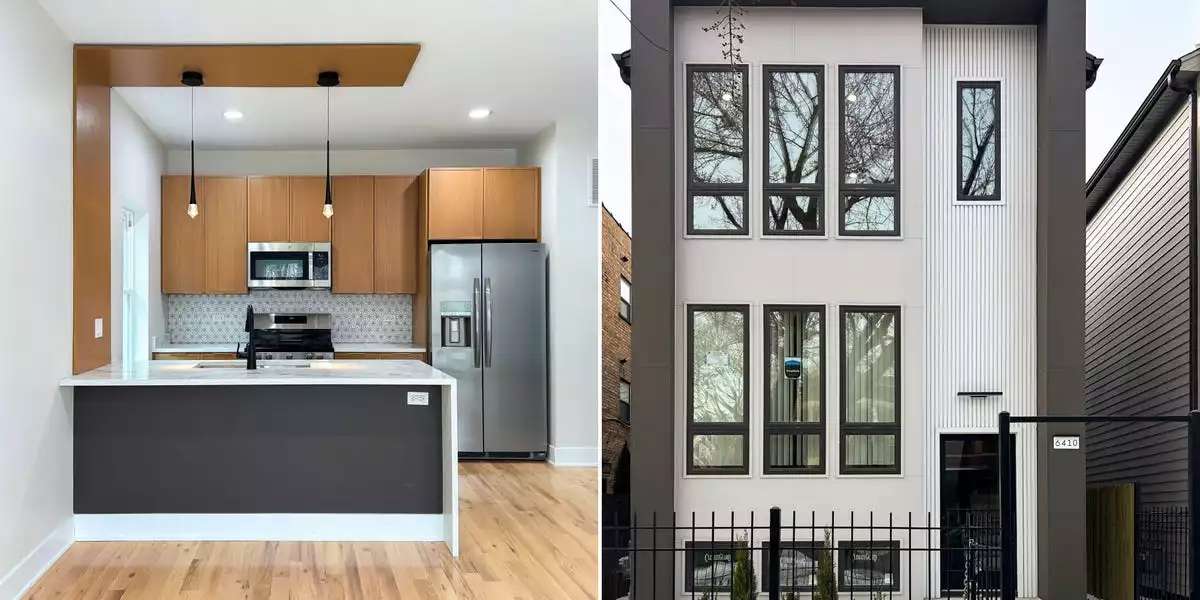

A rent check that buys radically different urban lives
A single data point can sometimes illuminate a structural reality more clearly than a spreadsheet. A Business Insider reporter paying $2,200 per month for a 650-square-foot, one-bedroom in Queens—notably without an oven, in-unit laundry, or adequate storage—found that the same monthly budget in Chicago’s Woodlawn could secure a 1,400-square-foot, three-bedroom with a full modern kitchen, two marble-finished bathrooms, in-unit laundry, a walk-in closet, parking, and nearby retail.
This is not merely a lifestyle contrast; it is a market signal. Average rents reinforce the gap: Queens at roughly $3,486/month versus Chicago around $1,976/month. The anecdote functions as a practical demonstration of how housing affordability, amenity access, and household financial flexibility diverge across U.S. metro areas—even when renters bring the same nominal purchasing power to the table.
For business leaders, investors, and policymakers, the underlying question is not whether New York is expensive and Chicago is cheaper—that is well known. The sharper issue is how these differences reshape labor mobility, consumer spending, technology adoption in housing, and capital allocation across the urban hierarchy.
Why New York’s scarcity premium persists while Chicago’s value proposition endures
The Queens-versus-Woodlawn comparison sits at the intersection of supply constraints and urban economics. New York City’s housing market continues to exhibit a scarcity premium driven by a combination of structural and regulatory factors:
- Zoning and permitting friction: In built-out neighborhoods, adding units is slow, politically contested, and expensive—raising the “all-in” cost of new supply.
- High land and construction costs: Even when development is feasible, the land basis and labor costs tend to push projects toward higher rents to pencil out.
- Legacy building stock: Many units are older, with layouts and mechanical systems that make upgrades (like in-unit laundry or modern electrical capacity) costly or impractical.
Chicago, by contrast, often offers a different set of fundamentals—especially in neighborhoods outside the most premium corridors:
- More elastic supply conditions: Greater availability of developable or adaptable space can translate into larger unit sizes and more amenities at comparable rents.
- Lower cost basis: Land and construction costs can be meaningfully lower, enabling developers and landlords to compete on space and features.
- Neighborhood-by-neighborhood pricing: Chicago’s rent landscape is more variegated, allowing renters to “trade” proximity to the highest-demand districts for substantial gains in size and finish.
The economic implication is straightforward: the same rent payment can generate dramatically different consumer surplus. A household spending $2,200 in Chicago may free up budget for other categories—childcare, mobility, healthcare, or discretionary services—while a Queens renter may experience a tighter consumption basket, with knock-on effects for local retail and service ecosystems.
PropTech, smart buildings, and the new transparency of cross-market arbitrage
What makes this moment distinct from past affordability debates is the role of technology in accelerating awareness and action. Renters no longer need insider knowledge to compare markets; they can run cross-city comparisons in minutes. Platforms aggregating rent and amenity data—such as Zillow, Zumper, and broker analytics stacks—have turned housing into a more legible, searchable product.
That transparency enables a form of cross-market arbitrage: renters (and increasingly remote workers) can benchmark what their budget buys elsewhere and make relocation decisions with greater confidence. This has several second-order effects:
- Pricing pressure and amenity bundling: In high-cost markets, landlords may be pushed to justify premiums through better service, renovations, or bundled amenities—where feasible.
- Rising expectations for digital building operations: Newer or recently renovated properties in markets like Chicago often include smart thermostats, efficient appliances, and app-based package or access systems. These features are becoming baseline expectations rather than luxuries.
- A widening retrofit divide: Older buildings in dense, high-cost areas can struggle to modernize. The result is a technological gap in tenant experience: not just square footage, but quality-of-life infrastructure (laundry, storage, climate control, delivery management) that shapes daily friction.
For PropTech providers, this divergence creates a two-track opportunity: tools that help newer buildings optimize operations and tenant experience, and retrofit-oriented solutions that help legacy stock compete without full gut renovations.
Strategic implications for employers, investors, and city policymakers
The Queens-to-Woodlawn contrast lands squarely in boardrooms because housing is no longer a background variable in talent strategy. It is a primary driver of recruitment, retention, and compensation expectations—especially in hybrid and remote-eligible roles.
For employers and HR leaders, the emerging playbook increasingly includes:
- Location-economics analytics: Using geo-spatial and demographic tools to model how cost of living affects attrition risk, productivity, and employee satisfaction.
- Compensation recalibration: Pressure is rising to either subsidize housing in high-cost metros or preserve flexibility so employees can relocate without career penalty.
- Distributed footprint planning: Site selection is becoming more dynamic, with secondary markets offering compelling combinations of affordability and access to talent.
For real estate investors and REITs, the narrative aligns with capital flows already underway:
- Secondary-market allocation: Midwestern and Sun Belt markets can offer attractive cap-rate spreads and clearer paths to value-add upgrades.
- Amenity modernization as alpha: Upgrading kitchens, baths, HVAC, and digital building systems can capture demand from renters priced out of coastal cores.
- Adaptive reuse and modular strategies: Office-to-residential conversions and prefab/modular construction can shorten timelines and improve feasibility—particularly where demand is rising but traditional development is slow.
For policymakers, the lesson is less about rivalry between cities and more about the consequences of constrained supply. When high-demand metros cannot add housing at scale, the market response is predictable: households either pay more for less, or they leave. Over time, that dynamic influences tax bases, commuting patterns, and the geography of innovation.
The most telling aspect of the reporter’s apartment tour is that it frames affordability not as an abstraction, but as a measurable trade: space, amenities, and modern living systems on one side; proximity and prestige on the other. As data platforms sharpen comparisons and hybrid work preserves mobility, that trade-off is becoming one of the defining economic decisions for urban professionals—and a competitive variable for the cities and companies that want to keep them.

 By
By
 By
By

 By
By


 By
By
 By
By







