


A prestige adaptation that chooses clarity over contradiction
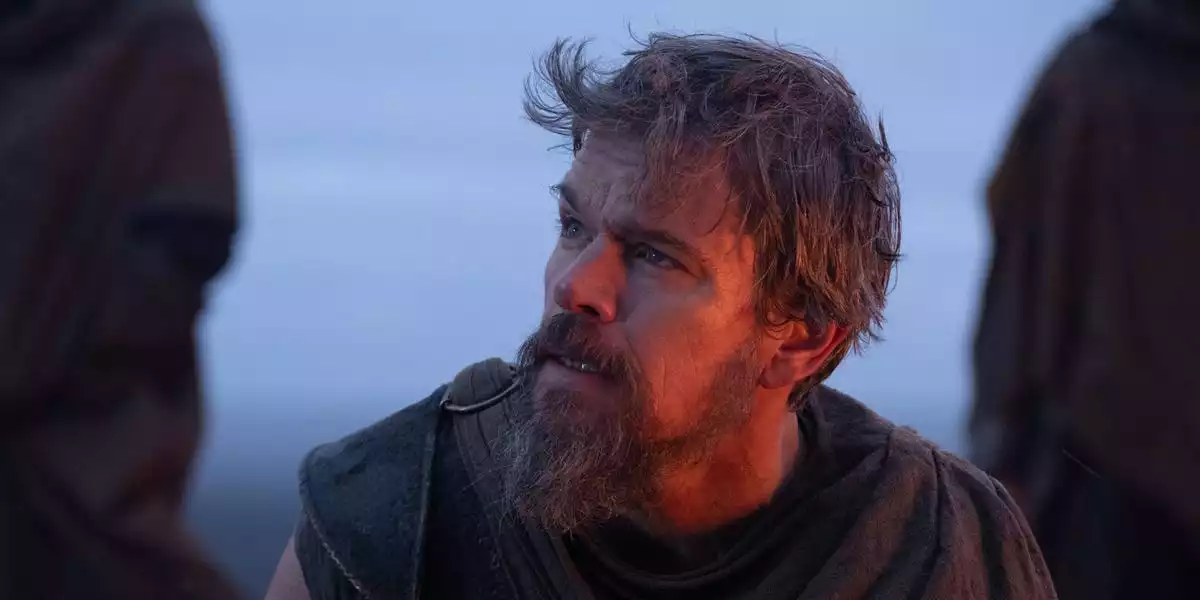
Christopher Nolan’s film adaptation of Homer’s “The Odyssey”, with Matt Damon as Odysseus, arrives carrying two kinds of expectations: the cultural weight of a foundational Western epic and the commercial pressure attached to a modern tentpole release. The movie signals awareness of contemporary scholarship by opening with a nod to Emily Wilson’s translation—the idea of Odysseus as “a complicated man.” Yet the adaptation’s most consequential creative decision is to treat that complexity as a rhetorical flourish rather than a governing principle.
What emerges is a version of Odysseus that is sanitized and morally unambiguous, a hero engineered for broad identification. The epic’s defining tensions—hubris versus survival, cunning versus cruelty, devotion versus desire—are softened into a more legible arc of perseverance and righteousness. Several key episodes are reframed to reduce moral friction:
- The Cyclops encounter is presented less as a study in pride and provocation and more as a straightforward trial of courage.
- The sojourn with Calypso, traditionally charged with questions of agency, temptation, and responsibility, is minimized or reinterpreted to protect the protagonist’s moral coherence.
- The vengeance against Penelope’s suitors, one of the poem’s most ethically volatile sequences, is either omitted or rendered less ruthless, reducing the sense that homecoming comes at a psychological cost.
This is not merely a literary critique; it is a strategic one. In the current global entertainment market, moral ambiguity can be perceived as risk—harder to market, easier to misread, and less compatible with four-quadrant positioning. Nolan’s “Odyssey” appears to choose narrative accessibility over the unsettling power that has kept the source material alive for millennia.
The technology stack behind “event cinema” in the IMAX era
Nolan’s brand is inseparable from the theatrical experience, and “The Odyssey” reinforces that identity through a production philosophy that privileges large-format cinematography, IMAX presentation, and practical effects. For exhibitors, this is not aesthetic preference—it is competitive differentiation. A film designed for premium screens gives theaters something streaming platforms cannot fully replicate: scale, resolution, and communal immersion.
At the same time, the subject matter—storms at sea, mythic creatures, and expansive environments—makes it difficult to imagine a purely in-camera solution. Even if Nolan’s public posture remains skeptical of overreliance on digital tools, the likely reality is a hybrid production pipeline: practical photography as the foundation, with advanced VFX used to extend the world.
Early indicators point toward a post-production model increasingly common across the industry: AI-augmented visual effects that accelerate labor-intensive steps without eliminating human authorship. In practice, that can mean:
- Faster rotoscoping, compositing, and cleanup workflows
- AI-assisted creature animation and motion refinement
- More efficient iteration cycles that reduce rework and compress schedules
For studios, the significance is economic as much as technical. AI tooling—when deployed responsibly—can help contain costs on films whose spectacle demands would otherwise inflate budgets beyond sustainable thresholds. For the workforce, it intensifies the ongoing negotiation over credit, craft boundaries, and what “authorship” means when machine learning becomes embedded in the pipeline.
The $200M calculus: global appeal, brand safety, and ancillary revenue
With an estimated production cost north of $200 million, “The Odyssey” exemplifies the modern studio dilemma: how to justify blockbuster spend in an era of fragmented attention and inflation-sensitive consumers. One answer is to reduce narrative risk. A PG-13-friendly hero with a clean moral arc is easier to sell internationally, easier to localize, and less likely to trigger cultural backlash or ratings constraints that narrow the audience.
That choice also aligns with the film’s broader monetization strategy. A streamlined protagonist is more compatible with brand partnerships and merchandise, expanding revenue beyond box office into a portfolio of ancillary streams. The reported ecosystem—action figures, VR experiences, and educational licensing tied to classical literature—illustrates how public-domain IP can be industrialized when packaged for contemporary consumption.
From a business perspective, the adaptation functions as a platform, not a one-off. The logic resembles the franchise playbooks of gaming and serialized publishing:
- Establish a recognizable, broadly palatable baseline
- Build transmedia extensions that reinforce the “official” version of the story
- Keep tonal edges smooth to maximize partnership compatibility
Yet this approach carries a trade-off. The more the film optimizes for mass resonance, the more it risks flattening what differentiates the property in the first place. For a segment of the audience—educators, classicists, and viewers drawn to moral complexity—the simplification may feel less like adaptation and more like brand management.
What Nolan’s “Odyssey” signals for streaming windows, IP strategy, and next-gen storytelling
Beyond the creative debate, the release operates as a case study in how distribution technology and contractual frameworks are evolving. Studios increasingly blend traditional theatrical windows with carefully timed digital availability, using premium formats and limited exclusivity to extract maximum value before titles migrate into PVOD and streaming ecosystems. Nolan’s theatrical emphasis strengthens the negotiating position of cinemas and may influence how future deals define digital rights, window lengths, and premium pricing.
Strategically, the film underscores a broader industry trend: IP simplification versus authenticity. Executives are betting that audiences under economic pressure will favor escapism and clarity over introspective ambiguity. That may be true in the aggregate—but it also opens space for differentiated offerings elsewhere. The most forward-looking opportunity may lie in tiered narrative experiences:
- A mass-market cinematic version optimized for scale and accessibility
- Premium, interactive adaptations—AR/VR or narrative games—that can reintroduce the epic’s ethical complexity without sacrificing engagement
If “The Odyssey” has survived as a story, it is because it refuses to resolve neatly: heroism and harm travel together, and victory rarely arrives without consequence. Nolan’s adaptation, whatever its artistic merits, reveals how today’s media economy often asks ancient myths to behave like modern brands—coherent, safe, and endlessly extensible. The industry will learn as much from what this film smooths over as from what it puts on the screen.

 By
By
 By
By
 By
By
 By
By
 By
By


 By
By







