

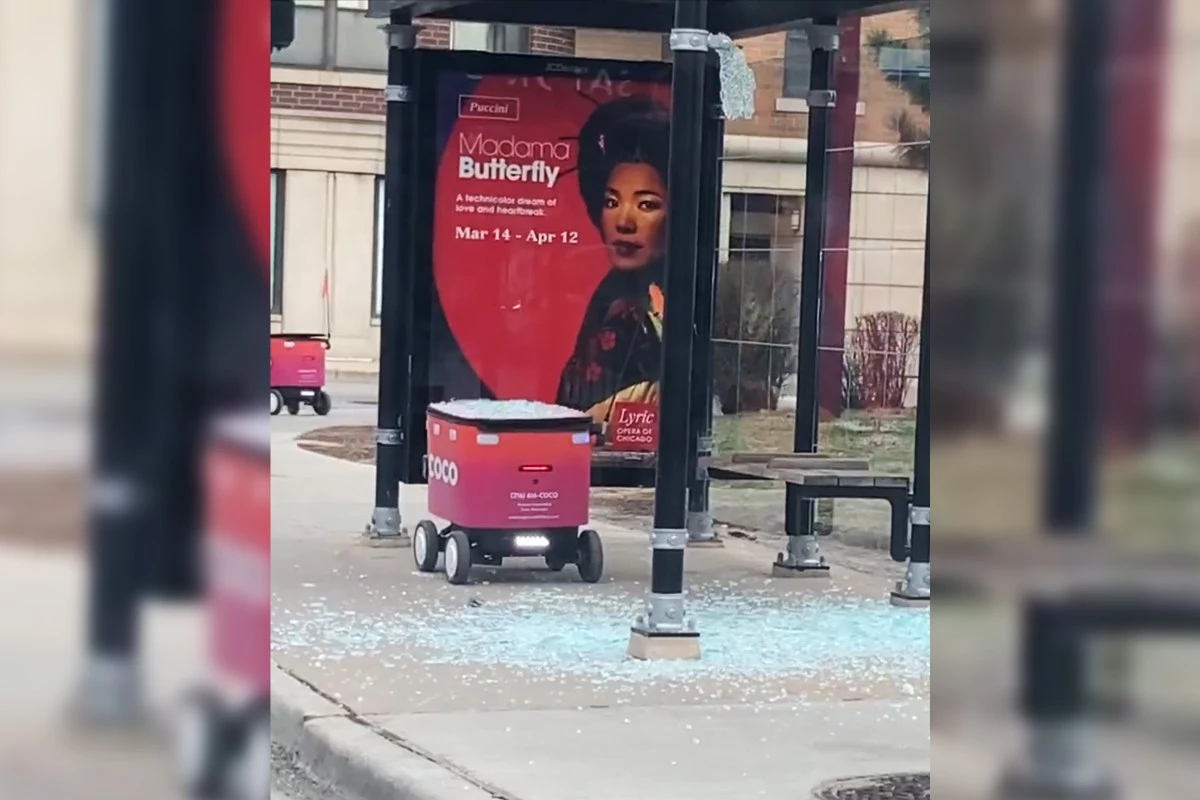

Chicago’s bus-shelter crashes expose the fragile social license of sidewalk autonomy
Two autonomous delivery robots—one operated by Serve Robotics and another by Coco—struck glass bus shelters on Chicago sidewalks within days of each other, scattering tempered glass across pedestrian routes and quickly becoming viral footage. Both companies have pledged internal safety reviews, with Coco characterizing its event as a “rare, isolated incident” and emphasizing a top speed of roughly five miles per hour.
Yet the public impact of these collisions is not measured in speed alone. Sidewalk robots operate in the most socially sensitive layer of the city: spaces shared by pedestrians, wheelchair users, parents with strollers, and commuters moving at human pace. When something goes wrong—especially in a way that looks visually dramatic on social media—the narrative can shift from “innovation” to “nuisance” overnight. In Chicago, that shift is amplified by existing political resistance, including an alderman’s earlier refusal to allow expansion in the city’s 1st Ward, a reminder that municipal acceptance is often the true gating factor for last-mile robotics.
For business and technology leaders, the takeaway is clear: operational safety is inseparable from public trust, and public trust is inseparable from the ability to scale.
The technical lesson: reflective, transparent infrastructure remains a hard autonomy problem
The Chicago incidents spotlight a persistent challenge in robotics perception: glass and reflective surfaces. Bus shelters combine transparency, glare, reflections, and changing lighting—conditions that can confound camera-based systems and even LiDAR under certain geometries and materials. These are not exotic edge cases; they are common features of modern streetscapes.
Key technical implications emerging from the crashes include:
- Perception limits around transparent/specular obstacles
Even mature navigation stacks can misclassify or under-detect glass, particularly when reflections mimic open space. This raises the premium on sensor fusion that goes beyond cameras and LiDAR, potentially incorporating radar (robust to weather and some reflective artifacts) or thermal imaging (useful for differentiating objects under low light), alongside improved probabilistic modeling.
- Simulation gaps between digital twins and sidewalk reality
Many autonomy programs rely on simulation to accelerate learning and reduce real-world risk. But urban sidewalks are dense with “corner cases”: shifting pedestrian flows, temporary signage, construction barriers, curb cuts, and micro-obstacles. The Chicago collisions reinforce that digital-twin fidelity must extend to stochastic, messy conditions—variable lighting, occlusions, and infrastructure materials—if simulation is to predict real-world performance.
- Mapping freshness and data integrity as safety-critical inputs
Sidewalk environments change quickly: new shelters, seasonal street furniture, pop-up construction zones. If map updates lag, robots can operate with stale situational awareness, increasing the chance of mislocalization or obstacle misinterpretation. Near-real-time update cycles, robust change detection, and conservative fallback behaviors become less like “nice-to-haves” and more like baseline safety requirements.
From a product standpoint, these events may accelerate a shift toward more conservative operational design domains (ODDs)—limiting routes, times of day, or weather conditions until perception reliability improves. That restraint can protect pedestrians, but it also constrains utilization, which directly affects unit economics.
Unit economics meet liability: why minor collisions can have major financial consequences
Sidewalk delivery robotics is often pitched as a solution to last-mile cost pressure—driver shortages, wage inflation, and the inefficiencies of short-distance urban drops. But the business model is sensitive to disruptions, and incidents that generate property damage and viral attention can ripple through the cost structure.
Several economic dynamics are now more salient:
- Capital intensity versus thin last-mile margins
Robots carry expensive hardware—sensors, compute, batteries—and require fleet operations, remote monitoring, and maintenance. When incidents occur, costs accumulate beyond repairs: downtime, investigation, software remediation, and potential fleet-wide retrofits. Over time, repeated mishaps can elevate insurance premiums and liability reserves, compressing already narrow margins.
- Public backlash intertwines safety and labor narratives
Even if robots are positioned as supplements to strained delivery capacity, public debate often frames them as job displacement. When safety incidents occur, opposition can consolidate: concerns about employment, accessibility, and sidewalk obstruction become mutually reinforcing. Companies may need to quantify not only labor savings but also new job categories created—fleet supervisors, field technicians, safety operators, community liaisons—to sustain political and community support.
- Municipal cost recovery and infrastructure policy risk
Cities may respond with fees, permits, usage caps, or mandates—potentially including requirements for sidewalk-usage rights, incident reporting, or even infrastructure modifications. Any move toward robotics lanes, shelter retrofits, or stricter compliance regimes would reshape route density assumptions and could favor operators with the scale to absorb regulatory overhead.
In practical terms, the Chicago crashes illustrate how a “low-speed” platform can still produce high-cost outcomes when it intersects with fragile public infrastructure and public attention.
Regulation and reputation become the competitive moat—and the bottleneck
The strategic center of gravity is shifting from pure engineering to governance, transparency, and coalition-building. Chicago’s pushback hints at a broader future: a patchwork of city-by-city rules that can stall national scaling even if the technology improves.
For operators and their enterprise partners, several strategic moves stand out:
- Treat regulation as a product surface, not an obstacle
Proactive engagement—co-developing safety standards, sharing anonymized incident data, and aligning on clear operating rules—can position a company as a credible long-term partner. In a world of municipal discretion, being seen as cooperative can be as valuable as a marginal gain in navigation accuracy.
- Adopt third-party validation early
The market is likely to demand independent audits and certification-style assurance, akin to practices in automotive and aerospace. Operators that embrace external validation—testing protocols, safety cases, and standardized reporting—may earn faster approvals and stronger commercial partnerships.
- Build trust with radical clarity after incidents
Viral videos are reputational accelerants. Companies that respond with specific, verifiable actions—root-cause explanations, software changes, operational restrictions, and measurable safety metrics—can reduce speculation and demonstrate maturity. Trust is not rebuilt through reassurance; it is rebuilt through observable controls.
- Use urban testbeds to de-risk deployment
Partnerships with universities and smart-city “living labs” can provide controlled environments to harden perception stacks, validate sensor fusion, and refine fail-safe behaviors without externalizing risk onto the general public.
The Chicago collisions may ultimately be remembered less as isolated operational failures and more as a forcing function: a moment when sidewalk robotics had to prove it can meet the city on the city’s terms—safe, accountable, and compatible with the shared human choreography of the sidewalk.

 By
By
 By
By
 By
By

 By
By
 By
By
 By
By
 By
By







