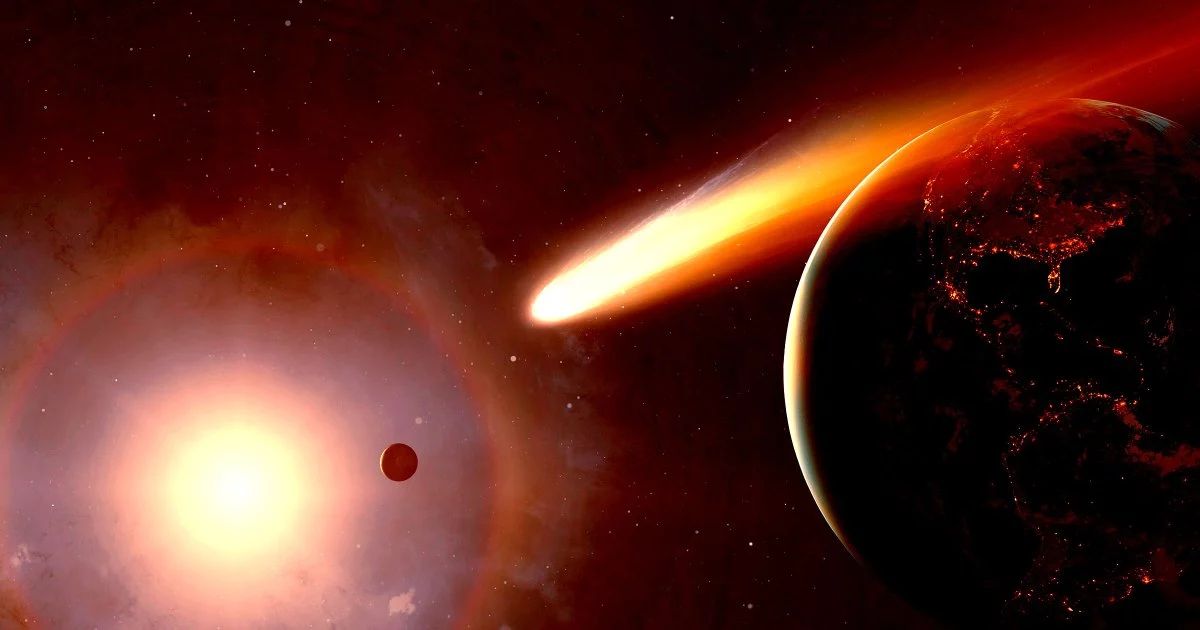

3I/ATLAS and the scientific urgency of fleeting interstellar chemistry
When 3I/ATLAS was first identified in July, it immediately joined a rare and strategically important class of targets: interstellar objects—bodies formed around other stars that briefly traverse our Solar System. What made 3I/ATLAS especially consequential was not merely its trajectory, but its measurable outgassing during perihelion in October, including ancient carbon dioxide (CO₂) and water vapor (H₂O). Those emissions function like a chemical time capsule, offering direct constraints on extrasolar planetary formation environments, volatile retention, and irradiation histories that cannot be reconstructed from remote exoplanet observations alone.
From a science perspective, the appeal is straightforward: interstellar visitors provide ground-truth samples of other planetary systems without requiring a multi-generational voyage to another star. Yet the same physics that delivers these objects to us also makes them difficult to study up close. Their high hyperbolic excess velocities compress decision timelines and force mission designers into a trade space where speed, thermal survivability, and communications become the dominant variables.
Key scientific value propositions associated with 3I/ATLAS-like objects include:
- Volatile inventories (CO₂, H₂O, CO, organics) that inform models of protoplanetary disk chemistry
- Isotopic ratios (where measurable) that can distinguish formation reservoirs and thermal processing
- Dust-to-gas behavior that reveals surface evolution under stellar irradiation and interstellar exposure
- Comparative planetology insights that complement exoplanet spectroscopy and meteorite studies
The central tension is that the most information-rich phase—perihelion activity—arrives quickly, while spacecraft development cycles remain measured in years.
The extreme mission design: Oberth maneuvers, Venus flybys, and refueled heavy lift
The proposed pathway to chase 3I/ATLAS underscores how interstellar interception pushes current engineering to its edges. Technically, a mission is described as feasible, but only by stacking multiple high-consequence techniques into a single architecture:
- A close solar pass to exploit the Oberth effect, where a high-thrust burn at maximum orbital speed yields disproportionate energy gain
- Sequential Venus gravity assists to reshape the trajectory and build heliocentric energy efficiently
- In-orbit refueling of a “Starship Block 3” variant, implying a mature tanker-and-depot ecosystem in low Earth orbit
This is not merely a propulsion problem; it is a systems problem. A perihelion burn demanding >5 miles per second of delta‑V near the Sun imposes punishing constraints on:
- Thermal protection systems (materials, coatings, possibly active cooling) under intense solar flux
- Autonomous navigation and fault management, because timing errors at perihelion are unforgiving
- Cryogenic propellant management, including boil-off control, transfer reliability, and standardized docking
The communications and operations burden grows even more stark at the mission’s far end. A rendezvous projected around 2085 at over 700 astronomical units (AU) would operate in a regime that dwarfs today’s deep-space experience—well beyond the heliosphere’s familiar boundaries and far past Voyager 1’s current distance. At those ranges, mission viability depends on next-generation capabilities such as:
- Deep-space optical (laser) communications to sustain data rates with limited power
- AI-driven autonomy to handle multi-day light-time delays and degraded real-time control
- Long-life power systems and radiation-tolerant avionics designed for multi-decade reliability
The engineering ambition is undeniable. So is the risk: each element—close-Sun operations, multi-flyby choreography, orbital refueling at scale, and ultra-deep-space comms—can be mission-limiting on its own. Combined, they create a program whose success would represent a landmark, but whose failure modes are numerous and expensive.
The economics of a half-century chase: opportunity cost and strategic signaling
The most consequential question is not whether a probe *could* be sent, but whether it *should*—given the timeline, cost, and scientific opportunity cost. A mission that delivers its primary encounter decades after launch forces agencies and stakeholders to justify investment against nearer-term alternatives with higher cadence and clearer payoff.
From a budgetary standpoint, a single-target interstellar chase risks becoming a capital-intensive bet on a narrow outcome, potentially crowding out:
- Planetary defense and near-Earth object characterization
- Lunar and Mars infrastructure programs
- Flagship astrophysics missions and Earth-observation priorities
- Smaller, faster planetary science missions with repeatable returns
At the same time, the proposal highlights a structural shift in the space economy: the growing expectation that agencies will procure capabilities rather than bespoke launch vehicles, leveraging commercial platforms such as SpaceX Starship. This model can accelerate development and distribute risk—but it also ties mission feasibility to the maturation of commercial refueling, depot operations, and standardized interfaces.
There is also an unavoidable geopolitical layer. A credible interstellar intercept program would be a high-visibility demonstration of industrial capacity, autonomy in space logistics, and deep-space operational excellence. Conversely, choosing not to pursue such a mission may reflect a rational prioritization of nearer-term needs—but could be interpreted externally as a strategic decision to focus elsewhere, such as cis-lunar security, climate monitoring, or resilient communications architectures.
The emerging playbook: telescope-driven discovery and “on-call” interceptors
Researchers arguing for future intercepts over a dedicated 3I/ATLAS chase are effectively advocating a new operating model: treat interstellar objects as a recurring class of targets, not a once-in-a-generation anomaly. That shift is enabled by the coming discovery pipeline—especially wide-field surveys such as the Vera C. Rubin Observatory—which could raise detection rates from rare events to potentially annual opportunities.
In that context, the most practical path to high science return looks less like a single heroic pursuit and more like a standing readiness posture, exemplified by ESA’s Comet Interceptor (2028) concept: a mission designed to wait in reserve and rapidly retarget when a suitable object appears.
A scalable interstellar strategy increasingly points toward:
- Pre-positioned interceptor spacecraft in LEO or cis-lunar space for rapid departure
- Modular payload architectures that can be integrated quickly as targets are identified
- Decision-gated funding tied to demonstrable milestones in heat shields, autonomy, and refueling
- Shared infrastructure investments (propellant depots, docking standards, optical comms) that benefit multiple civil and commercial missions
The deeper implication is that interstellar science may be won less by a single flagship and more by an ecosystem: telescopes that provide early warning, spacecraft designed for responsiveness, and in-space logistics that turn short notice into actionable capability. In that framework, 3I/ATLAS becomes both a scientific gift and a strategic lesson—revealing how much we can learn from visitors beyond our system, and how urgently spacefaring institutions must evolve if they intend to meet the next one on its own terms.

 By
By
 By
By

 By
By
 By
By

 By
By
 By
By