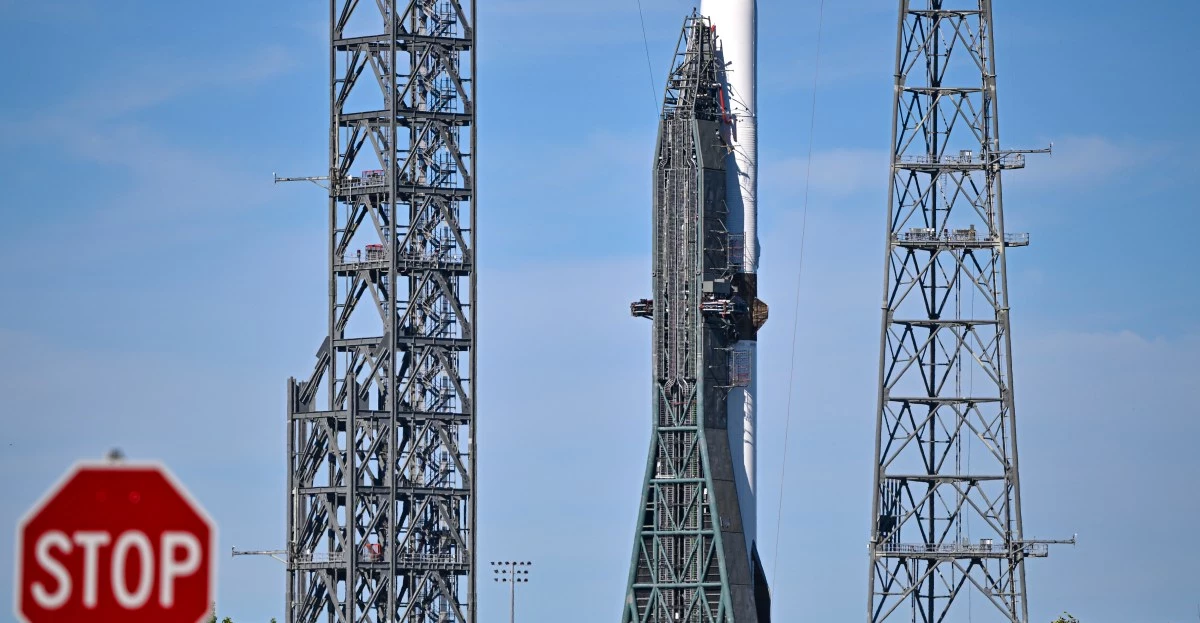

New Glenn’s Weather Delay: A Crucible for Heavy-Lift Reusability and Mars Ambitions
The Florida coast, with its capricious autumn squalls, has once again imposed its will on the ambitions of the space industry. Blue Origin’s decision to postpone the second flight of its New Glenn heavy-lift rocket—now eyeing a November 12 launch—may seem a mere footnote in the annals of orbital logistics. Yet beneath this meteorological hiccup lies a moment of extraordinary consequence for the future of American launch capability, NASA’s interplanetary science, and the economic architecture of space itself.
The Stakes of Reusability and Interplanetary Access
New Glenn’s upcoming mission is freighted with technical and symbolic weight. Its 23-foot fairing, nearly double the payload volume of SpaceX’s Falcon 9, is engineered for the next era of space infrastructure: high-energy missions and the deployment of sprawling satellite constellations. This flight, carrying NASA’s twin ESCAPADE probes on their four-year journey to Mars, is more than a scientific venture. It is a public test of Blue Origin’s ability to recover its first-stage booster after a sea-platform landing—a milestone it failed to achieve in January.
The implications are profound:
- Validation of the BE-4 Engine Family: Success would not only vindicate Blue Origin’s own architecture but also de-risk United Launch Alliance’s Vulcan rocket, which relies on the same engines.
- Cost Curve Disruption: If New Glenn can reliably insert 550 kg-class spacecraft onto interplanetary trajectories, it could bend the economics of deep-space missions downward, just as Falcon 9 did for low-Earth orbit.
- NASA’s Distributed Mission Model: ESCAPADE’s dual-satellite, low-cost approach exemplifies NASA’s pivot toward risk-tolerant, modular science missions—an ethos that could flourish if commercial heavy-lift launchers prove dependable.
Regulatory Chess and Economic Realignment
The regulatory landscape is shifting as rapidly as the technology. Blue Origin’s acquisition of an FAA waiver—allowing a post-10 PM launch despite shutdown-induced restrictions—signals more than bureaucratic agility. It underscores the growing recognition of orbital launch slots as scarce, high-value economic assets. The ability to bypass congestion rules for high-priority missions sets a precedent, potentially inaugurating a tiered regime that privileges deep-space science over commercial satellite constellations.
This regulatory flexibility is not without its risks. The temporary restrictions imposed during the government shutdown exposed the fragility of the civil-aviation interface. The industry’s future may hinge on automated airspace deconfliction, a technological leap reminiscent of Wall Street’s shift to algorithmic trading to sidestep human bottlenecks.
On the competitive front, Blue Origin’s progress is being watched with hawk-eyed intensity by both rivals and regulators:
- Reusability Race: SpaceX’s rapid booster turnaround has set a new industry cadence. New Glenn’s higher payload capacity, if paired with reliable reusability, could carve out a lucrative niche in high-mass, high-energy missions.
- Market Leverage: Each successful New Glenn flight amplifies Blue Origin’s bargaining power for commercial and national-security contracts, especially as ULA’s Vulcan and Europe’s Ariane 6 face delays and cost overruns.
- Revenue Diversification: Demonstrated first-stage recovery is not just a technical milestone; it is the linchpin for funding Blue Origin’s broader ambitions in in-space logistics and orbital servicing.
Strategic Inflection Points and Forward Trajectories
The outcome of this launch will reverberate across multiple time horizons:
- Short-Term: New Glenn’s booster reuse cycle time will be scrutinized. A turnaround under 90 days would pressure competitors and enable NASA to batch Mars-bound missions within fixed windows.
- Medium-Term: Success with ESCAPADE could embolden mission planners to piggy-back science payloads on commercial rockets, reducing reliance on bespoke vehicles like SLS for secondary objectives.
- Long-Term: The maturation of cost-effective, reusable heavy-lift vehicles from multiple vendors could hasten the shift toward modular, serviceable platforms in cislunar and Martian orbits, eroding the economic rationale for monolithic geostationary satellites.
For decision-makers, the actionable imperatives are clear:
- Diversify launch portfolios across at least two reusable heavy-lift providers to mitigate risk and secure volume discounts.
- Engage proactively with regulators to shape the standards for automated airspace management, ensuring resilience against political disruptions.
- Invest in distributed small-sat architectures, as the marginal cost of interplanetary insertion is poised to fall, unlocking new commercial models in space weather, atmospheric science, and cislunar situational awareness.
As the countdown resets at Cape Canaveral, the stakes are unmistakable. This is not merely a test of hardware or meteorological patience—it is a crucible for Blue Origin’s reusable-heavy-lift thesis, NASA’s cost-efficient Mars exploration roadmap, and the evolving competitive geometry of the global launch industry. The outcome will shape not just the next launch window, but the very contours of humanity’s reach into the solar system.

 By
By
 By
By
 By
By

 By
By

 By
By