


The Paradox of Decentralization: Crypto’s Hidden Reliance on a Single Cloud Giant
In the early hours of a recent weekday, the digital pulse of the cryptocurrency world flatlined. An extended Amazon Web Services (AWS) outage—unremarkable in the context of cloud history, but seismic for digital assets—brought trading venues, NFT marketplaces, and critical data feeds to a sudden halt. The event was more than a technical hiccup; it was a mirror held up to an industry that touts decentralization as its founding mythos, yet is operationally tethered to a single cloud vendor. The episode laid bare a paradox at the heart of crypto: the infrastructure beneath its “distributed” economy is, in fact, perilously concentrated.
How Cloud Centralization Became Crypto’s Unspoken Backbone
The emergence of a cloud-centric crypto economy is not simply a matter of convenience—it is the result of calculated trade-offs. For startups and Web3 ventures, AWS’s pay-as-you-go model has been irresistible. The ability to scale infrastructure dynamically, without the burden of capital expenditure, has fueled a relentless drive for speed and market capture. Token incentives, designed to reward rapid network effects, have prioritized immediate scalability over the harder, slower work of building sovereign back-ends.
But beneath the surface, a more fragile reality persists. Critical components—RPC nodes, indexing services, custodial wallets, NFT image hosting, and oracle feeds—are often clustered in a single AWS region. The value chain, therefore, inherits a shared vulnerability: when that region falters, the entire ecosystem feels the shock. This is not merely a quirk of crypto; it reflects a broader macroeconomic trend. For a decade, cheap capital and a bias toward asset-light, high-growth models have encouraged businesses to tolerate—if not embrace—single points of failure. Now, as capital becomes more expensive and scrutiny intensifies, these vulnerabilities are coming into sharper focus.
The Technology Fault Lines: Where Decentralization Breaks Down
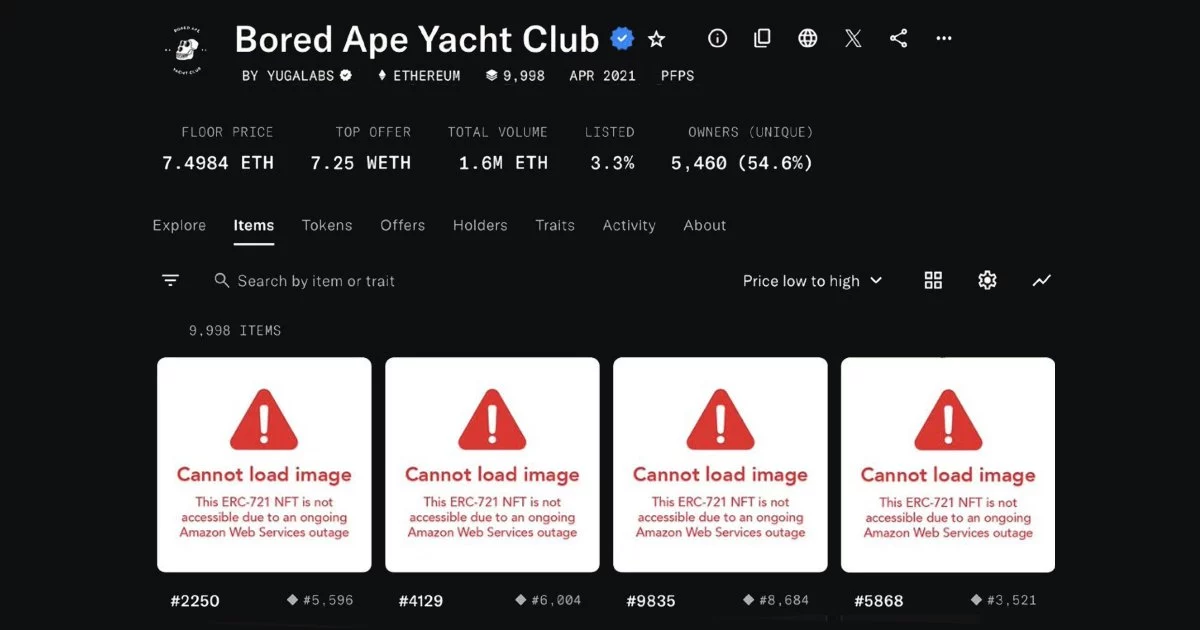
The AWS outage exposed the fragility of crypto’s peripheral dependencies. While blockchains themselves remained intact, the “edge” services—metadata, image hosting, and API gateways—proved to be single-threaded points of failure. NFTs, whose value proposition rests on immutable ownership, suddenly became invisible as their off-chain presentation layers evaporated. In the absence of these layers, the perceived value of digital assets collapsed, if only temporarily.
Efforts to decentralize storage—through IPFS, Arweave, Filecoin, and on-chain primitives—have made inroads, but integration remains complex and costly. Multicloud strategies, while feasible for stateless microservices, are far more challenging for state-heavy consensus layers and key management. The economics of resilience are sobering: regional failover can inflate monthly cloud spend by 15–30 percent, while true multicloud redundancy may double operational expenses. Until either tokenomics or regulation compels investment in high-availability patterns, most ventures will continue to under-provision for disaster.
Ripple Effects: Market Dislocation and the Future of Digital Asset Infrastructure
The immediate fallout was as dramatic as it was predictable. Bid-ask spreads widened, automated market makers throttled throughput, and arbitrage gaps yawned open. Retail traders found themselves locked out, forced to watch as NFT floor prices tumbled. The image of Bored Ape Yacht Club NFTs going dark became a viral symbol of the hollowness lurking beneath digital ownership. For institutional investors and insurance underwriters, the message was clear: risk premiums for NFT portfolios must now account for infrastructure resilience, not just smart contract integrity.
Regulators, too, are taking note. In the wake of this outage, policymakers in both the EU and the US are likely to push for greater transparency around cloud concentration and continuity planning—drawing analogies to the rules already governing financial market utilities. The specter of systemic risk in digital markets is no longer theoretical; it is a matter of public policy.
For industry stakeholders, the strategic imperatives are stark:
- Cloud providers can differentiate with “crypto-grade” service tiers, offering redundancy and observability tailored to digital asset markets.
- Exchanges and marketplaces must treat cloud outages as existential threats, with robust continuity plans, hot-cold data replication, and clear client communications.
- Protocol and dApp developers need to architect for decentralized storage, stateless front ends, and cross-provider observability.
- Institutional investors should expand due diligence to include cloud topology, failover testing, and vendor lock-in risk.
The AWS outage reframed decentralization as a spectrum, not a binary state. For digital asset enterprises, cloud concentration is now a board-level risk—one that demands both architectural and financial commitment to infrastructure pluralism. Those who adapt swiftly will not only weather the next outage, but may find themselves holding the keys to the industry’s most coveted asset: resilience.

 By
By
 By
By
 By
By
 By
By

 By
By
 By
By
 By
By







