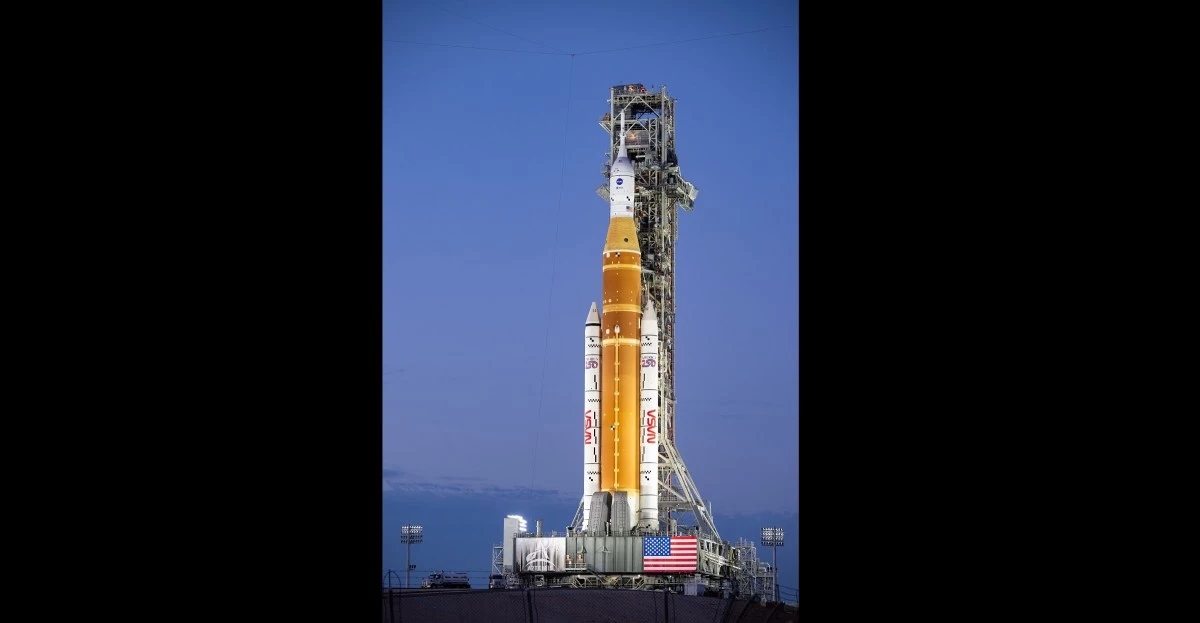

Artemis II: A New Era in Lunar Ambition and Industrial Policy
The slow, deliberate crawl of NASA’s Space Launch System (SLS) and Orion spacecraft to Launch Complex-39B is not just a feat of engineering—it is a ritual of renewal. For the first time since Apollo, a crewed lunar-orbital mission is within reach. Artemis II, scheduled for its earliest launch window in February, is more than a return to the Moon; it is a crucible for the technologies, alliances, and economic models that will define the next epoch of space exploration.
Engineering the Future: From Cryogenics to Closed-Loop Life
The Artemis II mission is a masterclass in systems integration and technological stress-testing. The rollout itself—often dismissed as spectacle—serves as a full-scale, real-world simulation. The 12-million-pound crawler’s journey is a calculated exercise in shaking out structural harmonics and thermal gradients, yielding data that will inform the next evolution of the SLS, the Block-1B upgrade. These are not mere academic exercises; they are the foundation for reliability in deep space.
The forthcoming “wet dress rehearsal” (WDR) is a crucible for ground-support infrastructure, pushing nearly 700,000 gallons of cryogenic propellant through systems that straddle the boundary between spaceflight and terrestrial innovation. The lessons learned here—high-capacity cryo-pumps, advanced insulation foams, and boil-off management algorithms—are already rippling into commercial hydrogen logistics and the fueling of small modular nuclear reactors. The boundary between NASA’s needs and the private sector’s ambitions grows ever more porous.
Inside Orion, the validation of closed-loop life-support systems—water recovery, trace contaminant control, metabolic heat rejection—becomes a forcing function for technologies that will soon underpin commercial low-Earth orbit stations and defense habitats. These advances are not isolated; they are the seeds of a future circular economy, where air revitalization and water reclamation, honed in the vacuum of space, become the backbone of sustainable “living buildings” on Earth.
Economic Gravity: Supply Chains, Capital, and Global Partnerships
Artemis II is as much an economic signal as it is a technological one. The program’s tentacles reach deep into the American industrial base, sustaining high-skill employment across North Alabama, the Gulf Coast, and the mid-Atlantic. With over 3,800 suppliers spanning all 50 states, Artemis has become a de facto instrument of federal industrial policy, its bipartisan support buttressed by the political resilience of its supply chain.
The successful rollout and imminent WDR reduce programmatic risk, unlocking cheaper capital for upstream suppliers and catalyzing venture investment in “picks-and-shovels” technologies—thermal coatings, additive-manufactured valves, and in-situ resource utilization payloads. Internationally, the inclusion of Canada’s Jeremy Hansen as a crew member cements Canada’s status as a Tier-I partner, while incentivizing other nations to barter hardware contributions for coveted crew seats. The Artemis Accords, once a diplomatic framework, are now a marketplace for global collaboration.
Yet, beneath the optimism, a tension simmers. SLS’s expendable architecture carries a marginal cost exceeding $2 billion per flight, a stark contrast to SpaceX’s Starship, which aspires to full reusability and sub-$10 million launches. Artemis II thus becomes a litmus test for how long policymakers will tolerate this cost asymmetry before accelerating a pivot to commercial heavy-lift providers—a scenario that would ripple through every layer of the aerospace supply chain.
Strategic Stakes: Norms, Dependencies, and the Cislunar Frontier
Artemis II is also a stage for geopolitical theater. Flying a diverse, international crew ahead of China’s projected Chang’e mission is a deliberate act of soft-power projection, reinforcing U.S. leadership in setting the norms for cislunar traffic management and resource rights. Yet, NASA’s reliance on SpaceX for the Artemis III Human Landing System exposes a strategic vulnerability—a single-point failure that echoes the Department of Defense’s dependence on Falcon 9 for national security launches. Contingency contracts with Blue Origin or Dynetics may soon become more than hedges; they may be necessities.
Meanwhile, regulatory precedents set by Artemis—particularly in propellant transfer and on-orbit refueling—are shaping the next generation of FAA rules, with implications that extend far beyond lunar missions. Commercial Earth-observation constellations and sovereign servicing missions will all operate under frameworks first tested in the crucible of Artemis.
The Next Horizon: Innovation, Talent, and the Cislunar Economy
The Artemis II rollout is not merely a procedural milestone; it is a strategic inflection point. For decision-makers across aerospace, energy, and critical infrastructure, the mission is a barometer of technological readiness and a springboard for adjacent innovation. Expect a surge in SBIR/STTR solicitations tied to cryogenic seals, sensor fusion, and AI-driven anomaly detection. International aerospace primes are already leveraging Artemis momentum to negotiate offset agreements, seeking entry into the U.S. defense-industrial base through the civilian portal of lunar exploration.
The narrative is reshaping STEM enrollment and driving wage inflation for cryogenic engineers and human-factors specialists. Corporations would do well to refresh their recruitment pipelines now, lest they find themselves on the wrong side of a talent shortage. Those who integrate lunar-derived technologies—be it battery chemistries or radiation shielding—into terrestrial products will capture first-mover ESG advantages, as sustainability narratives migrate from Earth-focused to space-enabled.
As the SLS and Orion stand poised on the pad, they are more than machines—they are the vanguard of a new industrial and geopolitical order. The choices made in the shadow of Artemis II will echo across the cislunar economy, shaping not just the future of space, but the very fabric of innovation here on Earth.

 By
By
 By
By

 By
By

 By
By
 By
By