

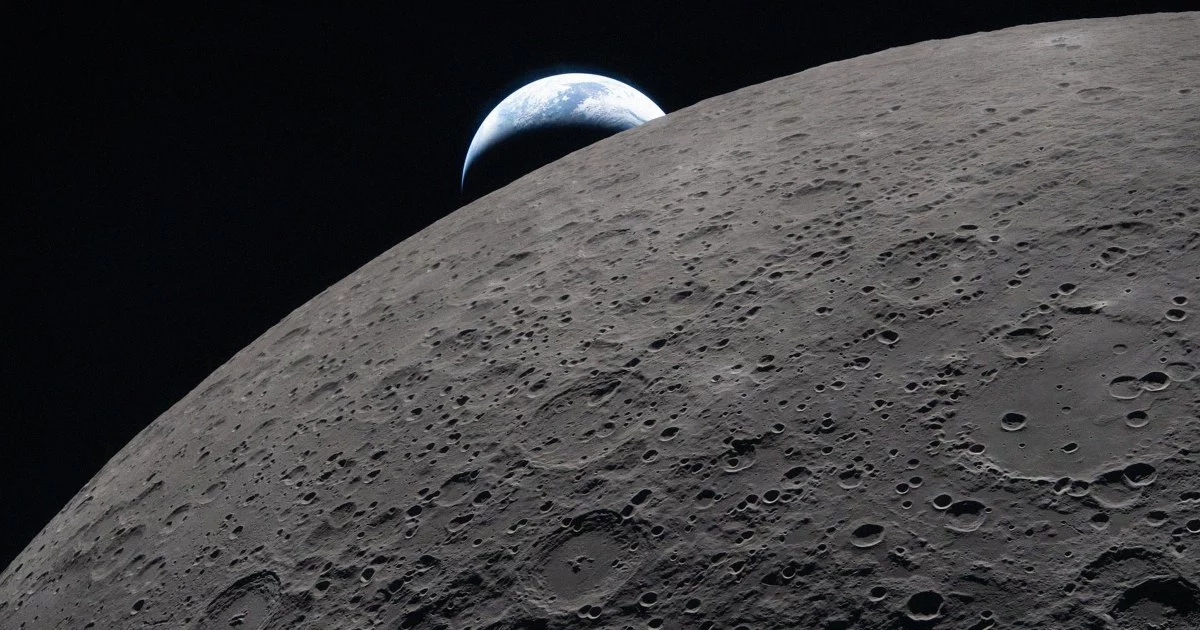

Artemis 2’s far-side milestone reveals an unpriced lunar hazard in real time
NASA’s Artemis 2 mission was designed to be a proving ground for deep-space operations—life support, navigation, communications, and human performance beyond low Earth orbit. It delivered that, and then something more consequential for the next decade of lunar planning: an unplanned, crew-observed dataset on micrometeorite impacts occurring in real time on the Moon’s surface.
During an almost hour-long total solar eclipse as the spacecraft passed around the lunar far side, Commander Reid Wiseman and Mission Specialist Jeremy Hansen reported seeing at least six brief impact flashes—transient bursts consistent with micrometeorites striking the regolith at extreme velocity. Mission control did not witness these events live, underscoring a key operational reality of cislunar space: even with modern telemetry, the crew can become the primary sensor when geometry, bandwidth, or timing limits ground visibility.
Science lead Kelsey Young’s confirmation and backup astronaut Jenni Gibbons’ emphasis on the significance of the observation sharpen the message for policymakers and industry: Artemis is not only a transportation program. It is a scientific reconnaissance campaign whose most valuable outputs may be the ones that force redesigns—especially as NASA and partners contemplate a sustained presence near the lunar south pole, where water ice and long-duration power opportunities are driving site competition.
From spectacle to systems engineering: why micrometeorite flux changes lunar base design
Micrometeorites are not new to lunar science, but Artemis 2 reframes them as a front-line engineering constraint rather than a background environmental factor. Estimates that an ISS-sized installation could face 15,000–23,000 impacts annually elevate the issue from “protective margin” to “architecture driver.” For executives and program managers, the implication is straightforward: lunar infrastructure economics will be shaped as much by shielding, inspection, and repair as by launch costs.
Several technology priorities emerge:
- Real-time science integration and onboard autonomy
The crew’s observations validate the need for high-sensitivity optical and acoustic arrays paired with onboard analytics. Future missions will require systems that can rapidly classify transient events—distinguishing true impacts from thruster reflections, sensor artifacts, or surface glints—without waiting for Earth-based adjudication. This is a natural fit for edge AI and sensor fusion, particularly when operating on the far side or during comms constraints.
- Habitat shielding becomes a life-cycle cost center
Traditional “Whipple-type” shielding concepts—multi-layer barriers that disperse impact energy—will likely evolve into hybrid protective envelopes incorporating Kevlar-ceramic composites, modular replaceable panels, and regolith-based structures. The most commercially relevant question is not whether shielding works, but whether it can be lightweight, repairable, inspectable, and scalable under lunar dust, thermal cycling, and radiation exposure.
- Designing with the Moon, not against it
The renewed focus on lava tubes, deep craters, and subsurface voids positions natural topography as a strategic asset—effectively “free shielding” that can reduce imported mass and simplify protective design. That shifts investment toward robotic mapping, geotechnical sensing, and autonomous site preparation—capabilities that can be procured and iterated faster than full-scale habitat redesigns.
The broader engineering takeaway is that micrometeorite resilience will likely be treated the way aviation treats bird strikes or maritime treats corrosion: not as an edge case, but as a certification-grade requirement embedded into standards, testing, and procurement.
The lunar business case recalibrates: insurance, materials, and a new risk premium
As lunar ambitions move from flags-and-footprints to operational permanence, micrometeorite exposure becomes a quantifiable financial variable. Shielding adds mass; mass adds launch cost; and repairability adds complexity. The result is a new category of capex and opex pressure that will ripple across the lunar value chain.
Key commercial ramifications are already visible:
- Risk-adjusted project finance for lunar infrastructure
Investors and mission planners will increasingly model micrometeorite exposure as a risk premium in net-present-value calculations. The “true cost” of a lunar base will include not only construction, but inspection cadence, spares inventory, downtime risk, and contingency operations.
- A nascent lunar insurance market needs better data
Underwriters cannot price what they cannot measure. Artemis 2’s observations strengthen the case for shared, high-resolution micrometeorite flux models and standardized reporting. Expect specialized insurance products covering:
– habitat and pressure-shell damage
– rover and lander degradation
– repair mission costs and schedule disruption
– evacuation and crew safety contingencies
- Industrial opportunities in regolith processing and sensing
Demand will grow for regolith-processing plants, additive manufacturing systems capable of producing structural elements on-site, and compact sensor suites for continuous monitoring. This is fertile ground for consortiums that combine aerospace primes, materials science firms, and robotics startups into end-to-end lunar construction and maintenance offerings.
In practical terms, Artemis 2’s flashes are a market signal: the winners in the lunar economy may be those who sell durability, monitoring, and maintainability, not only transportation.
Strategic spillovers: resilience as geopolitical leverage and dual-use capability
The Artemis program is also a geopolitical instrument, and infrastructure resilience is inseparable from strategic credibility. A lunar outpost that cannot withstand routine micrometeorite bombardment is not merely an engineering failure—it is a strategic vulnerability. As the U.S. advances Artemis with partners including Canada, Europe, and Japan, co-development of protective systems and shared environmental data can deepen alliances while reducing duplicated R&D.
At the same time, the enabling technologies for micrometeorite detection—high-bandwidth optical surveillance, in-situ data fusion, autonomous anomaly classification—map closely to capabilities used in space domain awareness and orbital debris tracking. That civil-military convergence will require careful governance, but it also accelerates innovation by linking lunar safety to broader national investments in space security.
Artemis 2’s most enduring contribution may be its reminder that the Moon is not a static destination—it is an active environment with a constant, high-velocity background of impacts. Each unexpected flash on the far side tightens the feedback loop between exploration and engineering, pushing lunar ambitions toward infrastructure that is not just achievable, but survivable, insurable, and strategically durable.

 By
By
 By
By

 By
By


 By
By
 By
By







