

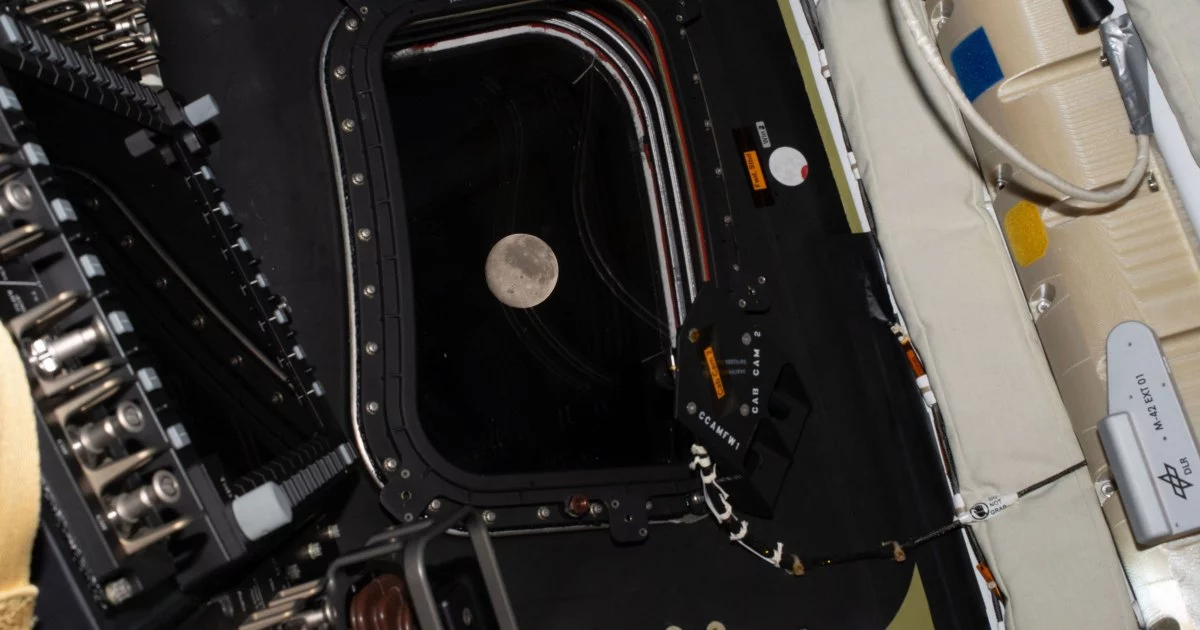

A new deep-space milestone—and what it really signals for human spaceflight
NASA’s Artemis 2 has pushed human travel farther from Earth than ever before, reaching 252,760 miles and surpassing Apollo 13’s 1970 record. On its face, the achievement is a clean headline: a new distance benchmark, a successful launch from Kennedy Space Center, and a four-person crew that notably includes Canadian astronaut Jeremy Hansen, reinforcing the mission’s international character.
Yet the deeper significance is less about mileage and more about operational credibility in cislunar space—the region between Earth and the Moon that is rapidly becoming the next contested and commercialized domain. Artemis 2’s passage behind the Moon triggered a ~40-minute communications blackout, a predictable consequence of lunar occultation, but also a proving moment: the spacecraft had to maintain stability, navigation, and systems health without real-time ground contact. That “quiet” interval is where modern human spaceflight is increasingly judged—not by spectacle, but by resilience, autonomy, and fault tolerance.
For NASA, Artemis 2 functions as a high-visibility validation of the Orion spacecraft and the broader Artemis architecture. For industry and policymakers, it is also a reminder that deep-space exploration is now a systems-of-systems challenge: communications links, radiation protection, supply chains, software assurance, and international coordination all matter as much as propulsion.
Behind-the-Moon blackout: autonomy, navigation, and the next communications economy
The communications gap as Orion slipped behind the lunar far side is not merely a mission footnote; it underscores a central constraint for sustained lunar operations: line-of-sight dependence. Artemis 2’s performance during this period highlights advances in:
- Trajectory planning and deep-space navigation, where precision reduces propellant margins and expands mission flexibility
- Onboard autonomy, including hardened computing and fault-tolerant software that can sustain safe operations without immediate ground intervention
- Operational discipline, as mission teams design procedures around intermittent connectivity rather than continuous oversight
This has direct implications for the emerging market in deep-space communications infrastructure. Artemis-era exploration will likely require more than upgraded ground stations; it points toward relay satellite architectures and, eventually, laser communications and mesh-like networks that can provide persistent coverage around the Moon. That creates a credible runway for commercial providers—particularly smallsat operators and optical comms specialists—to build services that resemble terrestrial telecom models, but with deep-space latency, radiation, and reliability requirements.
In practical terms, Artemis 2’s blackout experience strengthens the business case for a cislunar relay layer: a foundational utility that could support NASA, partner agencies, and private landers alike.
Radiation data as a strategic asset: health risk, materials science, and terrestrial spillovers
While the distance record captures attention, one of Artemis 2’s most consequential elements is its in-flight radiation monitoring experiment conducted with the German Aerospace Center (DLR). Beyond low Earth orbit, crews face a harsher environment of particle flux and episodic solar events that can elevate long-term health risks. Artemis 2’s dosimetry array is designed to generate empirical measurements that can refine models and, crucially, inform engineering tradeoffs.
This is where exploration becomes industrial policy. Better radiation data can accelerate:
- Advanced shielding materials and radiation-hard electronics, enabling longer missions and reducing mass penalties
- Regenerative life-support improvements, where reliability and maintainability become mission-critical in deep space
- Risk-informed mission design, shaping allowable exposure thresholds, crew rotation concepts, and habitat architecture
The spillover potential is not speculative. Techniques and materials developed for deep-space radiation monitoring can translate into terrestrial nuclear safety systems, improved real-time dosimetry, and more robust electronics for high-radiation environments. In the business and technology landscape, Artemis 2’s radiation work is a reminder that space programs often function as high-cost laboratories whose outputs diffuse into adjacent sectors—medical diagnostics, energy, and autonomous systems among them.
The far side as a scientific and economic frontier—and a geopolitical pressure point
Artemis 2’s far-side observations also carry outsized weight. The Moon’s far side is geologically distinct from the near side, and high-resolution imaging can sharpen models of crust formation, impact history, and volatile distribution. That matters for science, but also for future decisions about site selection—including where to place instruments, habitats, and potentially resource-focused operations.
The economic narrative is inseparable from the program’s architecture. Artemis 2 relies on SLS and Orion, systems with multibillion-dollar cost profiles that will continue to shape NASA’s procurement posture. Looking ahead to Artemis 4 (targeted for 2028), the plan for lower lunar orbits and potential rendezvous with commercial landers—such as SpaceX’s Starship or Blue Origin’s Blue Moon—signals a gradual shift toward:
- Milestone-based contracting and risk-sharing
- A more explicit public–private partnership model for lunar logistics
- The early contours of an off-Earth service economy, where transportation, comms, and surface systems become modular and competitively sourced
Hovering over all of this is strategic competition. China’s accelerating lunar program introduces a clear geopolitical dimension: distance records and mission “firsts” are not just technical achievements, but proxy indicators of national capability and prestige. The possibility that a Chinese crewed mission could soon eclipse Artemis 2’s record is less about bragging rights than about signaling momentum in launch capacity, mission planning, and sustained investment.
Artemis 2 therefore lands as both a triumph and a test: a demonstration that deep-space human flight is again operationally real, and a prompt that the next phase—communications infrastructure, radiation mitigation, commercial integration, and international norms—will determine who sets the rules in cislunar space and who merely operates within them.

 By
By
 By
By

 By
By
 By
By

 By
By
 By
By







