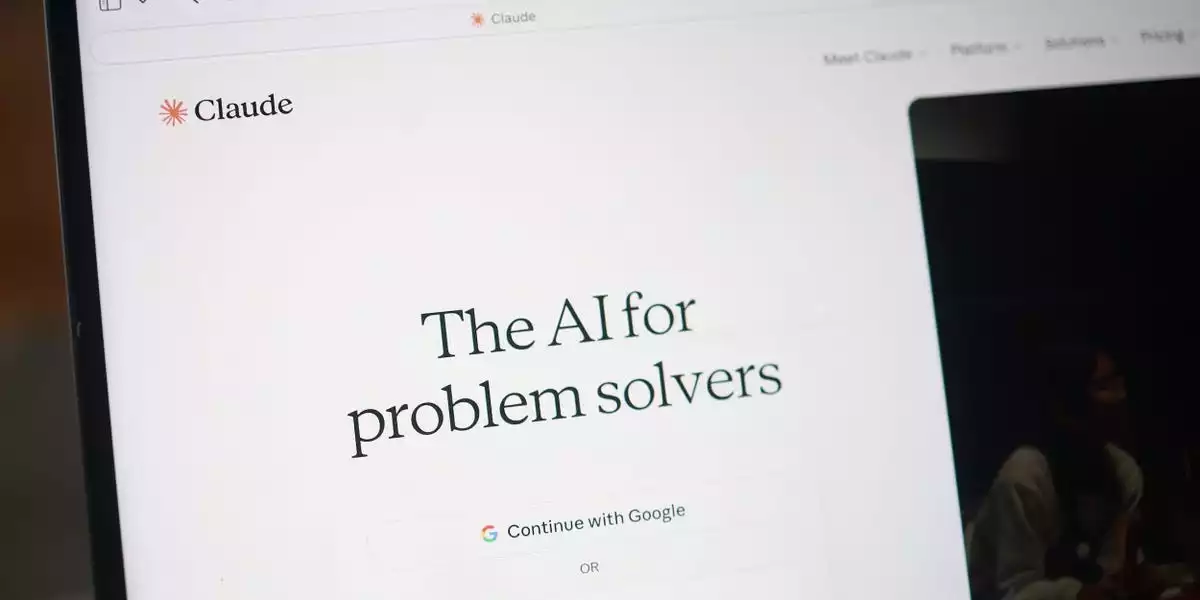

Anthropic’s Claude: a deliberate launch strategy that reshaped the enterprise AI race
Anthropic’s trajectory with Claude reads less like a consumer app story and more like a calculated enterprise platform build. Founded in 2021 by former OpenAI researchers, the company publicly released Claude in July 2023—after intentionally delaying launch to avoid inflaming what leadership anticipated would become an “AI arms race.” That restraint was not merely philosophical; it was strategic positioning. Rather than fight a winner-take-all battle for consumer mindshare, CEO Dario Amodei steered Claude toward business adoption, where switching costs, compliance requirements, and workflow integration tend to reward durability over virality.
Even so, Claude’s early consumer traction—briefly surpassing ChatGPT in App Store downloads—signaled that the product could compete on usability and perceived quality, not just on corporate procurement cycles. Over time, Anthropic reinforced this dual identity: culturally visible enough to be “top of mind,” while architected for enterprise value capture through deeper integration and monetization.
Key signals of this approach include:
- Enterprise-first monetization that favors predictable revenue and longer contracts over consumer churn dynamics
- A growing emphasis on productivity tooling, including voice interaction and plugins that embed Claude into daily work
- A willingness to spend on brand legitimacy, exemplified by a high-profile Super Bowl advertisement that functioned as an investor and partner signal as much as a marketing play
The result is a company positioning Claude not as a single chatbot, but as an emerging AI layer for enterprise workflows—a role that historically becomes defensible once ecosystems and integrations compound.
Modular model design and “constitutional AI” as competitive architecture
Under the Claude umbrella, Anthropic has leaned into model specialization—a design philosophy that mirrors modern software’s microservice mindset. Instead of a monolithic “one model for everything,” Claude’s capabilities are distributed across models such as Opus, Sonnet, and Haiku, each optimized for different performance profiles (e.g., engineering depth, creative fluency, concise reasoning). The latest Opus 4.6 being praised for clearing Anthropic’s toughest engineering benchmarks underscores the company’s intent to win credibility where enterprises feel risk most acutely: technical correctness, reliability, and measurable performance.
Equally central is Anthropic’s safety posture, formalized through “constitutional AI,” a training and alignment framework inspired by the UN Universal Declaration of Human Rights. In practical terms, it is a governance layer intended to keep Claude helpful, honest, and harmless—an approach that can be read two ways in the market:
- As a differentiator for regulated and high-stakes deployments (finance, healthcare, legal, critical infrastructure)
- As a constraint that may limit open-ended behavior in edge cases where creativity or permissiveness is valued
For executives, the strategic implication is that “safety” is no longer just a reputational shield; it is becoming a product feature and potentially a compliance accelerant. If regulatory regimes (including frameworks akin to the EU AI Act) increasingly reward auditable alignment methods, constitutional AI could translate into procurement advantage—especially where boards and risk committees demand defensible controls.
At the same time, Claude has not been immune to the category’s core weakness: misleading outputs. That reality keeps the enterprise conversation grounded in implementation discipline—human oversight, evaluation harnesses, and domain-specific guardrails—rather than marketing claims.
Cowork and the “SaaSpocalypse”: no-code AI as a valuation shockwave
In January 2026, Anthropic introduced Cowork, a no-code interface designed to let non-programmers orchestrate AI-driven workflows. This is more than a usability upgrade; it is a shift in who gets to deploy automation. By lowering the technical barrier, Cowork moves AI adoption from IT-led experimentation to line-of-business execution, where budget authority and operational urgency can accelerate rollouts.
The market impact described as the “SaaSpocalypse”—dramatic market-cap erosion among established software vendors—captures a broader re-pricing of software value. When a general-purpose AI system can replicate or approximate routine SaaS functions (drafting, summarizing, ticket triage, basic analytics, document workflows), feature-based moats weaken. The implication is not that SaaS disappears, but that:
- Commodity workflows become cheaper and easier to replicate
- Differentiation shifts toward data advantage, distribution, compliance, and embedded process ownership
- Vendors without proprietary leverage face margin compression or consolidation pressure
Cowork also converges with the low-code/no-code movement, hinting at a new layer of reusable assets: “AI playbooks”—templated workflows that spread inside organizations the way web templates and automation recipes did in earlier software eras. If that ecosystem forms, the competitive battleground becomes not only model quality, but also workflow libraries, governance tooling, and integration depth.
Statecraft, labor displacement, and the new politics of enterprise AI platforms
Anthropic’s story also illustrates how quickly AI companies become entangled in geopolitics and labor economics. A failed negotiation with the Pentagon over military AI use reframed the company as a national-security concern, highlighting a growing tension: governments want sovereign leverage over frontier models, while commercial labs seek to retain control over deployment boundaries and reputational risk.
That same episode appears to have indirectly accelerated Claude’s push into legal and financial tools, with knock-on market effects—reportedly including a sharp reaction in IBM’s stock when Anthropic entered those domains. Whether or not any single stock move can be attributed to one release, the underlying dynamic is clear: when frontier AI expands into professional services, it threatens incumbents whose value is tied to labor-intensive workflows and billable expertise.
The labor implications are no longer abstract. Amodei’s projection that up to half of entry-level clerical roles may vanish places workforce strategy at the center of AI adoption. For business leaders, the operational question is shifting from “Can we automate?” to “How do we redesign work responsibly and competitively?” The organizations most likely to benefit are those that treat AI as a restructuring catalyst—pairing automation with reskilling, role redesign, and governance—rather than as a blunt cost-cutting instrument.
Claude’s rise—amplified by celebrity endorsements, App Store prominence, and enterprise integrations—signals a maturing phase of the generative AI market: the winners may be defined less by who has the loudest chatbot, and more by who controls the interfaces, compliance narratives, and workflow ecosystems that determine how knowledge work actually gets done.

 By
By
 By
By
 By
By

 By
By

 By
By
 By
By