

Ant Group has led a reported $100 million pre-Series A round in Simplexity Robotics, giving the Chinese physical-AI startup a reported $1.6 billion post-money valuation and a powerful list of backers at a moment when robotics funding has been cooling. According to Bloomberg, existing investors named in the round include Alibaba Group, Tencent Holdings, HongShan Capital and Lanchi Ventures.
That matters beyond one startup’s cap table. China’s humanoid and embodied-AI sector has been making bold claims about scale, and Bloomberg separately reported that Chinese companies accounted for 97% of humanoid machines shipped in the first three quarters of 2026. A fresh nine-figure round led by Ant gives that broader thesis a concrete financing event: strategic capital still wants in.
The harder question is the one operators, suppliers and investors actually need answered: does this round suggest Simplexity is on a credible path from polished demonstrations to repeatable commercial fleets, or is it mostly a well-priced option on a market China does not want to miss?
What this capital is really underwriting
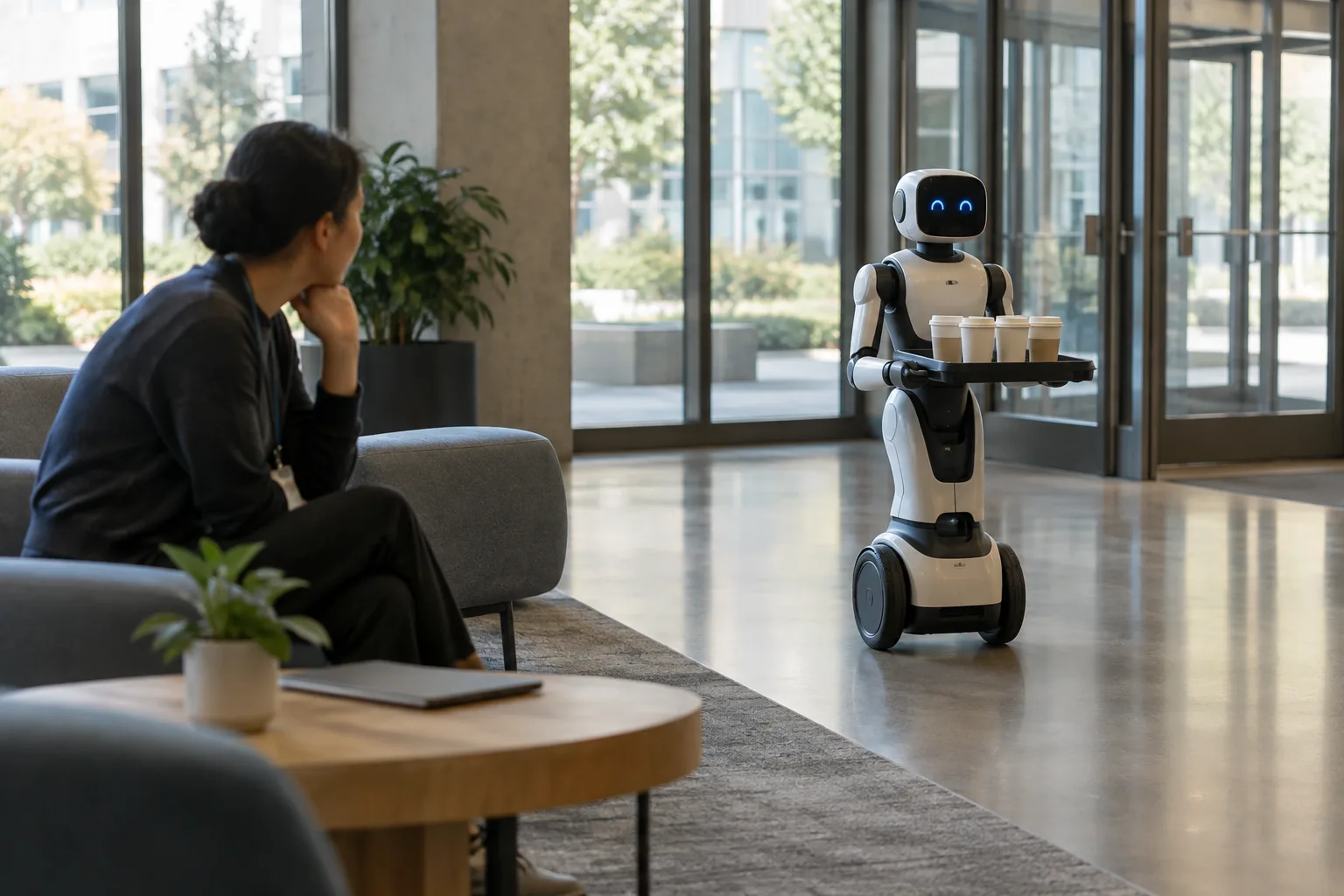
Simplexity’s appeal is understandable. TechNode, summarizing the Bloomberg report, said the company was founded by former Li Auto executives. Its latest disclosed product, the wheeled humanoid iX, has been shown preparing and delivering drinks, fetching objects and guiding visitors. Those are the kinds of service tasks that make embodied AI feel commercially near at hand: physical work in human spaces, not just software in a browser.
But a robot company is not an app company with motors attached. To get from a convincing demo to a dependable business, it needs actuators, sensors, batteries, control software, training data, safety systems, service operations and a production path that can keep uptime predictable. In that sense, this financing looks less like a simple vote for a single robot form factor and more like a bet that China’s automotive and manufacturing strengths can be transferred into embodied AI.
That is where the investor roster matters. Ant, Alibaba and Tencent bring more than money in theory: they can offer relationships across enterprise software, consumer services, logistics, payments, cloud infrastructure and commercial distribution. HongShan and Lanchi add venture backing with pattern recognition around scaling tech companies. None of that proves deployments are imminent, but it does help explain why a startup with limited public operating detail can command a billion-dollar-plus valuation so early.
Shipment share is not fleet economics
The bullish case for China’s humanoid push is straightforward. If Chinese vendors are shipping most of the world’s humanoid machines, they may be able to build a data-and-cost flywheel faster than rivals. More units in the field can generate more task data. Larger production runs can reduce component costs. Dense local supply chains can shorten the time between prototype, revision and manufacturing.
That mechanism is plausible, and it is exactly the kind of mechanism strategic investors tend to underwrite.
Still, shipment share is only a starting point. A shipped robot may be in a research lab, a showroom, a pilot program or a low-utilization deployment that never reaches acceptable economics. The available reporting on Simplexity does not disclose paying customers, contracted fleet size, production volume, intervention rates, safety performance, unit economics or service model. Its iX demonstrations show product direction. They do not yet answer the commercial questions that buyers care about.
Those questions are stubbornly practical. Can the robot perform one narrow task safely and repeatedly in a controlled workflow? How much human supervision does it need? How often does it stall, mis-handle an object or require remote help? What happens when a battery degrades, an actuator fails or the software needs an update? And when all the integration work, downtime and service response are counted, is the cost per productive hour better than the human labor or conventional automation alternative?
This is where much of the humanoid conversation still collapses three separate milestones into one. First, a robot can demonstrate a task. Second, a customer can run that task repeatedly in a specific site. Third, a fleet can deliver acceptable uptime and payback across many sites. Investors often finance the possibility that a company can move through all three gates. Customers eventually pay only for the third.
Why the round matters anyway
The significance of Ant’s bet is sharpened by the market around it. Bloomberg previously reported, citing ITjuzi data, that Chinese robotics-sector fundraising dropped to about 11 billion yuan in October, down from 24 billion yuan in August and 32.8 billion yuan in June. That is not the backdrop of indiscriminate enthusiasm. It is the backdrop of a shakeout.
In that context, Simplexity’s round looks selective rather than merely fashionable. If strategic investors are concentrating capital on a smaller group of teams they believe can combine manufacturing discipline, software capability and distribution access, a big pre-Series A can be a sign of triage as much as exuberance. The market may be deciding that not every humanoid startup deserves to survive, but a few deserve enough capital to try to turn demonstrations into fleet operations.
That is also why the valuation should be read carefully. A reported $1.6 billion post-money price signals scarcity, expectations and strategic value; it does not, on its own, prove revenue quality, customer traction or technical superiority. The same is true of the investor list. Ant, Alibaba and Tencent can help create a compelling financing narrative ahead of independent customer validation just as easily as they can accelerate real deployments.
For business readers, the useful takeaway is not to dismiss the round or to treat it as confirmation that service humanoids are ready for broad adoption. It is to recognize what is being tested. China has the supply chain, policy support and investor interest to push embodied AI into the field quickly. Simplexity now has capital and strategic attention to attempt that jump.
The evidence that would change the story from promising to proven is more operational than theatrical: named customers, hours worked per robot, retention across pilot sites, mean time between failures, intervention rate, safety incidents, software-update cadence, battery and actuator replacement cost, and a believable payback period. Until those metrics start surfacing, Ant Group’s $100 million commitment is best understood as a serious bet on China’s ability to scale embodied AI — and an open question on whether Simplexity can turn that national advantage into a repeatable robot business.

 By

 By

 By

 By

 By