

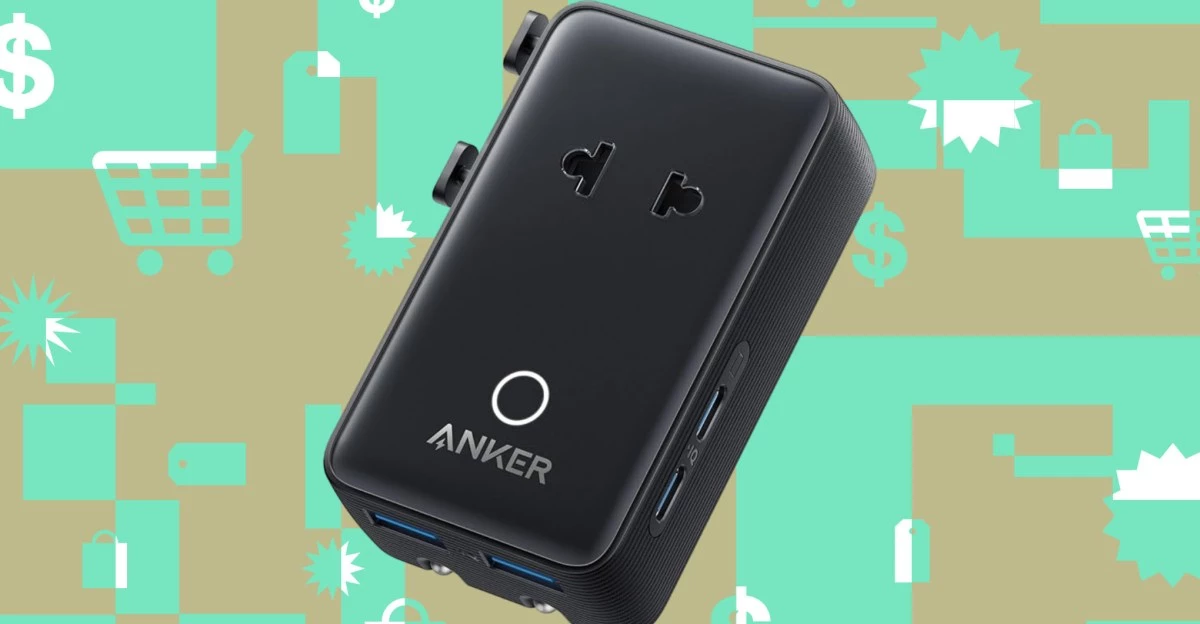

A pocket-sized adapter that signals a larger shift in global charging habits
Anker’s latest Nano Travel Adapter looks, at first glance, like a straightforward travel accessory: a compact block that folds to under an inch thick, weighs 3.77 ounces, and pairs an AC outlet with four USB ports—two USB-A and two USB-C. Yet the product’s design choices and pricing strategy reveal a more consequential story about where consumer power solutions are heading as USB-C standardization, device density, and international mobility converge.
At a promotional $19.99 price point (down from $25.99), Anker is effectively treating the adapter as a high-velocity staple—an item that can become a default purchase for travelers, remote workers, and anyone managing multiple devices. The hardware is tuned for modern carry-on realities: fewer bricks, fewer cables, and fewer compromises at the hotel nightstand or airport lounge.
Key specifications reinforce that intent:
- Four plug configurations (A, C, G, I) covering common standards across North America, Europe, the UK, and Australia/China
- Compatibility with outlets in 200+ countries (via plug support, not voltage conversion)
- Temperature regulation circuitry positioned as a safety and reliability differentiator
- A single USB-C port up to 20W, marketed as sufficient to charge an iPhone-class device to ~50% in under 30 minutes (conditions vary by device and protocol)
The result is a product that doesn’t try to be everything—no heavy transformer, no bulky conversion hardware—but aims to be the most frequently useful thing, most of the time.
Engineering trade-offs: convenience and safety, minus voltage conversion
The most important caveat is also the most instructive: this is not a voltage converter. That limitation is not a footnote—it’s a strategic boundary. Many travelers still conflate “international adapter” with “voltage conversion,” but the two solve different problems. Anker’s device adapts plug shapes and distributes power across ports; it does not transform 220–240V down to 110–120V for appliances that require it.
That design decision carries implications:
- Best fit: phones, tablets, earbuds, handheld gaming devices, power banks, and many laptops (especially those with 100–240V input chargers)
- Not ideal for: high-wattage or voltage-sensitive appliances such as hair dryers, curling irons, or certain grooming devices unless they explicitly support dual voltage
From a product strategy perspective, omitting conversion hardware preserves what consumers increasingly reward: portability, thermal management, and multi-device throughput. The inclusion of built-in temperature regulation is particularly telling. As charging density increases—multiple devices drawing power simultaneously—heat becomes the silent failure mode that separates commodity accessories from trusted brands. Safety features are not just compliance checkboxes; they are brand insurance in a category where a single incident can erase years of credibility.
The 20W USB-C ceiling also reflects a pragmatic positioning choice. It is fast enough for mainstream smartphones and travel-day top-ups, but it is not pitched as a high-wattage laptop charger replacement. In other words, Anker is optimizing for the broadest travel use case rather than chasing spec-sheet dominance.
Pricing pressure and omnichannel tactics in the accessory economy
The $19.99 discount—framed as an all-time low—lands in a market shaped by two forces that rarely coexist comfortably: rising consumer price sensitivity and rising expectations for quality. Accessories have become a battleground where shoppers demand premium features (USB-C, fast charging, thermal safeguards) while treating chargers as semi-disposable commodities.
Anker’s approach highlights how leading accessory brands defend margin and mindshare simultaneously:
- Omnichannel distribution: selling through Amazon for reach and conversion, while also maintaining a direct storefront to protect customer relationships, capture data, and manage lifecycle marketing
- Scale economics: leveraging component sourcing, manufacturing efficiency, and iterative R&D to hit aggressive price points without collapsing perceived quality
- Category trust: positioning safety and reliability as differentiators in a segment flooded with lookalike products
For competitors, matching the price is one challenge; matching the combined quality-control posture, certification discipline, and brand trust is another. In a world where consumers increasingly travel with $1,000+ phones and multiple connected devices, the adapter becomes a small purchase that protects larger investments—making reliability a rational buying criterion, not a luxury.
A curated deal ecosystem—and why it matters for travel tech strategy
The broader context—bundling attention around complementary deals like a commemorative Apple anthology, the Samsung Galaxy Watch Ultra with adventure-oriented GPS and siren features, and even a niche kitchen gadget—illustrates a modern retail reality: products are increasingly sold as part of a lifestyle narrative, not a single-item transaction.
For Anker, the Nano Travel Adapter functions as a gateway into a wider “connected traveler” toolkit. Its appeal maps cleanly onto high-value segments:
- Business travelers who want one compact solution for phone, laptop accessories, and wearables
- Digital nomads optimizing for weight, redundancy reduction, and outlet scarcity
- Families managing multiple devices in a single room with limited sockets
- Conference and event attendees who need fast, shared charging without carrying a power strip
The strategic opportunity is larger than one adapter. Travel power is adjacent to a broader stack—cables, power banks, GaN chargers, tracking tags, even connectivity services. Over time, brands that win this space may move beyond hardware into higher-retention offerings such as extended warranties, device protection bundles, or enterprise procurement programs for distributed workforces.
What makes this launch notable is not that it reinvents charging—it doesn’t. It’s that it captures the direction of the market with unusual clarity: USB-C-led consolidation, safety-forward miniaturization, and aggressive pricing delivered through omnichannel retail mechanics. In the travel economy’s next phase, the winners will be the companies that make “one less thing to think about” feel like a measurable product feature—and price it low enough to become habitual.

 By
By
 By
By

 By
By
 By
By

 By
By
 By
By







