

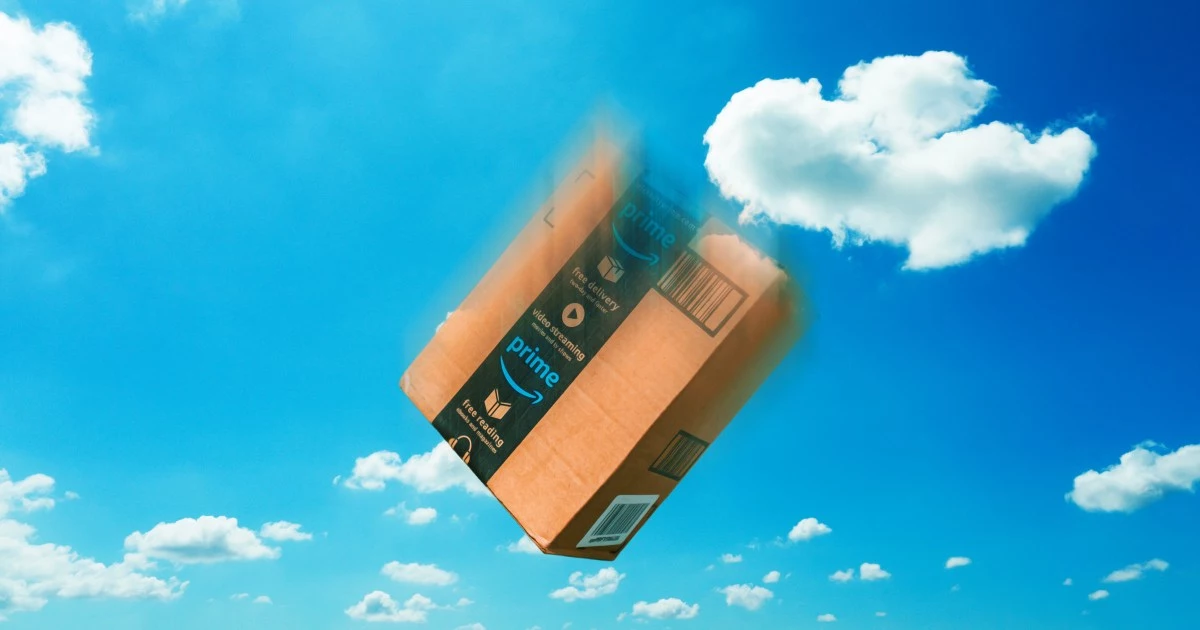

A faster last mile meets a harder landing: what the latest Prime drone tests reveal
Amazon’s expanded Prime Air drone delivery push is designed to make a bold promise feel routine: two-hour delivery to suburban homes for a $4.99 flat fee, bypassing traffic, driver availability, and the rising complexity of the last mile. The recent wave of influencer-led trials—circulating widely from markets including Nashville—adds a crucial layer of real-world visibility to that promise. The footage is compelling not because it shows drones failing to fly, but because it shows drones succeeding operationally while failing commercially: packages released from roughly ten feet can arrive on time yet arrive broken.
The viral example—a plastic bottle of blue raspberry syrup shattering on impact—is more than a quirky anecdote. It’s a diagnostic signal that the current delivery method is optimized for throughput rather than gentleness. The videos also highlight secondary effects that matter to customer experience and neighborhood acceptance, including rotor wash that can kick up debris and create a “high-velocity” moment at the doorstep. For a service positioned as premium convenience, the optics of a delivery that looks forceful—even when safe—can be as consequential as the damage rate itself.
From a business and technology perspective, this is the central tension: drone delivery compresses time-to-door, but it also compresses the margin for error. When the delivery endpoint is a driveway, patio, or walkway, the final ten feet can determine whether the service feels magical or messy.
The engineering trade-off behind the “drop-and-roll” approach
At the heart of the issue is a design choice that appears rational in isolation: minimizing hover time. Hovering consumes energy, increases noise exposure, and can complicate flight-path scheduling. A quick release reduces dwell time and helps the fleet scale. Yet physics is indifferent to product categories. A ten-foot drop converts speed into impact energy, and many consumer goods—especially liquids in rigid or semi-rigid containers—are not designed to absorb that shock.
Several technical gaps emerge from the current approach:
- Release mechanics without active deceleration: Without a winch, controlled tether, parachute-like device, or soft-landing pod, the package’s descent is essentially unmanaged. That may work for some items, but it is structurally hostile to fragile goods.
- Packaging built for trucks, not free-fall: Standard e-commerce packaging is tuned for vibration, compression, and occasional drops in ground networks—not repeated aerial drops onto unknown surfaces. The drone channel effectively creates a new test regime that packaging engineers must design for.
- Limited context awareness at the landing zone: GPS-guided navigation can place a drone near a target, but the last meter is about surface type and conditions. A hard concrete pad, a sloped driveway, wet grass, or a cluttered patio are materially different landing environments. Without real-time sensing and decision loops—potentially using stereo vision or LiDAR—the system can’t reliably choose a safer drop strategy.
This is not a condemnation of the platform so much as a reminder that autonomy is end-to-end. Flight autonomy is only half the product; delivery autonomy includes the handoff, the landing physics, and the customer’s perception of control.
Unit economics under pressure: speed is cheap until returns aren’t
The $4.99 price point is strategically aggressive. It signals Amazon’s intent to normalize drone delivery as a mainstream option rather than a novelty. But it also implies that Amazon is absorbing a meaningful share of fixed costs—fleet operations, maintenance, monitoring, compliance, and infrastructure—while betting that scale and automation will drive the marginal cost down.
Breakage changes that equation quickly. The economics of drone delivery are not just about cost per mile; they are about cost per successful delivery. If damage rates rise above a narrow threshold, the service can incur compounding penalties:
- Reverse logistics and replacements that erase margin and consume capacity
- Customer service load and reputational drag that undermines adoption
- Insurance and liability exposure, potentially increasing premiums or requiring tighter operational constraints
- Regulatory sensitivity, where recurring incidents—especially if paired with debris or perceived hazards—can influence the pace of approvals for broader operations such as BVLOS (beyond-visual-line-of-sight) expansion
Competitive dynamics sharpen the stakes. Traditional carriers like UPS and FedEx have decades of process maturity around damage reduction, claims handling, and packaging standards. Meanwhile, emerging drone and robotics startups can position themselves around reliability niches. In that environment, fragile-item performance becomes a differentiator, not a footnote. The first mover advantage in aerial logistics only holds if the service is trusted for more than durable goods.
A likely commercial response is service tiering—not as a retreat, but as a rational market design. A menu could emerge where customers choose between speed and protection, and where Amazon can price the risk transparently:
- Standard ground delivery (baseline reliability)
- Drone delivery for “drop-safe” items (fast, low-cost)
- Drone delivery with fragile-safe handling (premium pricing, insurance-backed, enhanced packaging or controlled descent)
The path to scalable trust: integrating packaging science, sensing, and policy
What the current moment exposes is not merely a bug but a roadmap. Drone delivery at scale requires a coordinated system spanning hardware, materials science, software intelligence, and governance.
The most credible near-term improvements cluster around three areas:
- Adaptive delivery hardware: Controlled descent mechanisms (winches or tethered lowering), energy-absorbing pods, or smart containers that deform safely on impact can reduce damage without sacrificing autonomy.
- Terrain-aware decisioning: Onboard sensing that classifies landing surfaces and detects obstacles could enable conditional behavior—lowering closer to the ground over concrete, selecting alternate drop points, or aborting if conditions are unsafe.
- Packaging innovation as a platform capability: Amazon has the volume to catalyze a new packaging standard optimized for aerial delivery—lightweight, impact-absorbing, and engineered for liquids and brittle items. Partnerships with advanced materials firms could turn “drone-ready packaging” into a competitive asset.
The broader context matters, too. Tight labor markets and wage inflation continue to push logistics toward automation, and consumer expectations remain unforgiving: shoppers want hyper-fast fulfillment without trading away reliability. Drone delivery can meet that demand, but only if it earns neighborhood-level acceptance and regulator-level confidence while maintaining a customer experience that feels controlled, not chaotic.
Amazon’s drone program is demonstrating that the future of last-mile logistics is not limited by flight—it is limited by the final interaction between machine, package, and doorstep. The companies that master that interface will define what “instant delivery” truly means in the automated economy.

 By
By


 By
By
 By
By

 By
By
 By
By







