

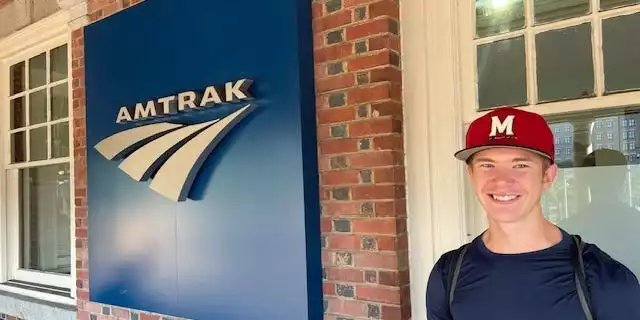

A small ritual of trust that reveals a larger rail strategy
Sara Clarke’s decision to place her 13-year-old children on a three-hour Amtrak trip—alone, but not unattended—captures a subtle shift in how families evaluate mobility. What begins as a practical summer routine (grandparents, predictable schedules, manageable distance) becomes a case study in how structured supervision can transform anxiety into confidence, and how a transportation provider can convert that confidence into durable brand equity.
Amtrak’s unaccompanied-minor service is deliberately formal: phone or in-person booking, pre-departure paperwork, wristband identification, and employee escorts at boarding and arrival. The children typically sit in the café car, a choice that functions as both operational convenience and a curated “public-but-supervised” environment. For parents, the value proposition is straightforward—duty of care. For the children, the experience is more layered: a first taste of independence, a contained adventure, and a sense of being treated as a legitimate traveler rather than an exception to be managed.
That emotional architecture matters. In an era when travel often feels like friction—crowded terminals, unpredictable delays, and heightened safety concerns—a controlled, human-led process can read as premium, even when the underlying product is simply point-to-point rail.
Duty-of-care as product differentiation—and a quiet revenue lever
From a business perspective, unaccompanied-minor travel is not merely a policy; it is a service tier. It adds labor, procedure, and accountability, but it also creates a differentiated offering that is difficult to replicate without operational maturity.
Several strategic dynamics are at play:
- Service design as competitive insulation: Supervised youth travel is a niche, but it signals that Amtrak can deliver “autonomy with guardrails.” That positioning can elevate rail from commodity transport to quasi-hospitality, where reassurance and experience are part of the purchase.
- Yield and ancillary upside: A minor traveling under supervision is more likely to be placed in a monitored zone (such as the café car), where onboard purchases and staff visibility intersect. Even modest incremental spend, multiplied across routes and seasons, can become meaningful.
- Lifetime customer value (LCV) formation: Clarke’s children earn Amtrak Guest Rewards points, turning a childhood trip into an early lesson in loyalty economics. In a market where customer acquisition costs keep rising, socializing minors into a brand ecosystem can be an unusually efficient long-term play.
The deeper insight is that this is not just “family-friendly rail.” It is brand imprinting. The child who reads, takes photos, and learns the rhythms of stations and conductors is also learning that rail can be safe, empowering, and even aspirational. Those associations can persist into adulthood—especially as today’s teens become tomorrow’s budget-conscious students, young professionals, and eventually parents making the same decisions Clarke is making now.
The operational trade-off: white-glove processes versus scalable systems
The current model is operationally intensive by design. Manual booking, in-station paperwork, identity checks, and staff escorts all introduce cost and complexity. The question for Amtrak is whether this remains a boutique capability—or becomes a scalable product line.
Key tensions include:
- Labor overhead vs. reliability: Human supervision is the point, but it also creates staffing dependencies and variability across stations. Consistency is essential because duty-of-care services are judged harshly when they fail.
- Compliance and risk management: The more formal the process, the more it resembles regulated custody transfer—documentation, verification, and clear chain-of-responsibility. That rigor protects the passenger and the company, but it also slows throughput.
- Scalability beyond minors: The same “escorted travel” blueprint could serve other segments—elderly passengers, non-native speakers, first-time riders, or travelers with situational needs—if packaged as tiered offerings with transparent pricing.
This is where rail operators can borrow from aviation and healthcare playbooks: define service levels, standardize handoffs, and treat exceptional-care travel as a repeatable operational product, not an ad hoc accommodation. Done well, it can increase system yield without requiring entirely new routes or rolling stock—an attractive proposition in capital-constrained environments.
Technology, loyalty, and sustainability: the next iteration of supervised rail travel
The most visible technology gap is the inability to book unaccompanied-minor travel online. That limitation is understandable—identity, consent, and liability are complex—but it also signals a modernization opportunity with measurable ROI.
A forward-looking roadmap would likely emphasize:
- Digital booking with compliance automation: A secure portal enabling role-based permissions, verified guardianship, e-signatures, and digital waivers could reduce station workload while improving data quality for customer relationship management (CRM).
- Real-time assurance and exception management: Opt-in tracking—via smartphone check-ins, QR-code milestones, or geofenced station events—could provide parents and staff with status visibility without turning the experience into surveillance theater. The goal is not novelty; it is faster intervention when plans change.
- Next-gen loyalty engagement: A child-friendly rewards interface—milestones, educational tie-ins, or family pooling—could deepen attachment while keeping privacy and consent standards front and center.
These upgrades also intersect with macro trends. The experience economy favors travel that feels meaningful and human-scaled; rail’s slower cadence can be a feature, not a bug, for multigenerational trips. Meanwhile, rail’s lower carbon footprint aligns with growing sustainability expectations from families and institutions alike. A supervised youth rail program can credibly sit inside a broader narrative of safe, low-emissions mobility—especially as consumers reassess the stress and congestion of short-haul flying.
What Clarke’s story ultimately surfaces is a strategic truth: when a transportation company makes safety feel personal and independence feel possible, it is no longer selling a seat—it is shaping a traveler’s identity, one trip at a time.

 By
By
 By
By

 By
By
 By
By


 By
By







