
A sub-$350 QD-OLED monitor signals a new phase in gaming display economics
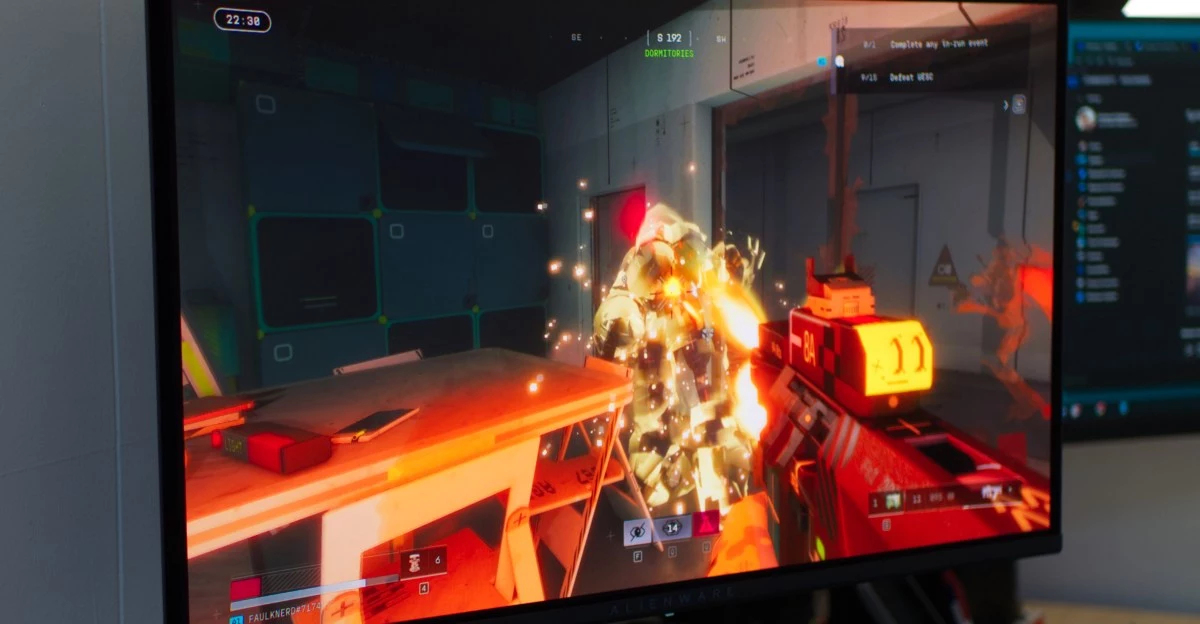
Dell’s Alienware AW2726DM landing at $319.99—down from $349.99—isn’t merely a routine promotion. It is a clear datapoint in the broader commercialization curve of QD-OLED gaming monitors, where once-premium panel technology is now being packaged into price bands historically dominated by fast IPS LCDs. At 27 inches, 2560×1440 (1440p), and 240 Hz, the AW2726DM targets the current “sweet spot” for competitive PC gaming: high frame rates without the GPU burden and pricing overhead that often comes with 4K.
The significance lies in what the discount represents: a market increasingly confident that self-emissive display advantages—near-infinite contrast, per-pixel lighting control, and rapid pixel response—can be delivered at scale without being confined to flagship SKUs. For buyers, it reframes the value conversation. Instead of asking whether OLED is “worth it,” the question becomes whether traditional LCD alternatives can justify their compromises when OLED is approaching mainstream affordability.
Key attributes anchoring the value proposition include:
- QD-OLED panel for high contrast and strong color performance
- 240 Hz refresh rate at 1440p via DisplayPort 1.4
- AMD FreeSync Premium Plus for variable refresh rate (VRR) support
- Three-year burn-in warranty, addressing a primary OLED adoption barrier
- Full ergonomics: swivel, tilt, height, pivot, plus VESA mount support
Performance-first design: what Alienware includes—and deliberately leaves out
The AW2726DM’s feature set is notable not only for what it offers, but for what it omits. Connectivity is functional and gaming-oriented: one DisplayPort 1.4 enabling 240 Hz at 2560×1440, and two HDMI 2.0 ports capped at 120 Hz at 2560×1440. That split is a practical reminder of how bandwidth standards shape real-world usage: PC players chasing maximum refresh will default to DisplayPort, while consoles and secondary devices may land on HDMI with a refresh ceiling.
This is a form of intentional “de-featureization” that has become increasingly common in value-driven gaming monitors. By trimming ancillary components—often USB hubs, KVM switches, advanced audio routing, or premium I/O stacks—manufacturers can preserve the core performance pillars that matter most to the target segment: refresh rate, response behavior, contrast, and VRR.
From a product strategy standpoint, this is a bet on modularity. Many PC gamers already operate with external ecosystems—USB switches, DACs, powered hubs, and dedicated microphones—making integrated monitor conveniences less decisive. The AW2726DM’s design suggests Dell is optimizing bill-of-materials allocation toward the panel and core gaming experience rather than becoming a do-everything desktop dock.
Warranty-backed burn-in coverage becomes a competitive lever, not a footnote
OLED’s mainstream challenge has rarely been picture quality; it has been buyer psychology around burn-in risk and long-term panel uniformity. Dell’s inclusion of a three-year burn-in warranty is therefore more than a reassurance—it is a commercial instrument designed to reduce purchase friction at the exact moment QD-OLED is moving downmarket.
In practical terms, warranty coverage functions as a trust signal that can accelerate category adoption. It also pressures competitors: once burn-in protection becomes normalized at a given price tier, brands that exclude it may find themselves forced into either price concessions or more aggressive service policies. Over time, this dynamic can shift competition away from raw specs and toward lifecycle value, including:
- Warranty scope and claim experience
- Panel health tooling and usage guidance
- Service add-ons and extended coverage models
For Dell’s Alienware brand, burn-in coverage also reinforces premium positioning even when the sticker price is aggressively accessible. That combination—premium assurance at mid-tier pricing—is a potent way to expand the funnel without diluting brand equity.
The strategic backdrop: QD-OLED scale, VRR alliances, and the 1440p/240 Hz battleground
The AW2726DM’s pricing and spec mix reflect intersecting industry forces. First is the growing efficiency of QD-OLED supply chains, where improvements in quantum-dot materials, deposition processes, and encapsulation are helping compress the cost gap versus LCD. As panel yields improve and production scales, QD-OLED is increasingly positioned not as a luxury, but as a competitive default for performance-focused segments.
Second is the ecosystem politics of variable refresh rate. The monitor’s AMD FreeSync Premium Plus support aligns with AMD’s long-running strategy to broaden VRR adoption without the licensing and certification overhead associated with proprietary approaches. For consumers, the benefit is straightforward: VRR becomes more available at lower prices. For the industry, it intensifies a familiar pattern—GPU and display OEMs using standards alignment and co-marketing to shape purchasing decisions across the PC gaming stack.
Finally, the product lands directly in a highly contested arena: 1440p at 240 Hz. This segment is increasingly the performance mainstream for esports and high-FPS gaming, balancing:
- GPU attainability (high frame rates are more realistic at 1440p than 4K)
- Visual clarity (a meaningful step up from 1080p)
- Competitive responsiveness (240 Hz as a perceived advantage threshold)
If QD-OLED continues to descend in price, the competitive pressure on fast IPS and mini-LED LCD offerings will intensify—especially where those technologies rely on brightness, local dimming, or feature bundling to defend higher price points. Dell’s AW2726DM, even with its restrained I/O, underscores a market reality: when panel performance becomes affordable, “extras” matter less, and the display itself returns to being the product.
That is the deeper signal in this discount—QD-OLED is no longer just aspirational hardware. It is becoming a baseline option for serious PC gamers who want high refresh, high contrast, and a warranty that treats longevity as part of the purchase, not an afterthought.

 By
By
 By
By
 By
By


 By
By
 By
By
 By
By