


A runway incursion at LaGuardia that exposes systemic fragility in U.S. airspace operations
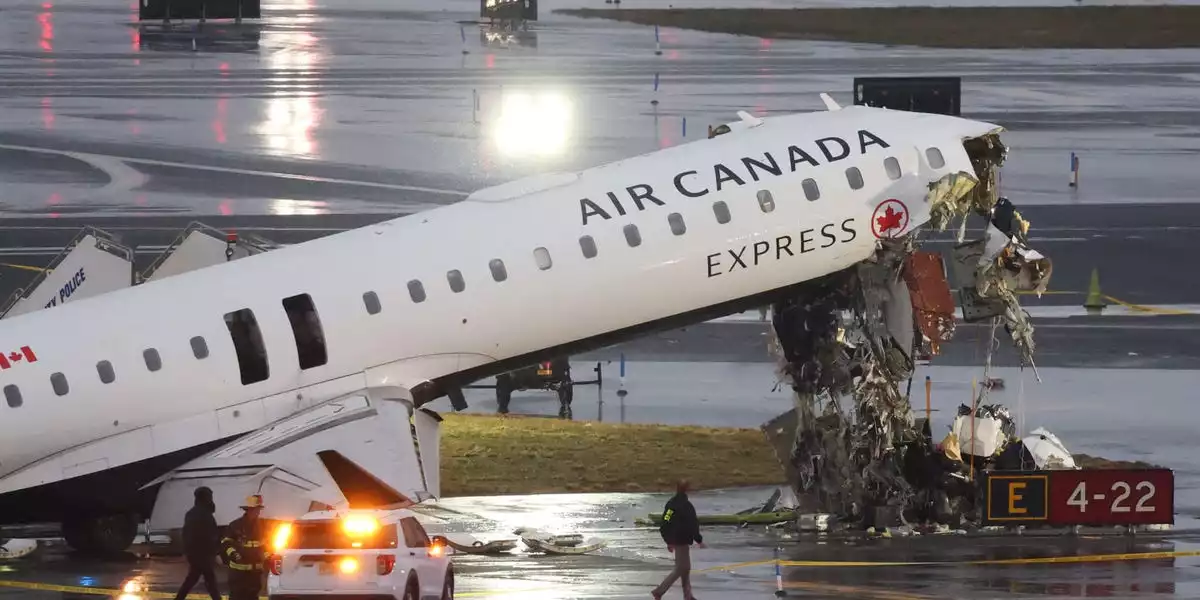
The collision at New York’s LaGuardia Airport (LGA)—in which a Bombardier CRJ-900 operated by Jazz Aviation for Air Canada struck a fire truck on Runway 4—lands as more than a tragic accident. It is a stark, operationally specific example of how modern aviation can still be undone by a familiar chain: simultaneous clearances, high workload, imperfect situational awareness, and technology that does not reliably prevent a last-second conflict.
According to the summary, the air-traffic controller cleared the regional jet to land while also clearing an emergency vehicle to cross the runway, the fire unit responding to an odor alert on a United Airlines flight. Audio logs reportedly capture a frantic “stop” command seconds before impact—an agonizing reminder that voice-based intervention is often the final, weakest barrier when timing collapses. The human toll is severe: both pilots were killed, and 39 passengers were injured, most later discharged.
Operationally, the incident immediately propagated beyond the runway: a prolonged closure, diversions of roughly 20 flights, and the cancellation of about 600 departures the following morning. For a constrained, slot-sensitive airport like LaGuardia, disruption is rarely local; it ripples through aircraft rotations, crew legality, maintenance positioning, and downstream hub connectivity across the U.S. and Canada.
Why this accident re-centers the debate on ATC modernization, not just human error
Runway incursions are often discussed as procedural failures, but the LaGuardia event—especially following a near-miss at Newark Liberty a week earlier—reframes the issue as a system design problem. In a safety-critical environment, the question is not whether people can make mistakes; it is whether the system is engineered to anticipate, detect, and block those mistakes before they become irreversible.
Key technology and design gaps highlighted by this incident include:
- Legacy surveillance and voice-centric control loops: Many U.S. airports still rely on operational concepts and tooling rooted in 1960s–1980s-era radar and radio procedures. While the FAA’s NextGen program aims to shift toward satellite-based surveillance and more automated separation support, uneven deployment and interoperability gaps can leave airports operating in a hybrid state—modern traffic volumes managed with partially modern tools.
- Human–machine interface limitations at the controller workstation: The dual clearance described in the summary points to a critical HMI question: *Where was the “hard” warning?* In other industries—banking fraud detection, warehouse robotics, rail signaling—systems are designed to generate predictive conflict alerts and enforce constraints. Aviation has elements of this, but runway operations still too often depend on verbal coordination and the controller’s mental model.
- Insufficient integration of vehicle transponders and runway status logic: A robust runway incursion prevention architecture typically requires that all vehicles operating on movement areas be electronically visible, reliably tracked, and tied into runway occupancy and clearance logic. If a runway crossing clearance and a landing clearance can coexist without a system-level “red light,” the safety net is thinner than the public assumes.
- AI and data analytics as a safety layer—if governed correctly: Continuous ground-movement data can support machine-learning models that identify high-risk patterns (e.g., crossing behaviors under certain traffic states, weather, or staffing loads). Properly implemented, AI would not “replace” controllers; it would provide real-time conflict prediction and, where appropriate, automated escalation—alerts that are earlier, clearer, and harder to miss than a shouted “stop.”
This is not a generic call for “more technology.” It is a targeted argument that runway operations are a prime candidate for automation-assisted safety controls, because the geometry is constrained, the rules are explicit, and the consequences of timing errors are catastrophic.
The business impact: liability exposure, network disruption, and a coming wave of compliance spend
For airlines, airports, and public authorities, the LaGuardia collision is also a high-intensity business event—one that will likely reshape budgets and risk models.
Material consequences are already visible:
- Network and revenue shock: The cancellation of roughly 600 departures the next morning illustrates how a single runway incident can trigger cascading disruption: missed connections, aircraft out of position, crew rescheduling, passenger reaccommodation, and compensation costs. In a high-utilization environment, recovery is not a reset—it is a multi-day operational unwind.
- Insurance and liability pressure: With fatalities and injuries, exposure will extend across airline operators, airport authorities, and potentially contractors. Even before final investigative findings, markets tend to reprice risk quickly—often through higher premiums, stricter underwriting requirements, and more demanding safety assurances for ground operations.
- Capital expenditure and retrofit acceleration: Expect intensified regulatory attention on runway incursion mitigation, including:
– expanded vehicle transponder mandates,
– upgraded surface surveillance and alerting systems,
– controller workstation enhancements,
– improved runway status indication and procedural tooling.
These are not trivial upgrades, particularly for congested airports balancing construction constraints, post-pandemic capital discipline, and competing priorities such as terminal modernization and sustainability projects.
Strategic stakes: staffing, infrastructure competition, and safety as an ESG credibility test
The incident also intersects with longer-running structural pressures: air-traffic control staffing shortages, an aging workforce, and traffic volumes projected to exceed pre-pandemic levels. When demand rises faster than system capacity—human or technical—risk concentrates at the margins: complex airports, peak banks, and irregular operations.
Strategically, several dynamics are likely to intensify:
- An infrastructure investment race among major airports: Airports that can demonstrate measurable runway-safety modernization—surface movement automation, integrated alerting, high-fidelity tracking—may gain an advantage in federal grant competitiveness and airline confidence.
- Workforce pipeline innovation: If staffing shortages are a persistent constraint, stakeholders will face pressure to expand simulation-based training, shorten time-to-proficiency without lowering standards, and deploy smarter scheduling tools that reduce fatigue and coverage gaps.
- Safety modernization as a board-level ESG issue: Investors increasingly treat operational safety as a governance and social performance indicator. For airlines and airport authorities, credible disclosure will likely shift from broad commitments to specific roadmaps: what technologies will be deployed, on what timeline, with what measurable reduction in incursion risk.
LaGuardia’s runway collision is now a defining data point in a broader narrative: aviation demand is scaling, but the safety architecture—technical, procedural, and human—must scale faster. The next era of air transport competitiveness will not be decided only by routes and fleets, but by which systems can prove they are engineered to prevent the rare, devastating moment when two authorized movements occupy the same runway at the same time.


 By
By
 By
By
 By
By

 By
By
 By
By







