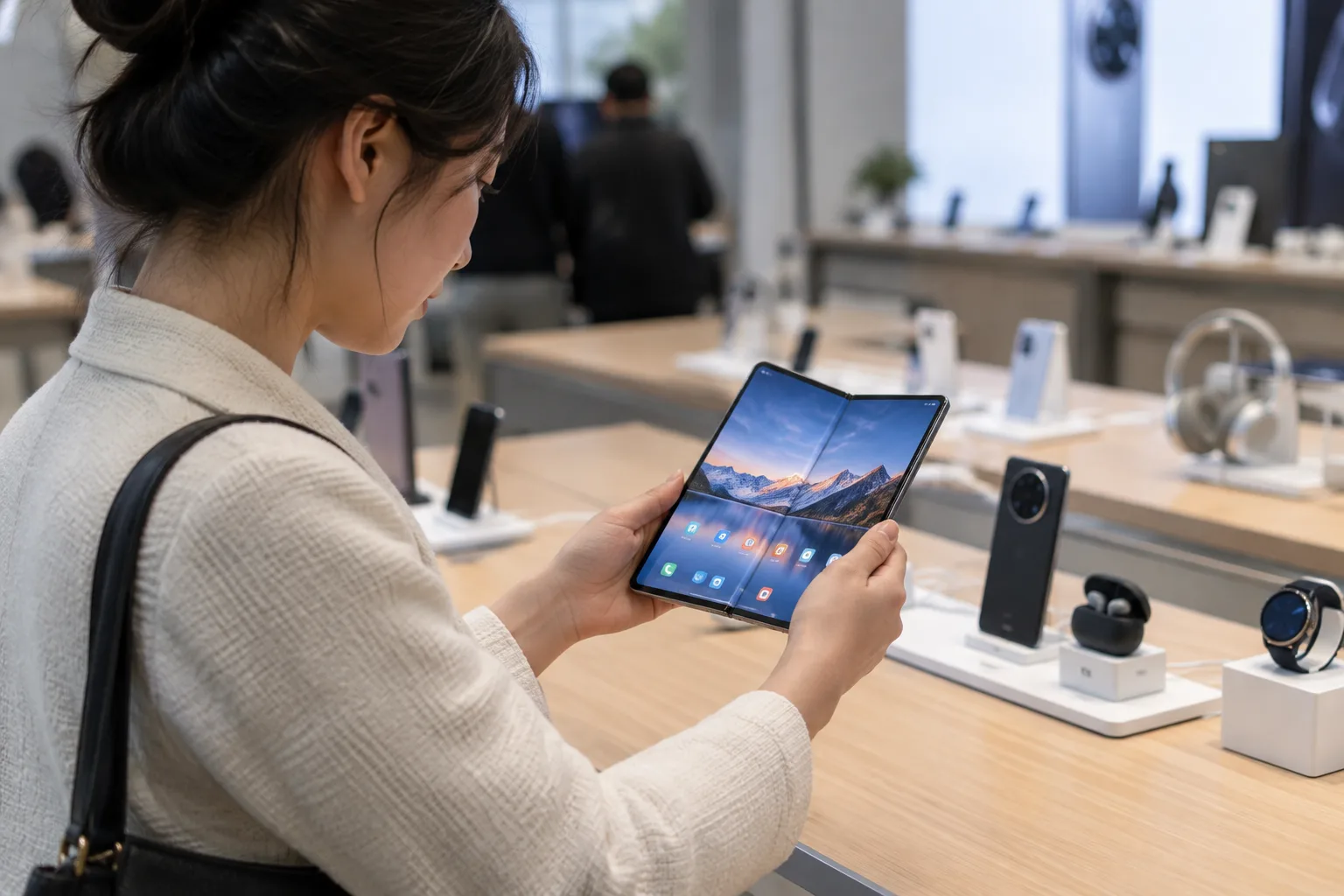

Huawei has launched the Mate X8 in China, putting a new premium foldable at the center of a much larger bet: that the company can combine its own chip, operating system, hardware design, AI features, imaging stack, and satellite capability into a convincing high-end device ecosystem. On paper, the Mate X8 is a headline-grabbing phone. In business terms, it is a test of whether Huawei’s vertical integration can produce not just a thinner foldable, but a premium product that buyers trust to last.
At Huawei’s November 24 event, the company introduced the book-style Mate X8 with HarmonyOS 7, a Kirin 9050 Pro chip, a 6,200 mAh silicon-carbon battery, a redesigned hinge, and a reinforced inner display structure, according to Huawei’s Chinese product page. Independent coverage from Notebookcheck and Gizmochina says the device has an 8.2-inch inner screen, a 6.54-inch cover display, starts at 12,999 yuan, and is scheduled to go on sale in China on December 4.
The real question for readers is straightforward: is the Mate X8 mainly a better foldable phone, or is it evidence that Huawei can build a self-contained premium device stack whose appeal survives outside China? Right now, the answer leans toward the first, with the second still unproven.
More than a thin foldable
Huawei’s launch materials are packed with the kind of details that matter in foldables because the format punishes weak engineering. The company says the Mate X8 measures 4.2 mm when unfolded, supports 66 W wired and 50 W wireless charging, and carries IP58/IP59 dust-and-water resistance under controlled test conditions. It also says the inner display stack uses ultra-thin glass, high-strength steel laminate, and carbon-fiber support, with higher impact resistance for the screen and hinge versus the prior design.
Those claims matter because foldables are not judged on thinness alone. The hinge, display layers, battery packing, thermal behavior, and software continuity all have to work together. A foldable that looks advanced on day one but develops a deeper crease, weaker battery life, or costly repair needs six months later does not succeed as a premium category product.
That is why the Mate X8’s most important hardware story is not any single number. It is Huawei’s attempt to present the device as an integrated system: custom silicon, Huawei-controlled software, XMAGE camera branding, device-side AI features, and BeiDou satellite messaging. In a conventional flagship, those pieces can come from several suppliers. In the Mate X8, Huawei is pushing the idea that tight control across the stack is itself the product.
Why the Kirin-HarmonyOS combination matters
The Mate X8 arrives under conditions that give vertical integration unusual strategic weight. Huawei has been building out Kirin chips and HarmonyOS while operating under U.S. technology restrictions and with less access to advanced foreign technology than many rivals. A premium device that runs on Huawei silicon and Huawei software can reduce outside dependence, tighten product planning, and give the company more control over optimization.
That does not mean the Mate X8 has already proved a performance breakthrough. Huawei says the Kirin 9050 Pro delivers overall performance 31% higher than the Mate X7 in company lab conditions. That is useful as a product-positioning signal, but not as a direct comparison with Apple, Qualcomm, or Samsung platforms. The current materials do not provide independent same-condition benchmarks for CPU, GPU, NPU, modem behavior, sustained thermals, or battery endurance.
That missing evidence is especially important in a foldable, where heat, battery life, and app behavior often matter more than peak benchmark scores. A large 8.2-inch display, multitasking, camera processing, and AI features all create sustained workloads. Without independent testing, the practical value of the Kirin-HarmonyOS combination remains a business hypothesis rather than a settled competitive result.
Huawei’s AI story falls into the same category. The company describes meeting summaries and other on-device intelligence features, but also notes that some functions depend on connectivity, app support, software updates, or limited scenarios. For buyers, the question is not whether AI appears on the feature list. It is whether those tools are fast, reliable, privacy-conscious, and useful enough to justify part of the premium price.
China-only launch is a feature of the story, not a footnote
The Mate X8 is launching in China, and Huawei has not announced international pricing or availability. That fact changes how the device should be read.
In China, Huawei can combine hardware, HarmonyOS services, retail channels, repair logistics, accessories, and China-specific features more tightly than it can abroad. The company’s product page says BeiDou satellite messaging, including picture messaging through Huawei’s Changlian app, is limited to mainland China and requires activation or related service support. That is a meaningful feature for domestic buyers, but not a sign of worldwide satellite utility.
The China-first path also matters economically. Premium phone buyers care about apps, payments, cloud services, resale value, support networks, and repairs almost as much as industrial design. A foldable is an especially demanding purchase because the hardware is expensive and more failure-sensitive than a conventional slab phone. Huawei can make a stronger case inside its home market, where its ecosystem position is deeper and its service assumptions are clearer.
Outside China, the unanswered questions multiply quickly: supported bands, app availability, service policies, repair cost, spare-parts access, and whether the software package would differ by region. Until Huawei addresses those issues, the Mate X8 is better understood as a domestic ecosystem test with premium ambitions than as a global answer to Samsung, Google, or future Apple foldable plans.
What decides whether the Mate X8 really matters
For now, the Mate X8 looks like a serious hardware release and a strategically important one. The large battery, thin chassis, larger inner display, new hinge narrative, and Huawei-controlled platform make it more consequential than a routine annual refresh. But the decisive questions sit beyond the launch event.
The first is durability. Buyers and competitors need independent evidence on hinge life, crease behavior over time, drop resilience, battery wear, and whether IP claims hold up in ownership conditions rather than demo conditions.
The second is utility. The 8.2-inch screen and 1-120 Hz LTPO setup sound attractive, but the real test is whether apps scale well, multitasking feels natural, cameras fit premium workflows, AI features save time, and battery life holds up under foldable-style use.
The third is scale. China sell-through, returns, repair experiences, software update cadence, component supply, and any later international rollout will determine whether the Mate X8 becomes a durable product line milestone or remains a polished premium niche.
That makes the Mate X8 important even before those answers arrive. Huawei is not just selling a foldable phone. It is asking the market to accept a tightly integrated Huawei-made stack at the most demanding end of consumer electronics. The industrial design may get the first wave of attention. The harder question is whether Huawei can own every major layer of the device and still deliver the durability, utility, and ecosystem confidence that premium buyers expect.

 By

 By

 By

 By

 By