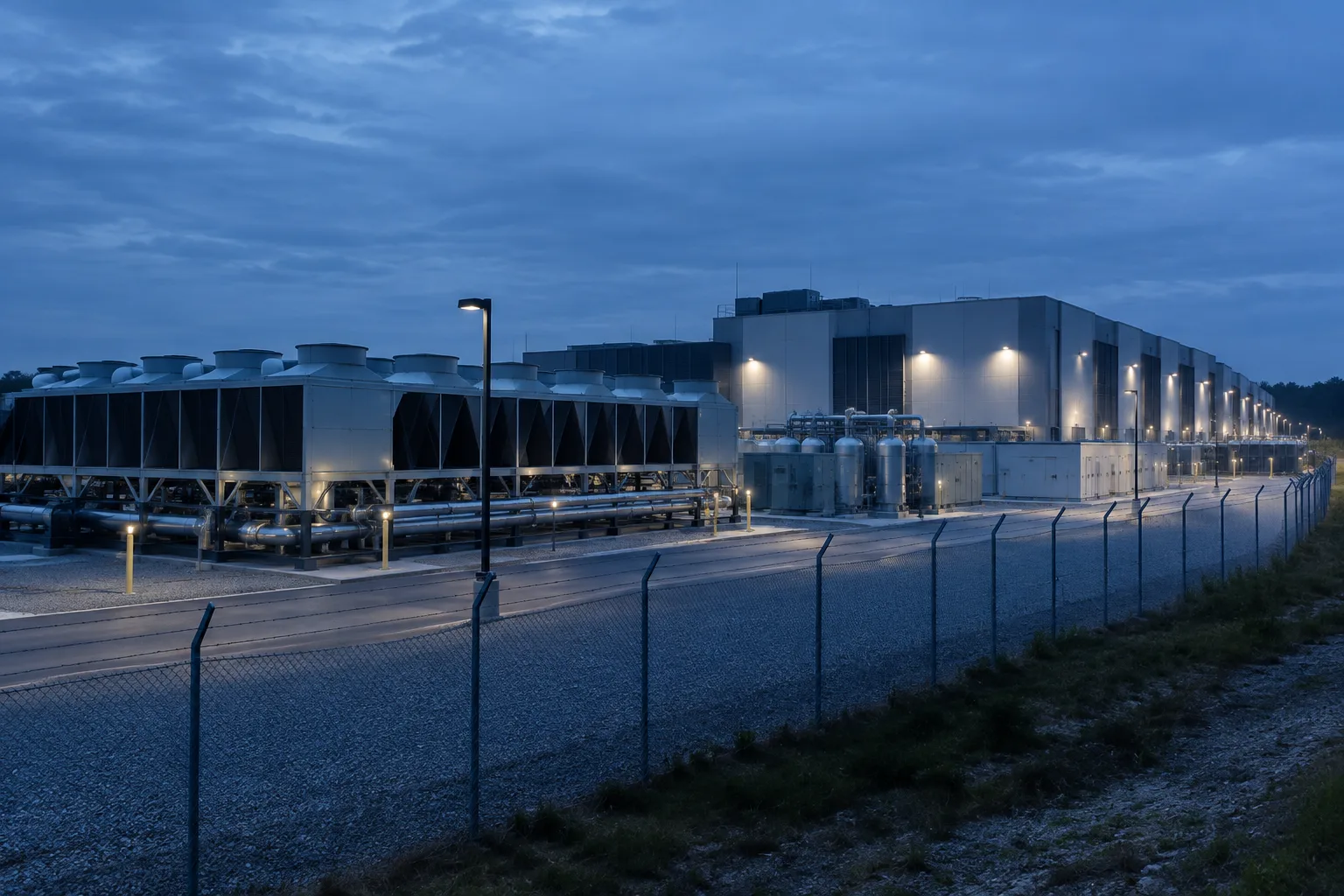

SoftBank Group’s latest results turned an abstract AI-financing story into a concrete balance-sheet event. In its financial report for the six months ended Sept. 30, the company reported a net loss attributable to owners of the parent of ¥1.115 trillion for the July-to-September quarter, versus a ¥2.502 trillion profit a year earlier. Reuters described that as roughly a $7 billion quarterly loss.
The headline matters because the loss did not come only from the usual SoftBank ingredients of changing investment values and derivatives. A large part of the damage came from something more operational and more revealing: a costly reset in how SoftBank-backed projects plan to secure power for U.S. AI data centers.
That leaves investors, lenders and partners with a sharper question than “Did SoftBank have a bad quarter?” The real issue is whether this was mainly a manageable one-off reset inside a sprawling, volatile portfolio — or an early warning that trying to control more of the AI stack is concentrating too much execution and financing risk in one place.
More than another portfolio swing
SoftBank is not a normal operating company, so its income statement needs sorting before the loss means anything. The group combines investment holdings, operating businesses, semiconductor assets, infrastructure bets and leveraged financing. That means a quarterly loss can reflect fair-value moves, derivative changes, finance costs and one-time project adjustments without implying that every business line deteriorated at once.
There are still signs of underlying activity rather than collapse. For the six-month period, net sales rose 13.3% from a year earlier to ¥4.235 trillion. Total investment gains remained positive at ¥1.726 trillion, even though that was down from ¥3.927 trillion in the prior-year period. SoftBank said those gains included ¥705.617 billion from the Vision Funds and ¥1.078 trillion from the Investment Business of Holding Companies, primarily a ¥1.063 trillion gain on Intel shares.
Its AI Computing segment — which includes Arm, Ampere and Graphcore — also grew. Revenue rose 23.7% in U.S.-dollar terms to $2.330 billion over the six months. But that segment still posted a loss of ¥322.050 billion as SoftBank continued to spend on research and future compute platforms.
So the quarter was not a simple story of AI assets suddenly imploding. SoftBank still had portfolio gains, revenue growth and a reported fair value for its OpenAI stake above cost at quarter-end. As of Sept. 30, SoftBank said it had invested $54.6 billion cumulatively in OpenAI with a reported fair value of $99.6 billion; a further $10 billion investment closed in October, bringing cumulative investment to $64.6 billion.
Still, those marks do not pay interest by themselves, and they do not erase the costs of getting infrastructure decisions wrong.
The cost of reserving the AI buildout
The most important number in the report may be the ¥597.248 billion loss tied to U.S. power-generation procurement for AI data-center projects. SoftBank said its Silver Bands 7 subsidiary revised procurement plans for power-generation equipment. That prompted recognition of ¥457.030 billion in non-refundable advance payments made to reserve manufacturing capacity or purchase equipment, plus another ¥140.218 billion from contract modifications and settlements.
This is why the quarter deserves more attention than a routine mark-to-market swing. SoftBank was not merely revaluing an investment because a comparable stock fell. It was unwinding or redesigning physical buildout commitments made to secure scarce equipment for AI campuses.
That matters because power has become one of the hardest bottlenecks in AI infrastructure. Reserving generation equipment and manufacturing slots can buy priority in a tight market. But it also behaves like an expensive option: if campus plans, load assumptions, financing terms or technology needs change, the reservation itself can become a source of loss.
SoftBank’s disclosures suggest exactly that kind of risk. Cumulative payments related to the procurement from the prior fiscal year through Sept. 30 totaled ¥1.501 trillion. The company said it may receive rebates of up to $2.1 billion over 10 years, subject to conditions, but did not book those contingent rebates as an asset.
That leaves two practical readings. The less severe one is that SoftBank paid to preserve speed, then paid again to change course, and now may claw back part of the cost over time. The more worrying one is that AI infrastructure commitments are being made earlier and at larger scale than projects can be fully specified, financed and absorbed.
The report does not say which U.S. sites were affected, which projects were canceled or delayed, what equipment was involved, or how much of the recognized loss might eventually be offset by rebates or redeployment. That limits any sweeping verdict. But the mechanism is clear enough: power procurement has moved from strategic talking point to real earnings and capital risk.
Financing will decide whether this is manageable
Whether this becomes a contained reset or a bigger problem depends less on the quarter’s accounting headline than on SoftBank’s funding capacity.
Here the pressure is harder to dismiss. Interest-bearing debt and lease liabilities across the consolidated group rose to ¥33.719 trillion at Sept. 30 from ¥25.664 trillion at March 31. During the period, SoftBank Group borrowed $11.87 billion through a term loan. A margin loan backed by Arm shares increased by $5 billion. SoftBank Vision Fund 2 borrowed $10 billion using OpenAI shares and another $4.2 billion through asset-backed financing. SoftBank also completed its $3.1 billion acquisition of DigitalBridge on Sept. 30, adding another digital-infrastructure asset to the mix.
The income statement shows the cost of that strategy becoming more visible. Finance costs for the six months were ¥790.662 billion. The company also recorded a ¥433.293 billion derivative loss and a ¥663.829 billion other loss, with the power-procurement realignment contributing to that latter figure.
This is the key test of SoftBank’s push to span more of the AI stack, from chips and compute platforms to OpenAI exposure, data centers and power. Vertical integration can help solve bottlenecks when inputs are scarce. It can also bring negotiating leverage and better visibility into where value is accumulating.
But vertical integration financed with more borrowing has a narrower margin for error. When valuations are rising, portfolio gains can make the model look self-reinforcing. When construction plans shift, counterparties demand changes, or financing conditions tighten, the same structure can convert strategy changes into immediate losses while leaving the debt load in place.
For now, the evidence points to a mix of portfolio volatility and a genuine infrastructure execution setback, not to a total operating breakdown. Six-month sales still grew. The Vision Funds still showed a gain. AI Computing revenue still rose. And the power-related loss was not simply a fresh cash burn in one quarter; it reflected advance payments, contract modifications and settlements linked to a broader procurement reset, with potential conditional rebates still outside the accounts.
But the burden of proof has shifted. Investors now need to see that revised power plans reduce future risk rather than merely moving it around the system. The most useful indicators in coming quarters will be cash flow, interest expense, debt structure, any realization of those rebates, AI Computing margins, and whether data-center and power assets begin producing contracted revenue instead of mostly consuming capital.
SoftBank’s quarter does not prove that controlling the AI stack cannot work. It does show that in AI infrastructure, speed and scarcity can make wrong-footed planning expensive long before the end customers show up on an income statement.

 By

 By
 By


 By

 By


 By