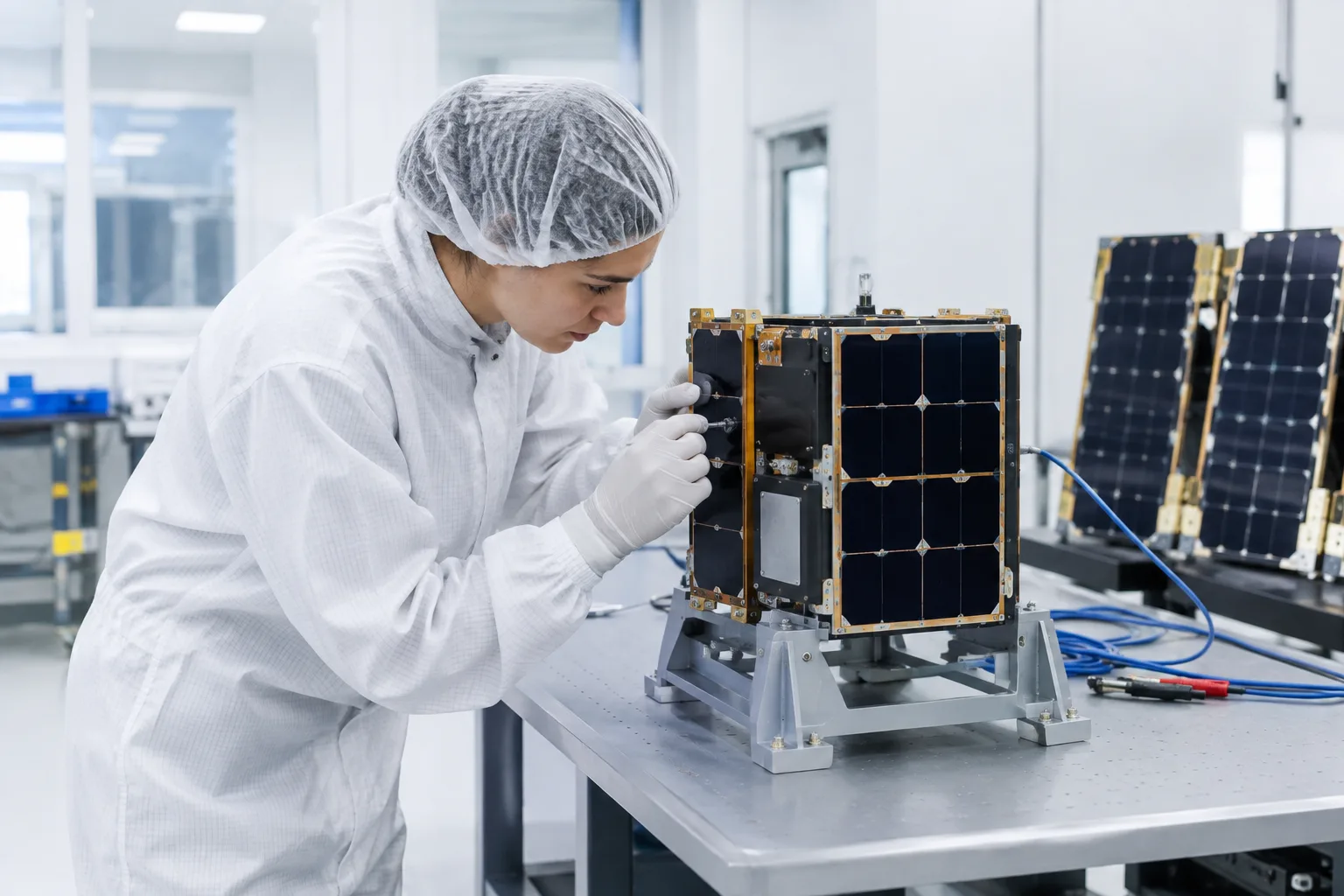

Google has scheduled the first in-orbit test of Project Suncatcher, its moonshot to see whether AI chips can run in space. In a September 24 update, the company said a prototype satellite carrying Google Tensor Processing Units will fly in low Earth orbit on SpaceX’s upcoming Transporter-18 rideshare mission in partnership with Planet. That makes this week’s development important not because Google is launching an orbital data center, but because it is finally subjecting the idea to the conditions that will decide whether space-based AI is infrastructure or just a striking headline.
The practical reader question is simple: is this the start of a credible alternative to terrestrial AI capacity, or mainly a disciplined experiment that will reveal how much harder orbital compute is than “free solar power” suggests? Right now, the second answer is closer to the evidence. But that is exactly why the test matters.
A real milestone, but a narrow one
Project Suncatcher has always been framed as a research bet, not a product launch. When Google first outlined the concept in late 2025, the architecture was ambitious: solar-powered satellites equipped with TPUs, linked together with free-space optical connections, drawing on near-constant sunlight in suitable low Earth orbits. Google argued that satellites there could generate up to eight times more solar power than comparable solar panels on Earth while avoiding some of the land, grid and water constraints facing terrestrial AI campuses.
That logic explains the interest. It does not yet prove a business.
The first flight is meant to answer a more basic question: can advanced AI hardware survive the trip and then function in orbit long enough to yield useful engineering data? According to Google, the launch to orbit lasts about 10 minutes, but the vehicle sees vibration and acceleration up to roughly 10 times gravity, while some individual components can experience 50 to 100 g. Once in space, the test shifts to radiation and temperature extremes, plus the awkward fact that vacuum eliminates airflow. High-power chips can no longer rely on the kind of cooling assumptions common inside Earth-bound data centers.
Reuters, which reported that the mission is expected to launch the following week, described it as Google’s first orbital test of a possible space-based AI-computing system. That framing is apt. This is a hardware-validation mission designed to identify failure points, not a demonstration of commercial AI service.
Every bottleneck solved creates the next bottleneck
The most useful way to read Suncatcher is as a proof ladder. Passing one rung does not clear the whole staircase.
The first rung is survivability. Google said it tested Trillium TPUs at UC Davis’s Crocker Nuclear Laboratory, exposing the chips to a proton beam while running AI workloads. The company reported that the initial tests survived a total ionizing dose greater than what the hardware would receive during a five-year space mission. That is encouraging, but it is still a company-reported laboratory result, not proof that the hardware will operate reliably for years in orbit.
The second rung is thermal management, and this may be the most unforgiving engineering problem in the near term. Space offers abundant sunlight, but no ambient air to carry heat away from dense accelerators. Google says it is testing heat pipes and radiators to move heat away from TPUs. That matters because an AI chip that survives radiation but cannot continuously shed heat is not usable compute; it is a short-lived demo. Future designs could carry dozens of chips per satellite, according to Google, but more compute only intensifies the cooling problem.
Then comes networking. A single satellite running an isolated workload is not the same thing as a scalable compute platform. Suncatcher’s longer-term concept depends on high-bandwidth laser links between satellites so workloads can be distributed across a cluster rather than trapped inside one box. Google says that milestone is slated for 2027, when it plans to test two satellites and the optical links between them. Until that happens, the architecture that would make orbital compute meaningfully different from a one-off experiment remains unproven.
Only after survivability, cooling and interconnect comes the hardest rung: economics. Space-based compute trades one set of bottlenecks for another. It may reduce some terrestrial pressure around power availability, water use, land acquisition, permitting and local opposition. But it substitutes launch cadence, radiation tolerance, heat rejection, satellite manufacturing, orbital operations, replacement cycles, debris management and security. A favorable solar profile does not make the overall system cheap.
What businesses should watch now
For cloud and data-center planners, the signal from Suncatcher is not that Google has found a replacement for conventional campuses. It is that a hyperscaler sees enough strain in the existing model to explore an entirely different one. Power demand for AI is already reshaping utility planning, substation timelines and the geography of new capacity. Even a partial future option that places compute in orbit, or closer to Earth-observation and communications workloads, has strategic value if it can offload a narrow class of jobs.
For chipmakers, aerospace suppliers and satellite operators, the scorecard is practical. Does performance degrade materially under radiation? How much thermal headroom exists once the chips are fully loaded? How much power is actually available after generation, conversion and cooling? Can laser links move enough data, with acceptable latency and fault recovery, to make a cluster useful? How often would satellites need to be replaced as AI hardware ages out faster than traditional spacecraft? Those are the questions that determine whether orbital compute can become dependable, auditable capacity rather than a lab curiosity.
Investors should pay closest attention to what Google has not yet published: the prototype satellite’s full mass, the number of TPUs on the first vehicle, mission duration, first-flight communications architecture, telemetry targets and total mission cost. More important, Google has not disclosed an end-to-end cost per watt, cost per inference, replacement model, manufacturing throughput or debris-mitigation plan. Without those, it is impossible to compare Suncatcher with terrestrial infrastructure on commercial terms.
That gap is why the competitive context cuts both ways. Reuters noted that SpaceX and Starcloud are also pursuing low-Earth-orbit data-center concepts. The clustering of interest suggests the problem is real: terrestrial AI infrastructure is colliding with power and siting limits. But Reuters also reported that outside experts see orbital data centers as years from commercial viability because of launch costs, engineering constraints and satellite-production bottlenecks. Both points can be true at once. A concept can be strategically serious and still economically distant.
What this launch changes is not the market, at least not yet. It changes the quality of the evidence. If the prototype survives launch, withstands radiation and manages its heat budget, Suncatcher becomes more than a white paper. If it struggles, that result is just as valuable, because it will put bounds around how realistic orbital AI really is. For now, the disciplined reading is that Google is building an option, not a replacement: a staged attempt to find out whether sunlight in orbit can be turned into useful compute before the physics, networking and replacement bill overwhelm the idea.

 By
By
 By
By


 By
By
 By
By