

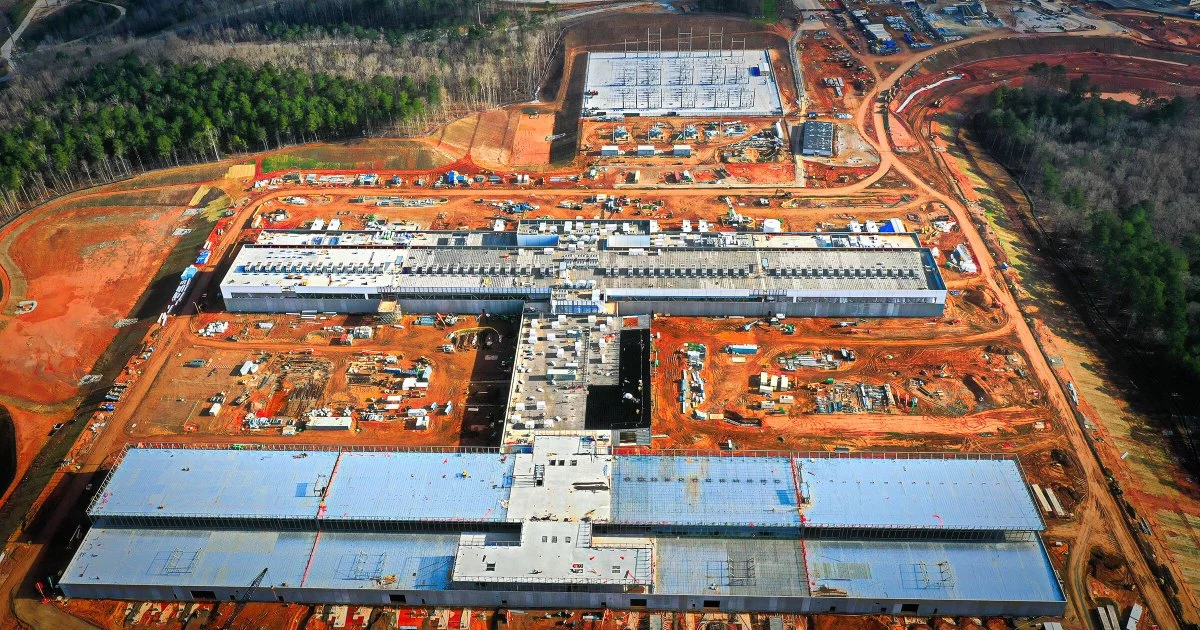

A $31.6 Trillion Buildout Signals AI’s New Center of Gravity—And a Growing Imbalance
The global AI economy is rapidly reorganizing itself around a single, capital-intensive bottleneck: compute infrastructure. A PwC–Bloomberg analysis projecting $31.6 trillion in global data-center spending by 2050—with more than $15 trillion in the United States—frames the scale of what is underway. Under a faster AI-adoption trajectory, that figure could approach $50 trillion within 25 years, a pace that would rival the largest infrastructure cycles in modern economic history.
This is not merely a story about more server halls. It is a structural reallocation of capital away from broad-based physical investment—commercial real estate, traditional industrial buildouts, and other non–data-center construction—toward facilities optimized for AI training and inference. The shift reflects a rational response to surging demand for GPUs and specialized accelerators, but it also introduces a macroeconomic tension: a world that overbuilds compute while underbuilding other productivity-enabling assets may find that the benefits of AI diffuse more slowly than the investment suggests.
For investors and policymakers, the key question is no longer whether AI will be transformative, but whether the financing, energy systems, and productivity outcomes can keep pace with the infrastructure being commissioned in its name.
Inside the Data-Center Redesign: Density, Edge Expansion, and the New Physics of AI Compute
Generative AI and large-scale language models are changing the engineering assumptions of data centers. The industry is moving from conventional enterprise racks to high-density deployments that demand new approaches to cooling, power delivery, and facility layout. The technical direction is clear: more compute per square foot, more watts per rack, and tighter coupling between hardware and infrastructure.
Several technology dynamics are shaping capital decisions:
- Compute intensity is rising faster than traditional efficiency gains. Even as chips improve, frontier models and enterprise adoption expand workloads, pushing aggregate demand upward.
- Architectural evolution is becoming infrastructure-led. High-density racks, liquid cooling, and advanced power distribution are no longer optional upgrades; they are prerequisites for modern AI clusters.
- Edge computing and “micro-data centers” are emerging as complements—not replacements. They offer latency reduction and localized compliance, particularly for regulated industries and sovereign data requirements. Yet they can also fragment capital allocation, complicating standardization and making utilization harder to optimize across a distributed footprint.
This creates a bifurcated market: hyperscale campuses designed for massive training runs and centralized inference, alongside regional nodes optimized for responsiveness and jurisdictional control. The strategic risk is that the industry builds both simultaneously without a clear utilization model—leading to pockets of stranded capacity even as other regions face shortages.
Energy, ESG, and the Grid: The Constraint That Could Redefine AI Economics
Data centers already account for roughly 1–2% of global electricity consumption, and aggressive growth scenarios imply a materially larger share. That reality turns energy from an operating expense into a strategic constraint—one that can reshape where data centers are built, how quickly they can be permitted, and which business models remain viable.
Operators are pursuing mitigation pathways, but progress is uneven:
- On-site renewables and long-term power purchase agreements (PPAs) to stabilize costs and reduce carbon intensity
- Immersion and liquid cooling to improve thermal efficiency and enable higher rack densities
- Waste-heat reuse for district heating or industrial applications, still limited by geography and infrastructure compatibility
The tension is timing. Capacity expansion is moving faster than green retrofits and grid modernization, raising the probability of regulatory intervention. If carbon pricing regimes tighten or local communities push back on water and power usage, the industry could face a new class of delays—less about construction complexity and more about energy politics.
For ESG-focused capital, this is becoming a differentiator. The market is likely to reward operators that can credibly demonstrate carbon-accounted compute, transparent energy sourcing, and measurable efficiency improvements per inference. In an AI-driven economy, sustainability metrics may increasingly function as capacity unlocks, not just reputational safeguards.
Capital Markets, Geopolitics, and the Productivity Test That Will Decide the Cycle
The financial architecture of this buildout is evolving under pressure. Rising interest rates and higher real yields make multi-billion-dollar projects more expensive, pushing lenders toward stricter terms and requiring pre-commitments from anchor tenants. This favors hyperscalers and the largest colocation platforms, reinforcing consolidation dynamics.
Notable financial and strategic currents include:
- Institutional reallocation into data-center REITs and infrastructure funds, attracted by long-duration leases with cloud providers
- Growing discussion of AI infrastructure bonds and blended-finance models that combine public guarantees with private capital—innovative, but still lacking mature credit frameworks
- A visible contraction in non–data-center construction, raising concerns that the broader economy may underinvest in complementary assets such as manufacturing modernization, logistics capacity, and housing near new tech corridors
Layered on top is geopolitics. Chip supply constraints, export controls, and national-security considerations are accelerating “tech sovereignty” strategies. Regions that pair data-center expansion with semiconductor capacity—through initiatives like the U.S. CHIPS Act or Europe’s industrial programs—may capture outsized investment. Others risk becoming dependent compute consumers, a dynamic sometimes described as digital colonization.
Ultimately, the cycle’s durability will be judged by a familiar but unresolved question: productivity. AI’s returns are real in pockets—software development, customer support, analytics—but measured economy-wide gains remain uneven. If enterprises struggle to translate model deployment into sustained ROI, markets could reprice AI infrastructure risk abruptly, turning today’s buildout into tomorrow’s overhang.
The next phase of the AI economy will be defined less by model announcements and more by execution: how efficiently capital becomes compute, how cleanly compute becomes power, and how reliably power becomes productivity.

 By
By


 By
By
 By
By
 By
By
 By
By
 By
By







