

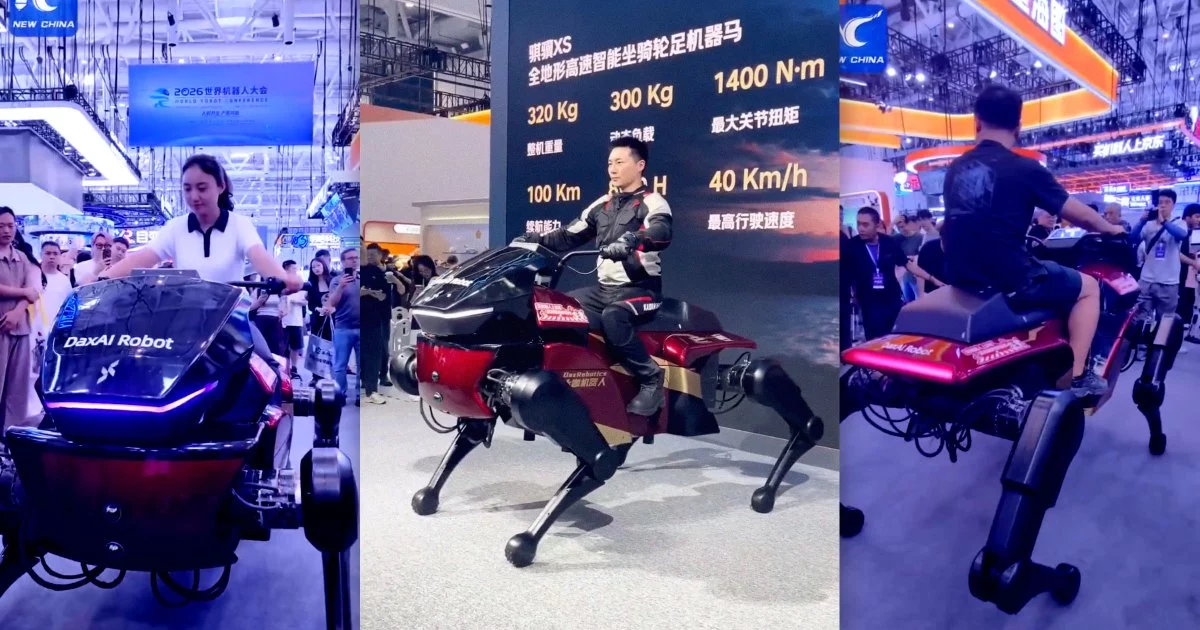

Beijing’s “Cyber Horse” moment: a legged machine steps into the mobility spotlight
At the 2026 World Robot Conference in Beijing, Chinese startup DaxAI introduced a quadrupedal platform that looks less like a lab prototype and more like a new category of vehicle: the Qiji X1 “Cyber Horse.” Part motorcycle silhouette, part oversized robotic canine, it arrives with specifications designed to be discussed in operational terms rather than research milestones—up to 660 pounds of payload, roughly 25 miles per charge, and speeds approaching 6 mph across mixed terrain.
The showroom demonstrations reportedly showed credible autonomous navigation over slopes, gravel, and mud, even if the gait still appeared somewhat jerky—a telltale sign of a system that can “do the task” but is still tuning the fine motor control and compliance needed for smooth, repeatable field performance. That detail matters: in legged robotics, the difference between a compelling demo and a deployable product often lies in the last 10% of stability, reliability, and maintainability.
Strategically, DaxAI’s timing is notable. Competitors like Kawasaki Heavy Industries’ Corleo remain closer to promotional imagery than production readiness, and several Western quadruped leaders have historically emphasized agility and perception over heavy-lift, range, and rugged mobility. Even without a clear Western-facing web presence or a firm market-release timeline, DaxAI has managed to capture attention by presenting something that feels like a near-term industrial tool—and by leaning into the cultural irony of a “horseless horse” at a moment when automation is reshaping physical work.
Under the hood: what the Cyber Horse signals about AI, batteries, and legged control
The Cyber Horse’s headline numbers point to a convergence of maturing technologies rather than a single breakthrough. Modern quadrupeds live or die by how well they fuse sensing, compute, and actuation under real-world uncertainty—dust, vibration, uneven ground, shifting loads, and intermittent connectivity.
Key technical implications suggested by the debut include:
- Sensor fusion moving from “awareness” to “assurance.” A platform navigating unstructured terrain autonomously likely relies on a perception stack combining LiDAR, stereo or depth vision, and inertial measurement (IMU), stitched together via real-time state estimation. The business value isn’t merely seeing obstacles; it’s maintaining predictable stability while carrying heavy loads and encountering terrain transitions that can destabilize a legged system in milliseconds.
- Reinforcement learning and model-based control meeting in the middle. The observed jerkiness hints at ongoing calibration of foot–ground interaction models, actuator timing, and compliance. In practical deployments, the winning approach is often hybrid: learning-based policies for adaptability, anchored by physics-informed controllers for safety envelopes and repeatability.
- Payload-to-range as a proxy for powertrain maturity. A stated 660-pound payload paired with 25 miles per charge suggests meaningful progress in battery energy density, power management, and drivetrain efficiency. For heavy-duty quadrupeds, the limiting factors are rarely just battery capacity; they are thermal constraints, peak power draw during stance transitions, and the ability to manage energy under variable load. Expect future iterations to emphasize:
– thermal management under sustained duty cycles
– modular battery packs for rapid swap logistics
– potential regenerative strategies where terrain and gait allow
- Autonomy in unstructured environments as the real differentiator. True “all-terrain autonomy” requires sub-second decisions: terrain classification, foothold selection, gait switching, and safe stopping behavior. The Cyber Horse’s demo suggests the autonomy stack is functional; commercial readiness will depend on how well it handles edge cases—slick mud, loose gravel, unexpected obstacles, and degraded sensor conditions.
China’s robotics acceleration: industrial policy, supply chains, and competitive positioning
DaxAI’s emergence fits a broader pattern: China’s push to cultivate domestic robotics champions capable of scaling quickly into sectors facing labor constraints and safety risks—agriculture, infrastructure, mining, and emergency response. The advantage is not only technical talent; it is the ability to align R&D subsidies, procurement pathways, and manufacturing depth into a faster commercialization loop.
From a business and technology standpoint, three strategic dynamics stand out:
- A “Made-in-China” stack reduces exposure to external controls. Localizing actuators, sensors, and batteries is increasingly central as global technology policy hardens. In an era of export controls and selective decoupling, supply-chain sovereignty becomes a product feature—affecting cost, lead times, and the feasibility of scaling.
- Differentiation through heavy-lift legged mobility. Many quadrupeds have proven they can walk, climb, and inspect. Fewer are positioned as load-bearing mobility platforms that can substitute for small off-road vehicles in terrain where wheels struggle. If DaxAI can deliver reliability metrics—mean time between failures, actuator lifespan, field serviceability—it can compete on cost-per-hour of operation, not novelty.
- Ecosystem economics will decide the category. The robot itself is only the beginning. Commercial adoption typically hinges on:
– predictive maintenance and parts availability
– digital twins for mission rehearsal and risk analysis
– 5G/edge connectivity for monitoring and fleet management
– integrator partnerships that translate hardware into workflows
This is where Western competitors have often excelled—through software tooling, developer ecosystems, and enterprise integration. DaxAI’s long-term competitiveness will depend on whether it can match that service layer while maintaining manufacturing speed.
Where quadrupeds go next: pilots, standards, and the geopolitics of autonomy
The most plausible near-term deployments for a heavy-lift quadruped like the Cyber Horse are not consumer mobility fantasies but industrial and municipal pilots where terrain and risk justify a premium:
- Mining, forestry, and pipeline inspection in remote or unstable ground conditions
- construction logistics and heavy-equipment escorting where wheeled robots bog down
- disaster response for supply delivery and reconnaissance in debris fields
- defense logistics for uncrewed resupply in forward or contested environments
As these systems move from conference floors to worksites, the next bottleneck becomes governance: safety certification, cybersecurity norms, and interoperability standards. International bodies such as ISO and IEEE will face pressure to codify requirements for legged robots operating near people, vehicles, and critical infrastructure. Companies that engage early in standards-setting can shape certification pathways—and, by extension, market access.
DaxAI’s Cyber Horse ultimately reads as more than a spectacle. It is a signal that legged robotics is shifting from “can it walk?” to “can it work?”—and that the competitive race will be decided by those who can industrialize autonomy: robust hardware, dependable AI control, and a service ecosystem that makes a machine like this not just impressive, but indispensable.


 By
By
 By
By

 By
By
 By
By
 By
By
 By
By







