
When synthetic war footage collides with real-world strikes
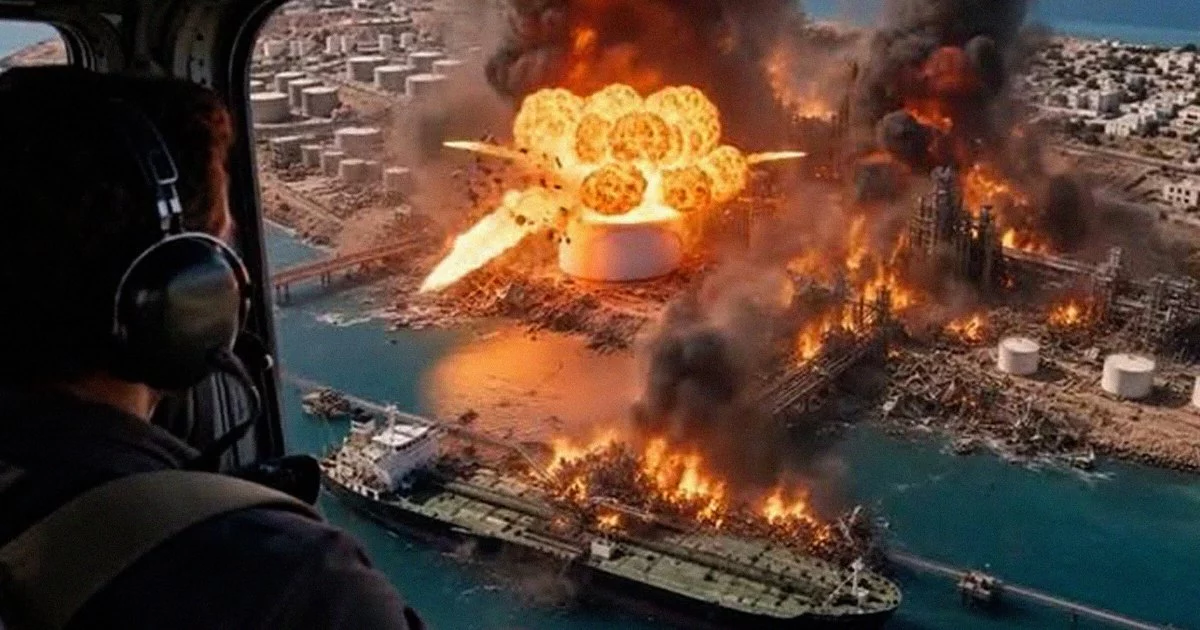
President Donald Trump’s recent Truth Social posts—two AI-generated videos depicting a fictitious U.S. strike on Iran’s Kharg Island, a critical oil export hub—landed in an already combustible information environment. The absence of any disclaimer that the clips were synthetic is not a minor etiquette breach; it is a structural stress test for modern crisis communications. In the same news cycle, the United States carried out real strikes on Larak Island, followed by an Iranian missile retaliation targeting U.S. bases in Jordan. The juxtaposition is stark: authentic military action unfolding alongside fabricated “battlefield evidence” distributed by a head of state.
Vice President J.D. Vance’s vague framing of the episode as a social-media “switch-up” may be politically convenient, but it underscores a deeper institutional dilemma: when leaders treat generative media as performative messaging rather than a high-risk instrument, they blur the boundary between narrative and operational reality. In national security contexts, that boundary is not philosophical—it is the line that separates deterrence from miscalculation.
For business and technology audiences, the more consequential point is that this is not merely a political controversy. It is a preview of a new market and governance regime in which synthetic content can move capital, redirect ships, and reshape risk premiums—even when it is demonstrably false.
Generative AI as a destabilizing layer in national security signaling
The Trump videos illustrate how consumer-accessible generative AI now produces war-like imagery with a level of realism that can bypass traditional gatekeepers: editors, intelligence briefers, and institutional spokespeople. The result is a fast-expanding “signal-to-noise” problem—one that is especially dangerous when the subject is military escalation in the Persian Gulf.
Key technological dimensions emerging from this episode include:
- Deepfake acceleration and decision latency: Hyper-realistic synthetic video compresses the time available for verification. In a crisis, leaders and markets often react before forensic confirmation is possible, creating a window where falsehoods can become “actionable.”
- Breakdown of shared evidentiary standards: When a prominent account publishes synthetic strike footage without provenance, it normalizes a world where “seeing is believing” no longer holds—eroding the baseline assumptions that stabilize diplomacy and crisis management.
- Verification gaps and watermarking urgency: The incident strengthens the case for mandatory provenance standards, including watermarking and cryptographic content credentials. Without them, the public sphere becomes an arena where authenticity is perpetually contested and therefore strategically exploitable.
This is where the technology sector’s responsibility becomes unavoidable. Deepfake detection tools exist, but they are unevenly deployed, inconsistently standardized, and rarely integrated into real-time public communications channels. The practical requirement is not just better detection—it is interoperable provenance infrastructure that can operate at the speed of social media and the scale of global news distribution.
Oil markets, shipping risk, and the rise of “deepfake-driven volatility”
Kharg Island is not a symbolic target in energy terms; it is a globally consequential node. Even rumors of disruption there can ripple through Brent crude pricing, cargo premiums, and hedging behavior. The fact that a fabricated strike narrative could circulate amid real hostilities highlights a new category of risk: deepfake-driven volatility, where synthetic media becomes an accelerant for market swings.
The economic and operational implications are immediate:
- Price discovery under information attack: Traders and risk desks increasingly must evaluate not only fundamentals and geopolitics, but also the probability that viral content is synthetic. This adds friction to price discovery and can widen bid-ask spreads during stress events.
- War-risk surcharges and insurance repricing: Heightened uncertainty around the Strait of Hormuz region tends to raise marine insurance rates and war-risk premiums. Synthetic “evidence” of strikes can amplify perceived threat levels even when the underlying reality is unchanged.
- Capital allocation and investment confidence: Prolonged ambiguity—especially when compounded by misinformation—can deter investment in regional upstream projects and complicate Western infrastructure upgrades. The energy transition already faces financing and permitting constraints; information instability adds another drag.
For corporations, the operational takeaway is that disinformation is no longer reputational-only. It is a balance-sheet issue. Energy firms, shipping companies, insurers, and commodity trading houses may need to treat synthetic media as a persistent market variable—akin to weather risk or sanctions risk—embedded into scenario planning and hedging strategies.
Credibility, deterrence, and governance in the era of synthetic influence
Strategically, the use of AI-generated “victory footage” points to a credibility problem that adversaries can exploit. Deterrence relies on believable signaling: capabilities, intent, and resolve. When synthetic media substitutes for verifiable outcomes, opponents may interpret it not as strength, but as a compensatory narrative—a sign that the information domain is being used to mask strategic ambiguity or operational limits.
This episode also illustrates the emergence of a digital front in geopolitical competition:
- Narrative control as a weapon system: State and non-state actors can flood the zone with synthetic content to provoke overreaction, fracture alliances, or manipulate domestic opinion.
- Alliance risk calculus: Gulf partners, already wary of missile exchanges and escalation dynamics, must now factor in the possibility that synthetic narratives—whether domestic or adversarial—could trigger unintended spirals.
- Corporate communications as a target surface: Multinationals operating in sensitive regions should assume that synthetic media may be used to fabricate incidents, sabotage trust, or force costly operational pauses.
What follows is a governance challenge spanning public and private sectors. Boards and C-suites will face rising expectations to verify the provenance of critical information before acting on it. Governments, meanwhile, will confront mounting pressure to implement AI content standards—not as abstract safety principles, but as infrastructure for national security, market integrity, and public trust.
The most enduring lesson from this moment is that generative AI has quietly become a macro-risk multiplier: it can intensify geopolitical crises, distort energy markets, and corrode institutional legitimacy—all without firing a shot, and sometimes while real shots are already being fired.

 By
By
 By
By
 By
By

 By
By
 By
By
 By
By