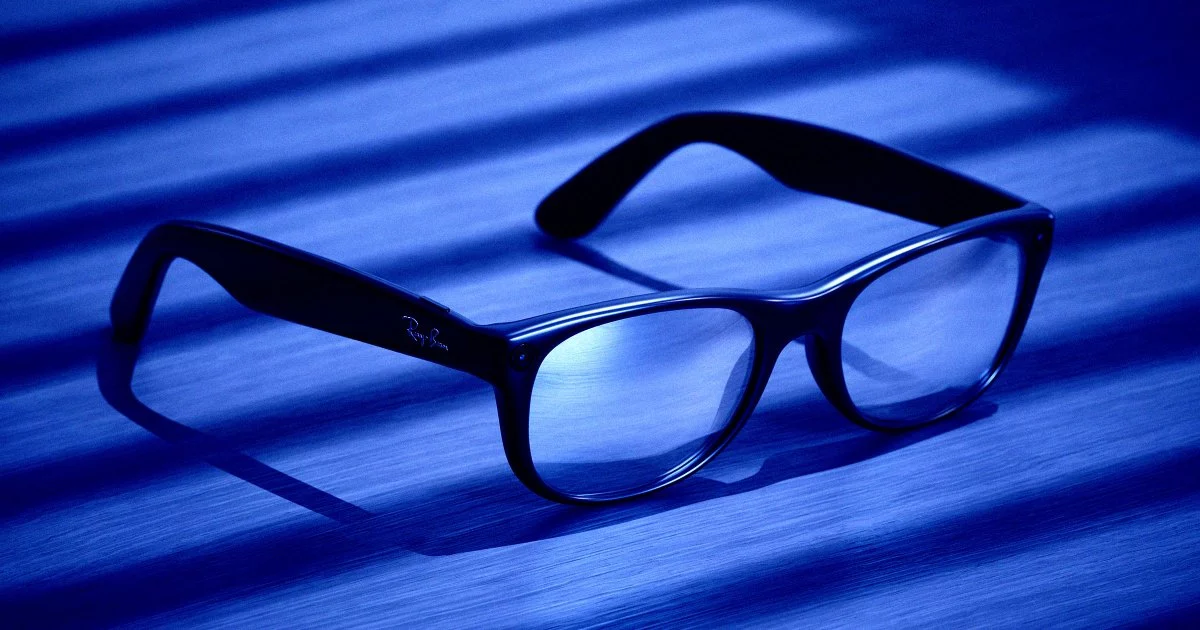

When smart eyewear becomes a social liability, not a status symbol
Meta’s Ray-Ban–styled AI glasses were designed to look ordinary—an intentional choice meant to normalize wearable computing. Yet that very normalcy has become a core part of the backlash. As reports of misuse spread—ranging from “pickup artist” content to prank recordings—the product has been recast in the public imagination as a tool for covert capture rather than hands-free convenience. The “pervert glasses” label is not just a meme; it is a market signal that social acceptability is now a gating factor for adoption.
Wearables occupy a uniquely sensitive position in the technology stack. A phone can be put away; glasses sit on the face, pointed outward, always plausibly “on.” That creates an ambient surveillance dynamic in public spaces—one that bystanders cannot easily interpret or consent to. The result is a reputational externality: even responsible owners may avoid wearing the device because the *category* has acquired stigma. For Meta, this is a strategic problem as much as a product problem, because smart glasses are positioned as a key interface for its broader AI and metaverse ambitions.
Several forces are converging to intensify the scrutiny:
- Visibility asymmetry: bystanders often cannot tell when recording is happening.
- Misuse at the edges becomes the headline: a small number of bad actors can define the narrative for everyone.
- Context collapse: what feels like “capturing a moment” to the wearer can look like “surveillance” to everyone else.
- Trust deficit compounding: once the public assumes covert recording is possible, every design choice is interpreted through suspicion.
The lesson is blunt: in consumer wearables, perception is part of the security model. If people don’t believe the safeguards, the safeguards don’t function as safeguards in the real world.
Hardware “kill switches” and the limits of cosmetic privacy signals
Meta’s newly surfaced patent for a hardware-enforced “kill switch”—a mute/lock feature intended to disable sensors—signals a shift toward privacy-by-design rather than privacy as an afterthought. In principle, that is the right direction. In practice, the credibility of any privacy control depends on whether it is:
- User-comprehensible (clear to the wearer),
- Bystander-legible (clear to people nearby), and
- Tamper-resistant (hard to bypass in the field).
Current safeguards have struggled on all three dimensions. The most visible cue—an LED indicator—has been criticized as too easy to obscure, reportedly as simple as covering it with a sticker. Software-based tamper detection can help, but software is inherently contestable: it can be bypassed, exploited, or outpaced by adversarial tinkering. That is why the industry’s privacy and security conversation is moving toward sensor-level enforcement and hardware-rooted trust.
For smart glasses, the technical bar is higher than it is for smartphones because the device is:
- Always oriented toward other people,
- Used in mixed public/private settings, and
- Expected to remain stylish and lightweight, limiting battery, thermal headroom, and physical space for robust mechanisms.
A credible next-generation approach typically involves combinations of:
- Physical shutters or mechanical interlocks that are obvious when engaged
- Immutable hardware coupling between sensor activation and visible indicators
- Secure boot chains and cryptographic attestation to prove the device is running untampered firmware
- Isolated security enclaves to protect sensor control paths from application-level compromise
Meta’s patent may be an important step, but the broader question is whether the company can deliver verifiable, not merely promised, privacy guarantees—and do so in a form factor consumers will actually wear.
Data handling, contractor review, and the governance risk that won’t go away
The trust challenge is not limited to what the glasses can record; it extends to what happens after recording. Reports that Meta contractors in Nairobi reviewed user footage—some of it sensitive—reignited concerns about surveillance-by-workflow, where privacy risk emerges not from a single feature but from the operational pipeline behind it.
This is where wearable AI becomes qualitatively different from earlier consumer electronics. Smart glasses are not just cameras; they are AI sensors feeding systems that may require human review for training, safety, or quality assurance. That introduces governance questions that regulators and consumers increasingly treat as first-order:
- Who can access raw footage, and under what controls?
- What is the retention period, and is deletion enforceable?
- Are users meaningfully informed, or merely “consented” via dense terms?
- How are contractors vetted, monitored, and audited across jurisdictions?
- What redaction or minimization is applied before human review?
For Meta, the geopolitical dimension matters as well. Distributed contractor operations can be efficient, but they also amplify cross-border compliance complexity and create reputational exposure when oversight appears opaque. In a world shaped by GDPR, CCPA, and emerging U.S. privacy proposals, the cost of getting this wrong is not theoretical: it can include fines, forced product changes, litigation, and recalls, alongside the harder-to-quantify erosion of brand trust.
Competitive pressure and the strategic reality: trust is the product
Meta is not building in a vacuum. Apple, Snap, Google, and a growing field of AR and AI wearable players are pursuing similar endpoints: hands-free computing, contextual AI assistance, and camera-enabled experiences spanning consumer, enterprise, and health-adjacent use cases. In that landscape, privacy and safety are not merely compliance checkboxes—they are competitive differentiators.
The economic risk for Meta is twofold. First, negative branding can suppress demand, undermining the scale needed to justify high R&D and manufacturing costs. Second, reputational drag can weaken developer and enterprise partnerships, which depend on predictable governance and low liability. A wearable platform cannot thrive if businesses fear it will be banned from workplaces, campuses, or public venues.
What would materially change the trajectory is not a single feature release, but a layered trust strategy that is easy to explain and hard to dispute:
- Hardware-enforced sensor disablement that is independently testable
- Third-party certification and audits of both device integrity and data handling workflows
- Transparent reporting on access, retention, and review practices
- Clear misuse policies with credible enforcement, without drifting into pervasive monitoring that creates new privacy harms
Meta’s smart glasses now sit at a defining crossroads for the entire wearable AR category. If the company can make privacy protections *tamper-evident, legible to bystanders, and verifiable by independent parties*, it can help reset expectations for what responsible AI eyewear looks like. If it cannot, the product risks becoming a case study in how quickly public spaces—and public opinion—can reject technology that feels like surveillance dressed as fashion.

 By
By
 By
By
 By
By
 By
By

 By
By
 By
By
 By
By