
A viral grizzly encounter exposes the attention economy’s risk calculus
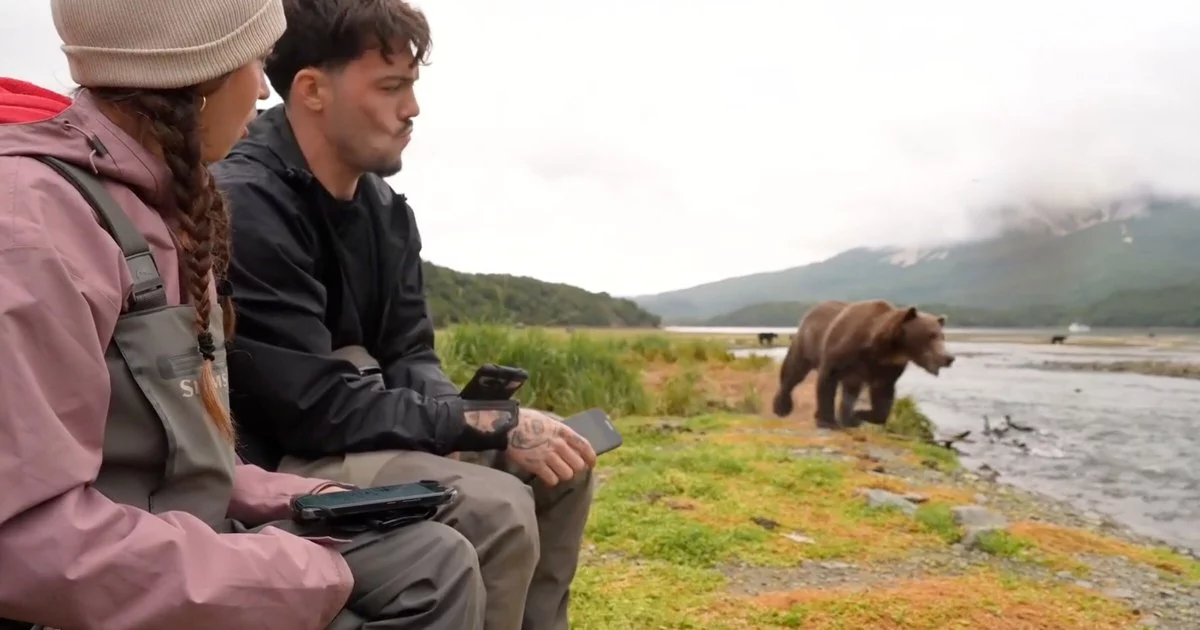
A widely shared livestream clip—circulating prominently on Reddit—shows streamer Maya Higa and esports personality FaZe Adapt sitting on a log in unnervingly close proximity to a wild grizzly bear. Over a span reported to be nearly 12 hours, the pair continued to engage their audience while the bear moved within what appears to be only a few yards, approaching the water to fish. At one point, Higa—who operates a Texas-based wildlife sanctuary—remarked that she recognized the bear from earlier sightings, while also suggesting that retreating could provoke an attack.
The moment lands with such force because it compresses multiple modern tensions into a single frame: the spectacle of proximity, the monetization of real-time danger, and the uneasy overlap between wildlife advocacy and wildlife entertainment. Viewers are not simply watching nature; they are watching people decide, minute by minute, how far to push a boundary while thousands of others react in real time.
It is also difficult to ignore the cultural echo of Timothy Treadwell, the subject of *Grizzly Man*, whose intense fascination with bears ended in his death in 2003. The comparison is not a claim of equivalence—contexts differ—but it underscores a recurring pattern: when awe becomes performance, and performance becomes identity, the margin for error narrows quickly.
Platform mechanics: how livestream design can reward escalation
Livestreaming is not merely a distribution channel; it is a behavior-shaping system. Platforms such as Twitch and YouTube optimize for metrics that correlate with retention and monetization—watch time, chat velocity, concurrent viewers, subscriptions, donations, and clip sharing. In that environment, “high-stakes” content can become structurally advantaged, even when no one explicitly intends harm.
Several platform dynamics are especially relevant:
- Algorithmic incentives favor intensity: Content that triggers spikes—fear, suspense, controversy—often generates stronger engagement signals, which can translate into broader reach.
- Real-time analytics create feedback loops: Live dashboards and chat reactions provide instant reinforcement. When numbers rise during risky moments, creators may feel pressure to maintain the scenario rather than de-escalate.
- Minimal production governance: Traditional film and television shoots typically involve producers, safety officers, location permits, and insurer requirements. Many livestreamers operate without comparable oversight, formal risk assessments, or professional wildlife guidance.
- Audience co-authorship: Live chat can function like a crowd-sourced director’s room—sometimes encouraging caution, sometimes rewarding bravado. Either way, it intensifies the sense that the “show” must continue.
This is not an argument that platforms “cause” dangerous behavior. It is a recognition that product design—what gets measured, rewarded, and amplified—can tilt decision-making under pressure. When the content itself is a live, unfolding risk, the system’s incentives can become indistinguishable from the storyline.
The business layer: sponsorship exposure, creator economics, and liability
The economics of creator media increasingly resemble a competitive market where differentiation is scarce and attention is expensive. As advertising rates and CPMs fluctuate and many niches saturate, creators often seek novel formats—travel, wilderness, endurance, “authentic” adventure—to stand out. That pursuit can be legitimate and creatively valuable. The problem emerges when novelty is achieved by compressing safety margins.
From a business and technology standpoint, the incident highlights three overlapping risk surfaces:
- Creator monetization pressure: When revenue depends on sustained engagement, the temptation is to extend the moment—stay longer, get closer, keep the tension alive—because the audience is visibly present and responsive.
- Brand and sponsor risk: Outdoor-gear, gaming, and lifestyle brands that sponsor creators may face reputational fallout if an affiliate is perceived to be endangering themselves or wildlife. A single incident can trigger rapid social backlash, calls for deplatforming, or demands for sponsor accountability.
- Legal and insurance gaps: If a dangerous encounter results in injury, rescue costs, or wildlife harm, questions arise quickly: Were there permits? Were guidelines followed? Was there negligence? Unlike established production environments, influencer-led expeditions often lack standardized documentation, safety protocols, or insurance coverage tailored to live content.
This is where the “attention economy” becomes an enterprise risk issue. The more brands rely on creators for reach and authenticity, the more they inherit the operational hazards of unscripted, lightly governed production—especially when the “set” is a wilderness environment with unpredictable variables.
Where governance may go next: standards, disclosures, and “responsible livestreaming”
Incidents like this tend to accelerate institutional responses—not always through sweeping regulation, but through incremental shifts in platform policy, sponsor contracts, and industry norms. Several plausible developments are already visible on the horizon:
- High-risk content labeling and age gating: Platforms may expand rules around dangerous acts to more explicitly include close wildlife interactions, requiring warnings, restricted distribution, or reduced algorithmic promotion.
- Creator safety certifications and training modules: Voluntary programs—potentially built with NGOs, wildlife experts, and insurers—could become de facto requirements for monetization eligibility in certain categories.
- Sponsor due diligence as standard practice: Brands may begin auditing creators’ safety track records, requiring documented protocols, and inserting stricter clauses around hazardous stunts and wildlife conduct.
- Specialized insurance products: Expect growth in “streamer liability” coverage for adventure and wildlife content, potentially bundled with risk assessments and compliance checklists.
The deeper strategic question is whether the industry can reprice “authenticity” away from peril. Audiences do reward expertise—credible wildlife education, ethical distance, and professional fieldcraft—when it is presented with narrative skill. Platforms and sponsors that elevate competence over closeness may ultimately build more durable trust, because the most valuable commodity in creator media is not adrenaline; it is credibility that survives the next viral clip.

 By
By
 By
By
 By
By
 By
By
 By
By