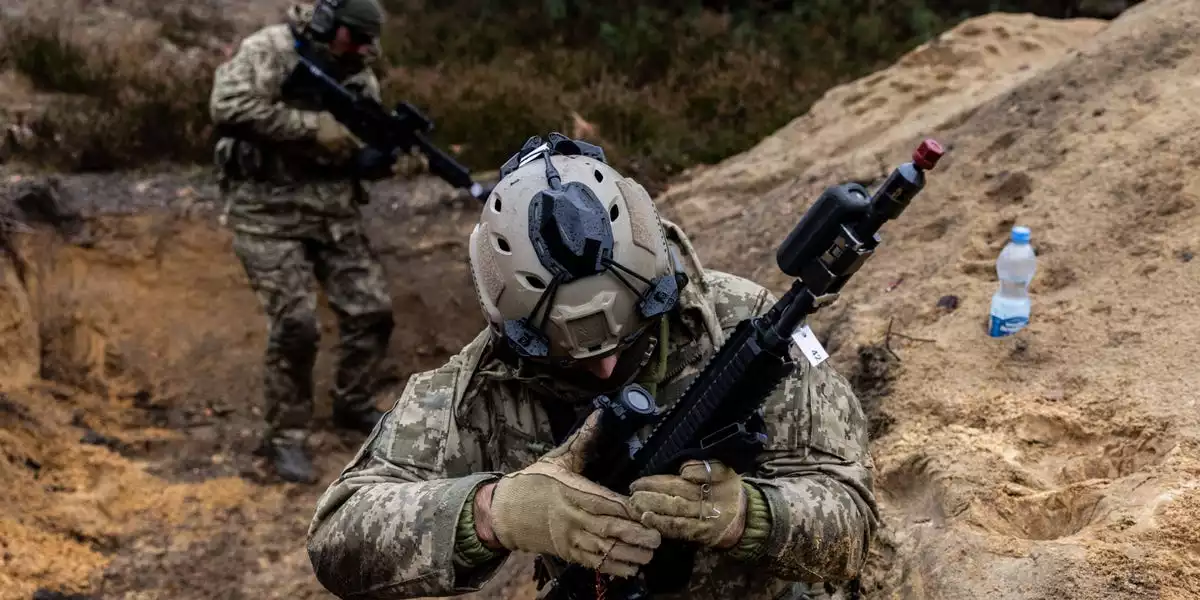

Camp Jomsborg and NATO’s “learning loop” from Ukraine’s drone war
At Camp Jomsborg in Poland, NATO’s Operation Legio has become a practical laboratory for absorbing frontline lessons from the Russia–Ukraine conflict—particularly the rapid evolution of unmanned aerial systems (UAS). Led by Norwegian Brigadier Atle Molde, the effort reflects a broader institutional shift: NATO is no longer treating drones as a niche enabler, but as a central feature of modern combat that reshapes reconnaissance, targeting, logistics, and force protection.
What makes this exchange unusually valuable is its bidirectionality. Ukrainian units arrive with hard-earned battlefield experience—how to iterate quickly under fire, how to improvise with limited inventories, and how to adapt tactics to a contested electromagnetic spectrum. NATO, in turn, offers the scaffolding Ukraine has often lacked in wartime conditions: standardized doctrine, structured training pipelines, and integrated combined-arms planning.
Yet the most important takeaway from Operation Legio may be its restraint. NATO’s message is not “copy Ukraine,” but “understand why Ukraine fights this way.” The Ukrainian model is shaped by constraints—limited air superiority, shortages of artillery and fixed-wing aircraft, and the necessity of rapid, low-cost adaptation. Those conditions generate innovation, but they also risk producing lessons that are overfitted to a specific battlefield.
Necessity-driven innovation versus NATO’s advantage-driven doctrine
Ukraine’s drone ecosystem has expanded across a wide spectrum: ISR quadcopters, FPV strike drones, loitering munitions, and UAS-enabled logistics. Many of these systems are built or modified using commercial off-the-shelf components, open-source software, and fast-turn manufacturing. The result is a wartime innovation engine that prioritizes speed and volume over exquisite performance.
For NATO planners, this creates a strategic tension. Western analysts such as Justin Bronk and Jakub Jajcay caution that NATO’s force structure is fundamentally different: it typically has access to a deeper bench of capabilities—manned aviation, long-range precision fires, layered air defense, and mature electronic warfare. In that context, over-rotating toward drones could unintentionally crowd out investments in platforms that remain decisive in high-intensity, peer-on-peer conflict.
A calibrated interpretation is emerging: NATO can adopt Ukraine’s *methods* without adopting Ukraine’s *constraints*. That implies:
- Rapid prototyping and modular payloads as standard procurement expectations, not wartime exceptions
- Shorter feedback cycles between operators and industry, mirroring Ukraine’s field-driven iteration
- Clear role definition for UAS—as force multipliers that extend sensing and reach, rather than substitutes for airpower, artillery, or integrated fires
This distinction matters because drones are not a universal solvent. They are highly effective in certain mission sets—persistent surveillance, target acquisition, point strikes, and tactical resupply—but they are also vulnerable to jamming, spoofing, kinetic interception, and attrition economics when facing a sophisticated adversary with robust counter-UAS capabilities.
The new combined-arms reality: drones, electronic warfare, and counter-UAS competition
The Ukraine theater has made one fact unavoidable for modern militaries: the air domain is now crowded at low altitude, and the electromagnetic spectrum is as contested as physical terrain. Drone swarms, electronic warfare (EW), and indirect fires interact in tight loops—spot, jam, strike, relocate—often within minutes.
For NATO, the operational lesson is less about any single drone tactic and more about multi-domain synergy. Effective UAS employment increasingly depends on:
- EW-aware mission planning, including frequency agility and emissions discipline
- Integration with indirect fires, where drones compress the sensor-to-shooter timeline
- Counter-UAS as a system, not a gadget—linking radar, passive detection, EW, and interceptors
Crucially, NATO’s advantage lies in its ability to systematize what Ukraine has often done ad hoc. Rather than replicating improvised countermeasures, NATO can embed counter-drone defense into a broader integrated air and missile defense (IAMD) architecture—pairing advanced sensors with layered effects, including interceptor drones where appropriate.
This is where Operation Legio’s training exchange becomes strategically consequential. Ukrainian experience provides realism: what breaks in the field, what operators actually need, and how quickly the threat evolves. NATO doctrine provides coherence: how to ensure drones support maneuver, how to prevent fratricide in crowded airspace, and how to keep tactical innovation aligned with operational objectives.
Industrial resilience and the economics of scale in autonomous warfare
Behind the tactics sits an industrial story with direct implications for defense technology markets and national security supply chains. Ukraine’s reliance on consumer-grade components—cameras, motors, batteries, microelectronics—demonstrates both the promise and fragility of dual-use sourcing. It enables rapid scaling and experimentation, but it also introduces vulnerabilities: inconsistent quality control, dependence on global supply routes, and exposure to export restrictions or adversary disruption.
For NATO allies, the industrial agenda is increasingly clear: build autonomy at scale without building fragility at scale. That means investing in:
- Certified, military-grade microelectronics and secure communications that can survive contested EW environments
- Surge-capable manufacturing for airframes, propulsion modules, and batteries—designed for sustained production, not boutique runs
- R&D prioritization in autonomy, AI-enabled targeting support, and resilient navigation, while maintaining rigorous governance to reduce misidentification and escalation risk
- Transatlantic innovation accelerators that connect defense primes, startups, and military labs—capturing Ukraine’s rapid-iteration ethos within controlled quality frameworks
Strategically, the conflict reinforces a foundational principle: air superiority remains a force multiplier. Ukraine’s heavy reliance on drones is partly a workaround for the absence of uncontested skies. NATO’s deterrence posture—especially in any scenario involving Russia—still depends on preserving air dominance, long-range fires, and electronic warfare superiority. Drones fit best when they extend those advantages, not when they are asked to replace them.
Operation Legio, viewed through this lens, is less a crash course in drone tactics than a disciplined attempt to modernize NATO’s doctrine, training, and industrial base without mistaking wartime improvisation for a universal blueprint. The alliance is studying the future of combat in real time—then stress-testing those lessons against the realities of peer conflict, where the decisive edge will come from integration, resilience, and the ability to scale credible capability faster than an adversary can adapt.

 By
By
 By
By

 By
By


 By
By
 By
By