
A Himalayan border hub collapses—and exposes a new class of compound risk
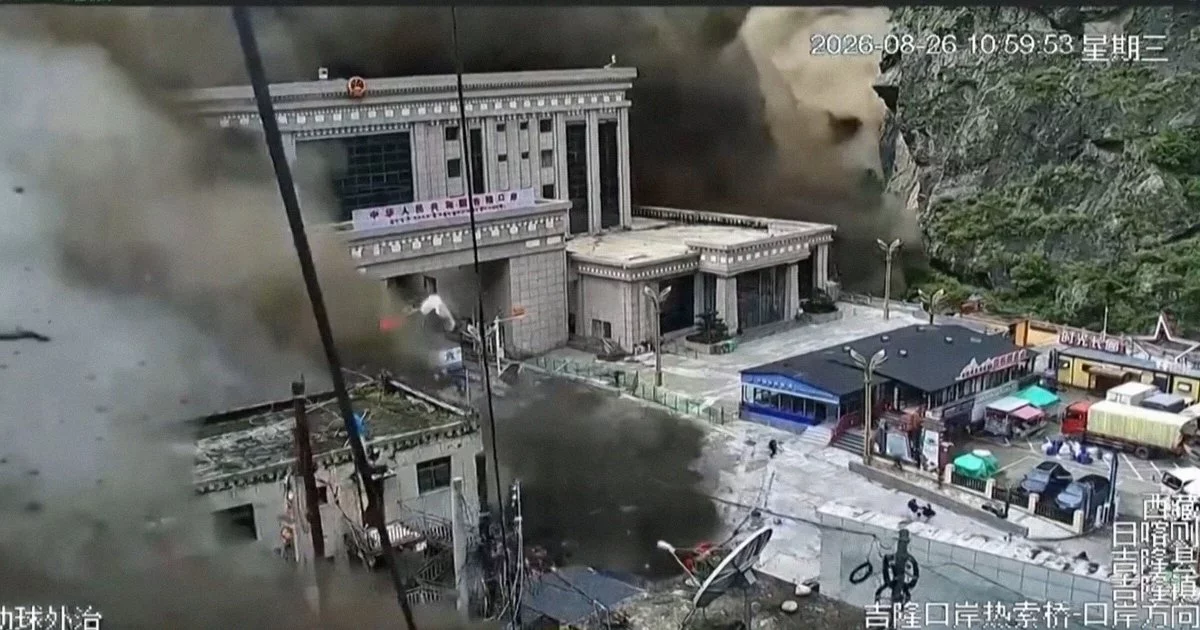
The destruction of the six-story Gyirong Port facility in Nepal’s Himalayan Gyirong Valley is more than a tragic breaking-news event; it is a high-velocity case study in how climate volatility, geophysical instability, and infrastructure fragility can converge into a single catastrophic failure. Security footage reportedly shows a wall of mud and glacial water swallowing the building within seconds—an image that underscores how little time modern systems often have to detect, decide, and respond when hazards compound.
Authorities have confirmed at least 95 fatalities, with hundreds still unaccounted for, while damaged roads, communications towers, and electrical lines have complicated rescue operations in extreme terrain and weather. Preliminary assessments point to a multi-factor trigger: record monsoon rainfall, a possible seismic disturbance that may have destabilized glacial ice, and an abrupt water release that accelerated downstream force. Whether the initiating event proves to be a landslide-dammed lake breach, a glacial outburst, or a quake-assisted slope failure, the operational lesson is the same: in the Himalayas, hazards rarely arrive one at a time.
For business and technology stakeholders, Gyirong is a reminder that “natural disaster” is increasingly an incomplete label. What is unfolding looks more like a systems failure across the built environment, where the physical shockwave quickly becomes a digital, logistical, and financial shockwave.
Infrastructure and technology gaps: when legacy design meets accelerated extremes
Many mountain-border facilities and highways across the region were engineered for historical baselines—monsoon patterns and slope behavior that now appear less reliable. The Gyirong collapse highlights a set of vulnerabilities that are as much technological as they are structural.
Key exposure points include:
- Legacy construction assumptions in high-risk corridors
Border ports, retaining structures, and mountain roads often reflect design thresholds optimized for “expected” rainfall intensity and runoff volumes. When precipitation regimes intensify, slope saturation and debris-flow probability can rise nonlinearly, overwhelming protective works that were never sized for today’s extremes.
- Fragile communications and power as a force multiplier
The loss of communication towers and electrical lines is not merely collateral damage; it directly reduces the speed and accuracy of evacuation coordination, situational awareness, and rescue logistics. In remote valleys, centralized grids and single towers can become single points of failure.
- Early-warning deficits and sparse sensor coverage
The Himalayas remain under-instrumented relative to the pace of risk. Seismic and hydrological sensors are sparse, and predictive models struggle with rapid meltwater surges from small glaciers and short-lived impoundments. Without dense telemetry, authorities and operators are left with delayed signals and incomplete hazard pictures.
- The promise—and current absence—of real-time digital risk operations
Tools such as digital twins, AI-driven slope-stability analytics, and near-real-time satellite monitoring are often discussed but unevenly deployed. The gap is not only technical; it is logistical (installation and maintenance at altitude), regulatory (spectrum and cross-border data), and financial (who pays for monitoring that benefits many).
This is where resilient architecture becomes a technology story: mesh networks, ultrawideband communications, edge computing nodes, and IoT sensor arrays are not “nice-to-have” upgrades. In fast-moving mass-wasting events, they can determine whether warnings arrive in minutes—or not at all.
Trade, supply chains, and Belt and Road exposure: the economics of a broken crossing
Gyirong Port is widely viewed as a strategic node on the China–Nepal border and a practical conduit within broader Belt and Road connectivity into South Asia. Its sudden loss introduces immediate operational disruption and longer-term strategic recalibration.
Near-term economic impacts are likely to include:
- Rerouted freight and higher logistics costs as cargo shifts to longer overland alternatives or maritime pathways, increasing transit times and working-capital requirements.
- Import backlogs in Nepal, particularly for time-sensitive or high-demand categories such as machinery, pharmaceuticals, and consumer goods.
- Export pressure on local producers, including Himalayan agricultural and specialty goods, as alternative routes reduce margins and reliability.
The financing implications may be just as consequential. If Beijing accelerates funding for upgraded border crossings or alternative routes through Tibet, Nepal could see faster reconstruction—but also heightened scrutiny around debt sustainability and project risk allocation. Meanwhile, multilateral lenders and international investors are likely to reassess risk premia for Himalayan infrastructure, potentially raising borrowing costs or tightening covenants for projects exposed to landslide, flood, and seismic hazards.
For corporate planners, the message is blunt: border crossings in extreme terrain are not interchangeable. They are concentrated risk assets, and the cost of redundancy—multiple routes, multimodal options, and contingency inventory—may be lower than the cost of prolonged disruption.
From tragedy to blueprint: resilience as strategy, finance, and competitive advantage
The Gyirong disaster lands amid broader climate signals, including recent data pointing to historically high ocean temperatures that can intensify atmospheric moisture and monsoonal volatility. For South Asia’s high-altitude economies, this acts as a financial risk multiplier: more frequent compound events can translate into higher sovereign risk, corporate credit stress, and infrastructure depreciation.
A pragmatic resilience agenda is emerging—one that blends engineering, data, and capital markets:
- Integrated monitoring ecosystems
Deploy combined seismic, hydrological, and glacial sensors connected via private 5G or mesh networks, backed by satellite links and edge computing for local decision-making when backhaul fails.
- A “geo-threat matrix” for planning and permitting
Infrastructure and transport planners often model floods and earthquakes separately. Gyirong argues for integrated scenarios that combine shake models, slope stability, and inundation mapping into a single operational framework.
- Insurance and capital markets innovation
Parametric insurance, weather derivatives, and catastrophe bonds—still nascent in the region—could provide faster liquidity after disasters and distribute risk beyond national budgets. The event may catalyze demand from governments and infrastructure operators seeking predictable recovery financing.
- Public–private data alliances
Private satellite operators and telecom firms increasingly have the coverage and analytics capacity to support hazard monitoring. Structured correctly, “data-as-a-service” for natural hazards can become a durable procurement category—while materially improving public safety outcomes.
Ultimately, Gyirong is a stark reminder that resilience is no longer a peripheral CSR theme; it is becoming a core determinant of operational continuity, cost of capital, and competitive positioning in climate-exposed corridors. The organizations that treat monitoring, redundancy, and rapid-recovery design as strategic investments—rather than discretionary upgrades—will be the ones still functioning when the next compound event arrives with the same unforgiving speed.

 By
By
 By
By

 By
By

 By
By
 By
By