

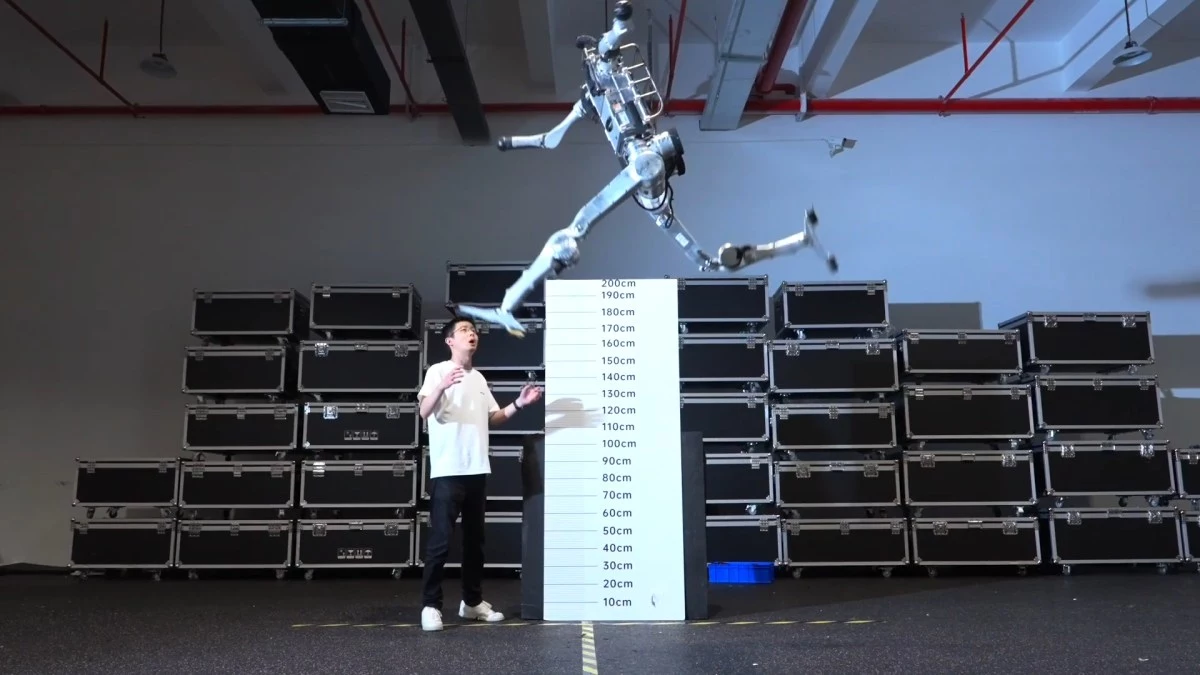

A headline-grabbing humanoid arrives as Unitree enters the public-market spotlight
Unitree Robotics’ unveiling of its new humanoid robot, “Superman,” lands at a moment when the company’s narrative is no longer shaped only by engineering ambition, but by the expectations of public shareholders. The timing is notable: the reveal follows Unitree’s Shanghai Stock Exchange IPO, which reportedly raised more than $900 million, and it comes just ahead of the World Humanoid Robot Games in Shanghai (August 22)—an arena where Unitree has already demonstrated competitive strength with four gold medals last year.
The company’s claims are designed for maximum visibility: a two-meter standing high jump and a 12.66 m/s sprint speed, both framed as exceeding elite human benchmarks. Whether every detail of these metrics translates cleanly into real-world comparability, the strategic intent is clear. Unitree is positioning itself as a performance leader in humanoid robotics at a time when the sector is crowded with well-funded contenders and when China’s industrial policy increasingly rewards domestic breakthroughs in advanced manufacturing.
Yet the same promotional footage that amplifies the robot’s speed and dexterity also invites scrutiny. Observers have pointed to an unconventional, scuttling gait, a reminder that “fast” and “humanlike” are not synonymous—and that commercial adoption often hinges on predictability, safety, and integration rather than spectacle.
What “Superman” suggests about actuation, control, and rapid robotics iteration
If the reported athletic feats are even directionally accurate, they imply meaningful progress in the core constraints of humanoid robotics: power density, dynamic balance, and real-time control under extreme loads. Jumping and sprinting are punishing tests for any bipedal platform because they compress the entire problem of locomotion into milliseconds of torque delivery, impact management, and stabilization.
Key technical implications signaled by the launch include:
- High-power-density actuation: A two-meter standing jump would require motors, transmissions, and structural components capable of delivering intense bursts of torque without excessive weight. That points to advances in lightweight electric drives, thermal management, and mechanical robustness.
- Dynamic stabilization and sensor fusion: High-speed maneuvers demand tight coordination across IMUs, force/torque sensing, and vision, with control loops that can correct posture instantly as the robot’s center of mass shifts.
- Modular engineering and compressed development cycles: Unitree’s claim that “Superman” was developed in just over three months is as much a process statement as a product statement. It suggests a platform strategy where core components—actuators, controllers, compute modules, and mechanical subassemblies—are reused and iterated rapidly, with performance gains increasingly driven by software tuning (trajectory optimization, motion planning, control policies) rather than full hardware redesign.
At the same time, the “uncanny” movement pattern is not a cosmetic footnote; it is a product risk. In many commercial settings—warehouses, hospitals, retail backrooms, public venues—buyers will prioritize safe, legible motion that humans can intuitively predict. A robot that moves in ways people find unsettling or difficult to read may face friction in deployment even if it is technically capable.
IPO capital meets the hard economics of deployment: from demos to durable revenue
The IPO proceeds give Unitree a rare advantage in a capital-intensive field: the ability to fund manufacturing scale-up, endurance testing, safety engineering, and specialized hiring without relying solely on private fundraising cycles. Public-market capital can accelerate the transition from prototype to product—if the company can articulate a credible path from viral demonstrations to repeatable unit economics.
That is where investor skepticism tends to concentrate. Humanoid robotics has long been rich in impressive demos and thin in scaled deployments. Unitree is not alone in facing the central question: What is the near-term business model for humanoids that justifies cost, maintenance, and operational complexity?
Several commercial pressure points stand out:
- Revenue mix risk: Demonstrations, research contracts, and event-driven showcases can generate meaningful revenue, but they rarely provide the predictable, high-retention cash flows public investors reward.
- Opaque cost structure: Without clarity on bill of materials, service costs, and expected lifespan, enterprise buyers struggle to model total cost of ownership (TCO)—a gating factor for procurement.
- Adoption depends on integration: The winners in enterprise robotics often succeed not by raw performance, but by fitting into existing stacks: fleet management, safety systems, warehouse execution software, and IT security requirements.
For Unitree, the strategic challenge is to convert athletic benchmarks into task benchmarks: hours of uptime, mean time between failure, safe operation around humans, payload handling, and autonomy in messy environments. Those are the metrics that determine whether humanoid robots become a line item in operating budgets rather than a marketing event.
Competitive and geopolitical stakes: China’s humanoid race, global rivals, and the risk of hype fatigue
Unitree’s “Superman” enters a global competitive landscape that includes Boston Dynamics, Tesla (Optimus), Agility Robotics, and a fast-growing cohort of Chinese humanoid startups. In this field, attention is abundant; differentiation is scarce. Sprint speed and jumping height are memorable, but the market’s center of gravity is likely to shift toward:
- Autonomy and software ecosystems (SLAM, path planning, developer tooling, no-code programming)
- Safety certification and liability readiness (e.g., alignment with service-robot standards such as ISO 13482)
- Partnerships with integrators and enterprise platforms that can turn a robot into a deployable solution
The broader context matters as well. China’s push for tech sovereignty—especially under supply-chain realignments and export-control pressures—creates both incentives and urgency to localize critical robotics components such as actuators, controllers, and AI compute. High-visibility humanoid achievements also serve a soft-power function, reinforcing national narratives around advanced manufacturing capability.
Still, the sector faces a familiar hazard: hype fatigue. Repeated spectacle without credible deployment stories can erode trust among enterprise customers who care less about world-record claims and more about reliability, serviceability, and ROI. For Unitree, the next signal investors and industry buyers will watch is not whether “Superman” can jump higher, but whether the company can translate performance theater into repeatable, safe, and economically rational humanoid labor—the threshold where robotics stops being a showcase and starts becoming infrastructure.


 By
By
 By
By
 By
By

 By
By
 By
By







