
When “space balls” wash ashore: a localized incident with global implications
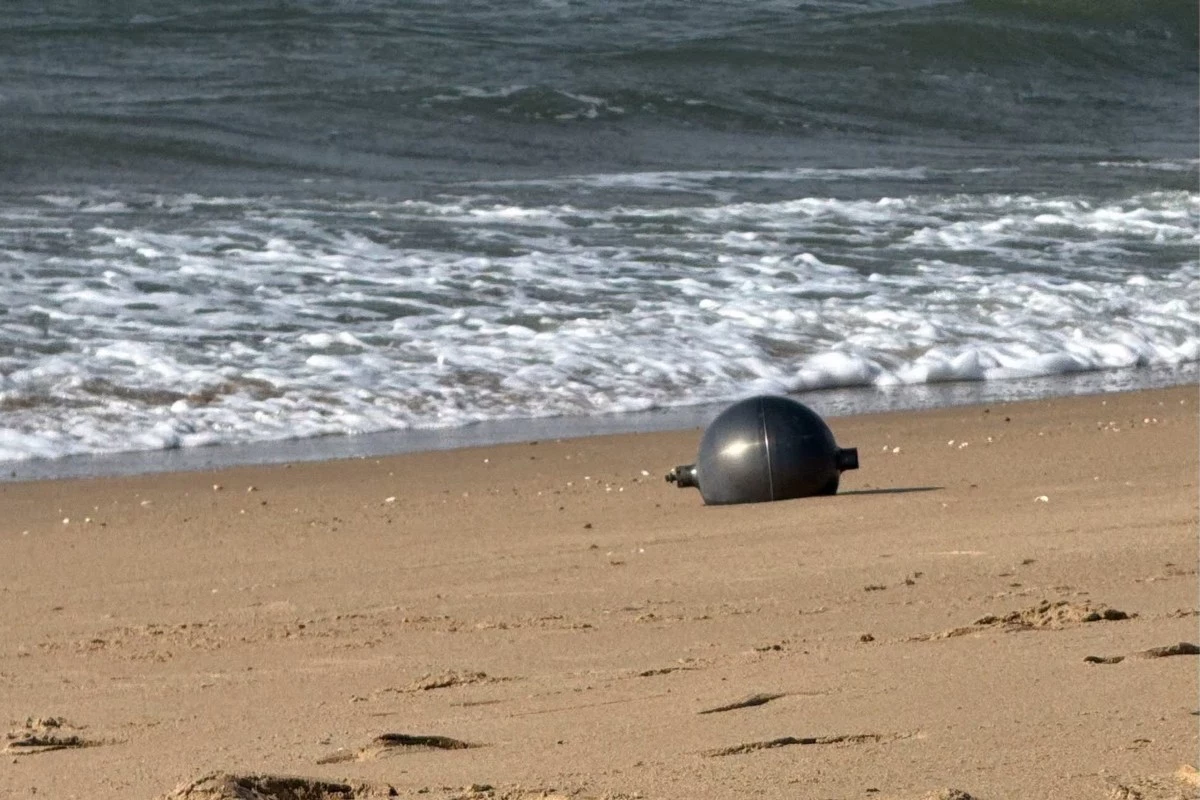
Six large metallic spheres scattered along a remote Australian beach might sound like an oddity—until the operational response and technical assessment reveal what they likely are: pressurized titanium-alloy tanks associated with a rocket stage, separated during ascent and later returning to Earth. The initial caution from local authorities—establishing a 164-foot exclusion perimeter and deploying hazmat teams—was not overreaction so much as a rational playbook for unknown industrial objects with potential chemical or radiological risk. Subsequent testing deemed the debris non-hazardous, but the episode still lands as a sharp signal to policymakers and industry: re-entry debris is becoming more frequent, more visible, and more economically consequential.
The Australian Space Agency’s involvement, alongside astrophysicists, underscores a key reality of today’s launch environment: the line between “space event” and “terrestrial incident” is thinning. As global launch cadence accelerates—more launches in the past five years than in prior decades, with 300+ orbital attempts last year and SpaceX accounting for roughly half—the probability of untracked components returning to populated or environmentally sensitive areas rises accordingly. What was once statistically negligible is becoming operationally relevant for emergency services, insurers, coastal managers, and national regulators.
—
Why titanium tanks survive: what the debris says about re-entry physics and mission design
From a technical standpoint, the absence of obvious fusion-scorch patterns on the spheres is telling. It suggests these objects likely separated at high altitude, avoiding the most punishing thermal loads of uncontrolled re-entry. That profile aligns with jettisoned tanks or support components, rather than a full upper stage breaking apart at lower altitude where heating and fragmentation are more severe.
Titanium-alloy vessels are used because they offer a compelling engineering tradeoff—high strength-to-weight ratio, corrosion resistance, and structural integrity under pressure. Those same virtues, however, make them more likely to survive the atmospheric gauntlet intact. The result is an uncomfortable paradox: components optimized for launch performance can become durable re-entry artifacts, challenging assumptions embedded in existing debris modeling.
This incident also highlights a persistent gap in space situational awareness (SSA). Tracking systems—commercial and governmental—tend to prioritize:
- Intact satellites and large rocket bodies, which pose collision risks in orbit
- Objects above certain size and radar cross-section thresholds
- Debris that remains cataloged and predictable over time
Smaller pressurized tanks can fall outside standardized tracking and notification workflows, even though they may be among the most survivable items during re-entry. As launch providers push for efficiency, expendable architectures still dominate many mission profiles, and while reusable first stages have become an industry benchmark, upper-stage reuse and component-level recoverability remain comparatively nascent. The beachside discovery is a reminder that “reusability” is not a binary label—it is a spectrum, and much of the spectrum still ends with uncontrolled disposal.
—
Liability, insurance, and the business of “what falls back down”
The regulatory stakes are clear. Under the Liability Convention, launching states bear responsibility for damage caused by their space objects. Even when debris lands harmlessly, each event tests the credibility of notification procedures, attribution capabilities, and the adequacy of insurance frameworks. Australia’s rapid hazmat posture may become a reference model for domestic response protocols, but it also exposes the need for international data-sharing mechanisms that can warn remote communities, maritime operators, and aviation authorities when re-entry risk is elevated.
For the market, the direction of travel is equally legible. As debris incidents become more common, insurers and reinsurers are likely to respond with:
- Higher liability premiums tied to demonstrated tracking and disposal plans
- Greater scrutiny of post-mission passivation (reducing explosion risk from residual propellants/pressurants)
- Policies that blend aerospace liability, maritime salvage, and environmental cleanup into new underwriting categories
This is not merely a cost increase; it is a reshaping of incentives. If insurers begin demanding stronger guarantees—better tracking, controlled re-entry, or retrieval commitments—then risk pricing becomes a lever that nudges engineering choices. Over time, competitive advantage may hinge not only on payload capacity and price-per-kilogram, but also on end-of-life stewardship and the ability to prove it.
—
The emerging debris economy: recovery hubs, new services, and a race for responsible scale
A less discussed but increasingly plausible outcome is the rise of a debris-mitigation and recovery services sector. Titanium is not scrap in the ordinary sense; it is a strategic material with real value. If recovery can be systematized—through rapid localization, safe handling, and certified chain-of-custody—then debris retrieval becomes a hybrid of public safety function and commercial opportunity.
Expect growth in capabilities such as:
- Autonomous maritime and aerial search platforms using lidar and hyperspectral sensing
- Specialized logistics for remote-area retrieval and environmental monitoring
- Onshore processing that supports material reclamation into domestic aerospace supply chains
Countries with large sparsely populated territories—Australia among them—could credibly position themselves as recovery hubs, attracting service providers and building employment clusters around aerospace safety, salvage operations, and environmental compliance. For launch providers, meanwhile, the strategic bar is rising: the next differentiator may be upper-stage innovation, including controlled de-orbit, rapid passivation, or reusable architectures that prevent these objects from becoming someone else’s shoreline problem.
The Australian “space balls” episode is not a spectacle; it is a systems-level prompt. The world is scaling launch activity faster than it is scaling the governance, tracking, and end-of-life infrastructure needed to keep that activity socially and commercially sustainable. The companies and countries that treat re-entry stewardship as a core performance metric—measurable, auditable, and engineered—will shape the next phase of the space economy on terms the public can live with.

 By
By
 By
By

 By
By


 By
By
 By
By
 By
By