
A half-century of ecological engineering meets measurable outcomes
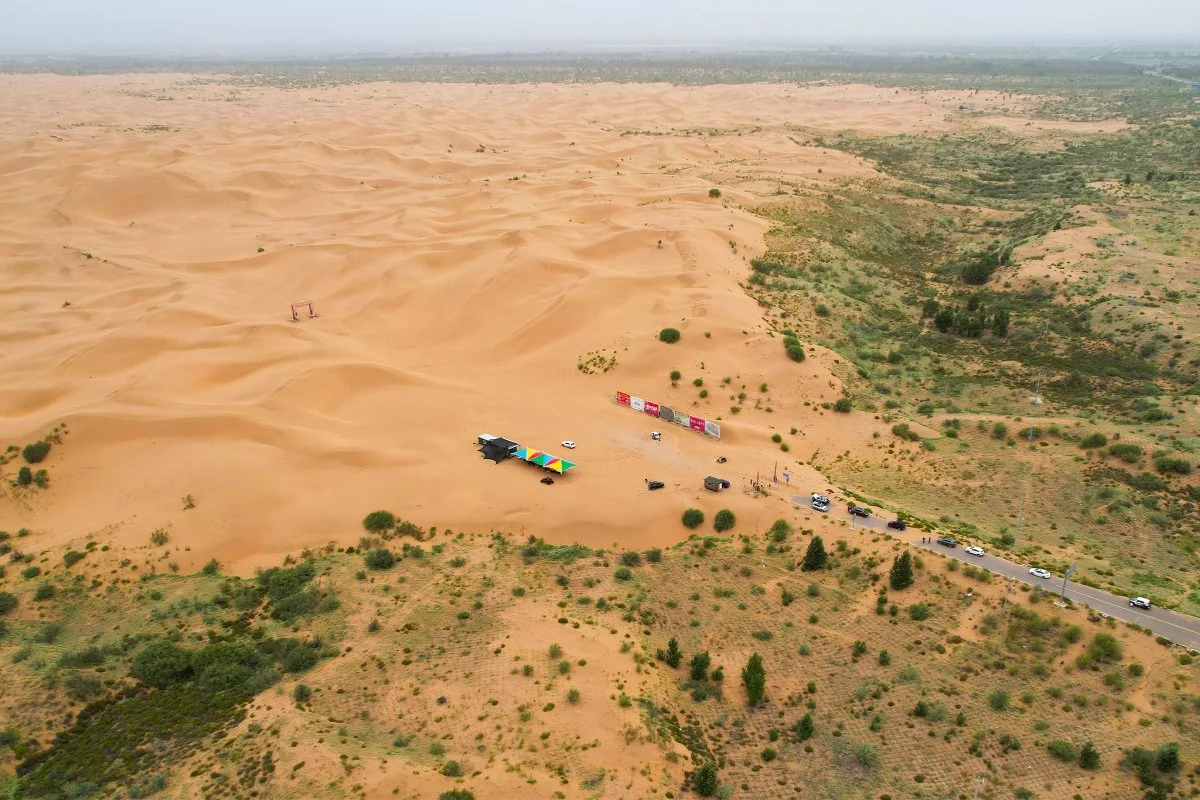
China’s “Great Green Wall” (Three-North Shelter Forest Program) has become one of the world’s most consequential experiments in large-scale land restoration—an initiative that blends state capacity, applied ecology, and increasingly sophisticated measurement. Since its launch in 1978, the program has aimed to slow desertification and reduce the dust storms that periodically blanket northern cities, including Beijing. The scale is difficult to overstate: roughly 66 billion trees planted across the margins of the Gobi and Taklamakan deserts, transforming more than 1,000 square miles of vulnerable desert edge.
The trajectory, however, has not been linear. Early phases were marked by high sapling mortality, a predictable outcome when ambitious planting targets collide with arid soils, harsh winds, and limited water. Over time, iterative improvements in species selection, planting methods, and irrigation practices helped shift the program from symbolic greening to demonstrable canopy establishment. The headline metric—forest cover rising from about 5% (1978) to 14% (2023) in targeted areas—signals real progress in stabilizing landscapes that were once defined by rapid degradation.
For policymakers and investors watching global land-restoration efforts, the Great Green Wall offers a rare combination: multi-decade continuity, measurable biophysical change, and a growing body of peer-reviewed research that can inform future decisions about carbon, water, and resilience.
Satellites, leaf-area analytics, and what “faster growth” really implies
A recent study in *Geophysical Research Letters* adds a new layer of analytical clarity by using remote sensing—specifically satellite-derived Leaf Area Index (LAI)—to quantify canopy density and growth rates across vast areas. This matters because restoration programs often struggle with verification: planting is easy to count; survival, growth, and ecosystem function are harder. LAI-based monitoring helps bridge that gap, enabling consistent comparisons across time and geography.
The study’s striking finding is that planted stands appear to grow about 66% faster than adjacent natural forests, with the research pointing toward an amplified CO₂ fertilization effect. In practical terms, rising atmospheric CO₂ can increase photosynthetic efficiency, particularly where other constraints are not immediately binding. In marginal landscapes, that can translate into surprisingly rapid early biomass accumulation—an outcome that, on the surface, seems to strengthen the case for plantations as a climate and land-management tool.
Yet the same research introduces an important caveat: the growth advantage diminishes for trees older than roughly 30–40 years. That inflection point is more than a biological curiosity; it is a strategic signal about carbon permanence and ecosystem durability. Faster early growth does not automatically equate to long-term sequestration if:
- Water limitations intensify as stands mature and demand rises
- Nutrient constraints cap continued biomass accumulation
- Monocultures prove more vulnerable to pests, disease, and climate volatility
- Carbon storage is offset by higher turnover, die-off, or replacement cycles
For climate accounting and corporate net-zero claims, this distinction is pivotal. A plantation that grows quickly but plateaus early may deliver meaningful near-term carbon uptake, while offering less certainty about multi-decade storage compared with more complex natural forest dynamics.
The economics: dust-storm mitigation, water costs, and carbon-market realism
The Great Green Wall was not originally designed as a carbon project; it was a public-good intervention aimed at reducing desert expansion and its downstream costs. Those costs are not abstract. Dust storms can impose measurable burdens through:
- Public health impacts (respiratory illness, hospital admissions, lost productivity)
- Infrastructure and maintenance costs (transport disruptions, cleaning, equipment wear)
- Agricultural losses in downwind regions (soil erosion, reduced yields)
Against these benefits sits a hard economic constraint: keeping trees alive in hyper-arid zones is expensive. Capital and operating expenditures accumulate in water conveyance, sapling replacement, labor, and ongoing maintenance—especially where irrigation is required. The program’s evolution underscores a core lesson for restoration finance: the cost curve is driven less by planting and more by survival and stewardship.
This is where carbon markets enter the conversation. Quantified carbon uptake creates a potential pathway to monetize ecosystem services, but only if accounting frameworks reflect biological reality. Fast-growing monocultures with a mid-life plateau raise questions about:
- Additionality (what would have happened without intervention)
- Permanence (how long carbon remains stored)
- Leakage and substitution effects (whether benefits shift pressures elsewhere)
- The need for discounting or differentiated crediting for short-lifecycle stands
If carbon-credit methodologies fail to distinguish between plantation profiles and natural forest longevity, markets risk overvaluing near-term gains and underpricing long-term uncertainty—an outcome that can distort both investment and climate integrity.
Where the next phase could be won: diversification, digital twins, and co-located renewables
The Great Green Wall is increasingly a test case for adaptive management at continental scale. The data infrastructure now exists—satellites, ground sensors, and long time-series records—to move from periodic assessment to something closer to continuous optimization. A plausible next step is the development of digital twin ecosystem management: machine-learning models trained on decades of LAI and survival data to anticipate die-off hotspots, refine planting density, and optimize irrigation schedules under changing climate conditions.
Strategically, the program also intersects with industrial policy. Desert margins are prime territory for solar and wind development, and co-locating renewables with shelterbelts and agroforestry could create mutually reinforcing outcomes:
- Renewable infrastructure can finance access roads and monitoring systems
- Vegetation can reduce dust loading and improve equipment performance
- Microclimate effects may modestly improve local moisture retention and soil stability
Internationally, China’s experience is already being positioned as a template for other regions, including the African Union’s Great Green Wall. The transferable lesson is not simply “plant more trees,” but rather: diversify species, match biology to hydrology, and build institutions that can learn over decades.
The Great Green Wall’s most enduring contribution may be that it reframes restoration as a long-run operating model—measured, iterated, and governed—rather than a one-time mobilization. In an era of climate volatility and land stress, that shift from planting campaigns to data-driven ecosystem stewardship is where the real competitive advantage now lies.


 By
By

 By
By

 By
By
 By
By