

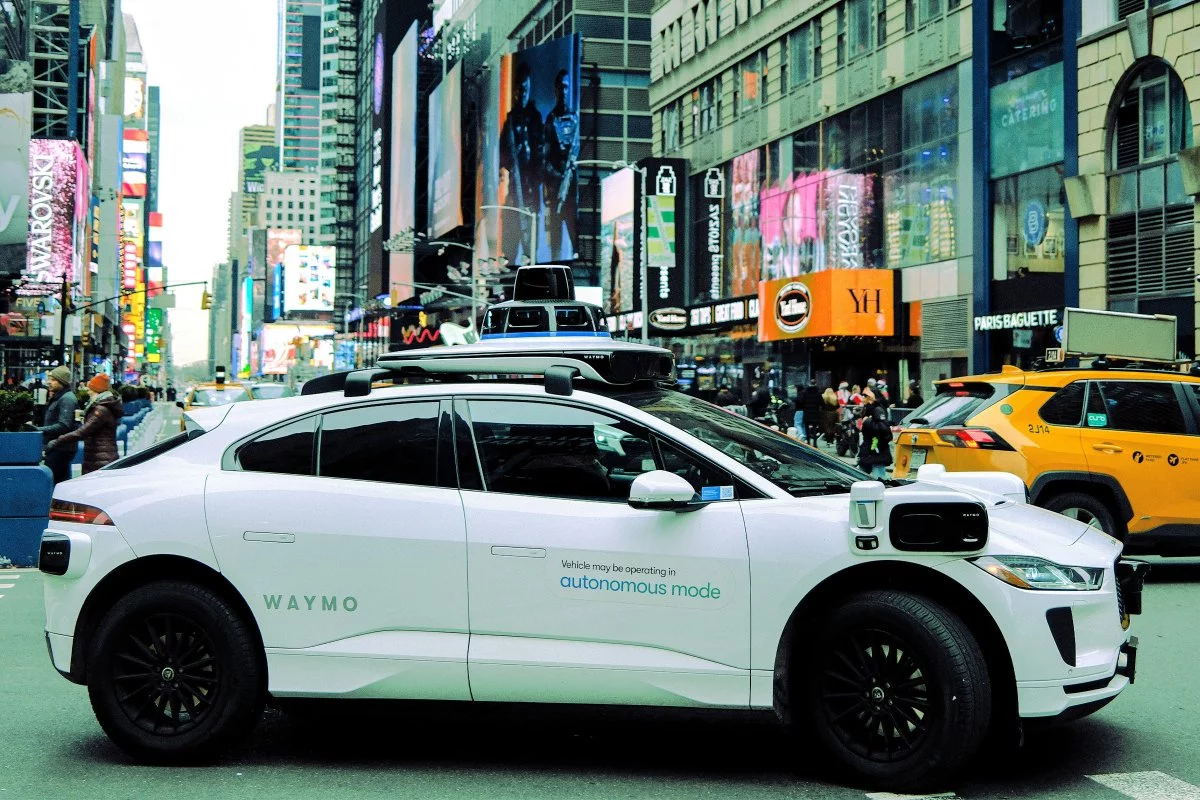

New York City as the “stress test” market for autonomous ride-hailing
Waymo’s attempted expansion into New York City’s autonomous vehicle (AV) market is colliding with a reality that has little to do with sensor fidelity alone. Manhattan’s dense grid of one-way streets, double-parking, aggressive lane changes, heavy pedestrian volumes, and constant construction churn makes it a uniquely punishing environment for robotaxis—yet the more immediate barrier is political and social, not technical.
Waymo arrives with a strong operational narrative: deployment experience across 11 U.S. cities and more than half a million weekly rides. In many markets, that scale functions as proof—evidence that autonomous ride-hailing can move from pilot to product. In New York, however, the same scale can read differently: not as maturity, but as inevitability, sharpening anxieties among incumbent workers and regulators who see a compressed timeline for disruption.
The city’s complexity also amplifies the “edge case” problem. Even if AV systems perform well statistically, New York’s streets generate an unusually high frequency of rare scenarios—jaywalking clusters, sudden curbside loading, emergency vehicles threading traffic, and weather that can rapidly degrade visibility. In this context, public trust is won locally, not imported from other cities. A safety record elsewhere may be necessary, but it is not sufficient.
The politics of deployment: labor power, taxi influence, and municipal veto points
The effective stalling of Waymo’s entry underscores how autonomous mobility is governed city-by-city, with local coalitions capable of blocking even well-capitalized, technically credible entrants. A coalition of local politicians, labor unions, and the taxi lobby has framed robotaxis as a direct threat to livelihoods and street safety—an argument that resonates in a city where taxi and for-hire driving is not just a job category but a deeply embedded economic layer.
The political recalibration described—initial openness from Governor Kathy Hochul followed by Mayor Zohran Mamdani aligning with traditional drivers—illustrates a familiar pattern in AI-era governance: early enthusiasm for innovation gives way to caution when the distributional impacts become tangible.
Several forces are converging:
- Job displacement fears at scale: With roughly 50,000 licensed drivers in the narrative frame, the debate becomes less about technology and more about economic security and dignity of work.
- Regulatory fragmentation: The absence of a single, harmonized federal framework leaves AV operators exposed to local veto power, permitting organized interests to shape outcomes.
- Safety as a political variable: Even when safety data is strong, high-profile incidents elsewhere in the industry can reset the baseline of skepticism. Municipal leaders often require visible, localized proof points—not just aggregate statistics.
For business and technology strategists, the lesson is blunt: in flagship cities, market entry is a political product. The “go-to-market” plan must include labor economics, coalition-building, and credible transition pathways—not as afterthoughts, but as core architecture.
Infrastructure, data, and the hidden prerequisites of robotaxi scale
Autonomous fleets do not simply “operate on roads.” They operate on a layered stack of high-definition maps, connectivity, real-time telemetry, and operational support systems. New York’s density raises the bar: the same fleet size produces more interactions per mile—more merges, more stops, more curb conflicts—meaning the city’s digital and physical infrastructure becomes part of the safety envelope.
Key dependencies likely to shape any eventual deployment include:
- Digital readiness: High-density AV operations benefit from robust 5G connectivity, resilient backhaul, and low-latency data exchange—especially when vehicles must continuously reconcile perception with map updates and live conditions.
- Traffic-management integration: Collaboration with city agencies on V2X (vehicle-to-everything) initiatives could reduce friction at intersections, construction zones, and emergency routing.
- Operational resilience: Severe weather, outages, and street closures demand redundancy—remote-operator support, rapid-response maintenance, and incident coordination that can meet New York’s pace.
This is where the public-private bargain becomes complicated. Cities may recognize potential upside—reduced collisions, smoother routing, lower emissions if fleets are electrified—but they also face near-term costs and governance questions: Who pays for upgrades? Who owns the data? Who is accountable when systems fail?
Strategic pathways: from confrontation to coexistence in autonomous mobility
Waymo’s New York challenge is not merely a setback; it is a case study in how AI-driven mobility collides with legacy urban systems. The most viable path forward may be less about forcing a citywide launch and more about designing a phased, coalition-compatible entry that converts opposition into negotiated participation.
Several strategic options emerge from the dynamics described:
- Phased deployment by geography: Starting in corridors or boroughs with fewer political and operational constraints—then scaling as localized safety evidence accumulates—can reduce the perception of a sudden labor shock.
- Alliance models with incumbents: Partnerships with established taxi operators or fleet owners could reframe robotaxis from replacement to augmentation, including roles such as fleet service, dispatch operations, remote assistance, and safety oversight.
- Labor transition programs with credible funding: Co-designed retraining—potentially supported by state workforce grants—can move the debate from “job loss” to “job evolution,” though it must be measurable and enforceable to be trusted.
- Trust-building through transparency: Community demonstrations, borough-level engagement, and public safety metrics tailored to New York conditions can help shift the conversation from abstract fear to observable performance.
Beyond transportation, the secondary effects are where New York’s policy instincts will focus. Insurance and liability models may shift toward usage-based premiums tied to AV safety performance. Curb zoning and real estate could be reshaped by pickup/drop-off “pods” and mobility hubs. And data sovereignty—who controls granular movement and demand data—may become the decisive governance battleground, potentially pushing the city toward data trusts or stricter privacy frameworks.
New York is not rejecting autonomy so much as insisting that autonomy submit to the city’s social contract. For Waymo and the broader autonomous vehicle industry, the message is clear: technical capability opens the door, but in the world’s most politically dense mobility market, only legitimacy gets you through it.

 By
By
 By
By

 By
By
 By
By

 By
By
 By
By







