

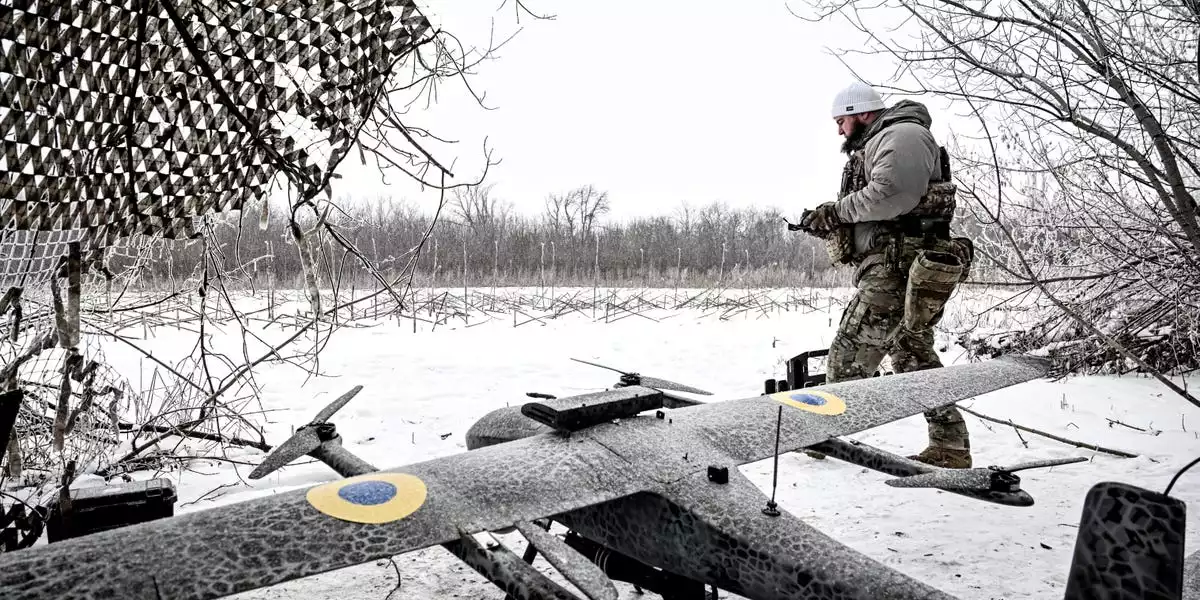

A new strike economy emerges from Ukraine’s mid-range combat drones
Ukraine’s deployment of a new class of mid-range combat drones—often exemplified by systems described as GARA-type platforms—marks a consequential shift in the war’s operational balance and, more broadly, in the economics of precision strike. Where Western-supplied long-range artillery and guided rockets such as HIMARS once symbolized Ukraine’s ability to reach deep into Russian rear areas, a growing indigenous drone fleet is now restoring and, in some respects, expanding that capability with a radically different cost structure.
At the center of this change is a simple but disruptive proposition: credible strike effects at 30–300 kilometers for $1,000–$50,000 per unit. Even allowing for variation in payload, survivability, and mission success rates, the cost-per-strike calculus is fundamentally altered when compared with million-dollar-class munitions. This is not merely “cheaper firepower.” It is a new model of sustained pressure—one that can be scaled, iterated, and replenished at a tempo that traditional procurement pipelines struggle to match.
Just as importantly, these drones reduce dependence on external political and procedural constraints. When targeting protocols, permissions, or escalation concerns slow the sensor-to-shooter loop, battlefield opportunities evaporate. A domestically controlled strike system, produced and tasked at national discretion, compresses decision cycles and aligns operational tempo with Ukraine’s own priorities.
Autonomy under jamming: why electronic warfare is no longer a veto
Electronic warfare (EW) has been one of the defining features of the conflict, with Russian jamming and spoofing designed to sever drone datalinks, degrade navigation, and neutralize precision guidance. The reported evolution in Ukraine’s mid-range drones is therefore less about airframe novelty and more about resilience in contested spectrum conditions.
Key technological attributes shaping this resilience include:
- Onboard autonomy and AI-assisted targeting: By embedding target recognition and mission logic on the platform, drones can continue to prosecute a strike even when communications are disrupted. This shifts drones from “remote-controlled assets” toward semi-autonomous munitions with greater independence at the edge.
- Modular payloads and rapid iteration: Borrowing from commercial UAV design philosophies, these systems can accept interchangeable warheads and sensor packages, enabling fast mission tailoring and quicker upgrade cycles for avionics, guidance, and counter-jam features.
- Distributed, scalable manufacturing: The use of mature components—commercial motors, common electronics, navigation modules—supports a production model that can expand quickly, though it also introduces new supply-chain sensitivities.
The strategic implication is subtle but profound: EW no longer guarantees denial. It becomes a contest of adaptation, where autonomy, navigation redundancy, and mission planning can partially offset jamming. That forces defenders to invest not only in EW, but also in layered air defense, counter-drone detection, and hardening of rear-area infrastructure—each of which carries its own cost and manpower burdens.
Operational independence and the targeting tempo advantage
The battlefield value of mid-range drones is best understood through what they enable operationally: persistent, distributed pressure on the systems that make an army function. Rather than focusing solely on front-line attrition, these drones can be used to degrade the “connective tissue” of military power—logistics, command nodes, ammunition storage, and movement corridors.
This approach yields several compounding effects:
- Logistics disruption: Strikes on supply convoys, depots, and transfer points create delays that ripple forward—fuel shortages, ammunition rationing, and reduced operational mobility.
- Command-and-control friction: Targeting command posts and communications hubs can slow decision-making and reduce coordination, particularly when paired with broader EW activity.
- Psychological and doctrinal pressure: The persistent threat of low-cost, hard-to-intercept strikes pushes the adversary toward more dispersed basing, deeper air-defense coverage, and increased rear-area security—resources that might otherwise reinforce the front.
Crucially, the autonomy and domestic control of these systems can shorten the sensor-to-shooter timeline. In modern warfare, speed is often more decisive than range. A strike capability that can be tasked quickly, without external approval chains, becomes a tool not only of destruction but of operational rhythm—forcing the opponent to react, reposition, and spend.
Business, supply chains, and the global defense-tech aftershocks
For business and technology leaders, Ukraine’s mid-range drone surge is a live demonstration of how commercial-grade innovation pathways can reshape defense outcomes. The implications extend beyond the war into procurement, industrial policy, and export controls.
Several macro trends stand out:
- Defense spending realignment toward unmanned systems: Major militaries and prime contractors are already shifting R&D toward autonomous munitions, swarming concepts, and low-cost precision strike. Ukraine’s experience accelerates the case for rapid-fielding programs and modular architectures over monolithic, long-cycle platforms.
- Supply-chain resilience becomes strategic terrain: Reliance on globally sourced electronics and navigation components creates potential chokepoints. Export controls, sanctions, and component scarcity could shape battlefield capacity as much as tactics do—driving investment in diversified sourcing, localized manufacturing, and secure alternatives for positioning and timing.
- Dual-use technology spillover: Advances in AI-based perception, resilient communications, and autonomous navigation will not remain confined to defense. They will feed back into civilian UAV markets—logistics, agriculture, inspection, and environmental monitoring—tightening the loop between commercial innovation and military adaptation.
- Export-control and non-proliferation pressure: As mid-range drone capabilities commoditize, governments face a tightening dilemma: enabling partners while limiting diffusion to hostile states or non-state actors. The policy challenge will be designing controls that are enforceable in a world of modular components and software-defined capability.
Ukraine’s mid-range combat drones illustrate a broader inflection point: precision strike is being democratized by autonomy, modularity, and manufacturing agility. The countries and companies that master rapid iteration, resilient supply chains, and edge autonomy will shape not only the next phase of this war, but the competitive landscape of defense technology for years to come.

 By
By
 By
By

 By
By
 By
By
 By
By
 By
By








